Why does Xanax withdrawal happen?
After weeks of daily use, the brain resets itself to the presence of the drug, reducing the sensitivity of the calming GABA receptors and raising the activity of excitatory systems. When the drug is suddenly withdrawn, the excitatory systems stay active without brakes, producing nervous system overactivity, which is what we call withdrawal.
Because Xanax leaves the body relatively quickly, this void also arises quickly, so the brain has no time to adapt gradually. That is why its withdrawal is described as starting sooner and being more intense than withdrawal from long-acting sedatives.
Xanax withdrawal timeline
This is an approximate timeline of what may happen with abrupt discontinuation after long daily use, which we never recommend:
- Within hours to two daysThe start
Anxiety, tension, insomnia, irritability and mild tremor, and panic attacks may return strongly.
- The first daysThe peak
Symptoms intensify: sweating, a racing heart, nausea and sensitivity to light and sound, and this is the period of highest seizure risk.
- Weeks 2 to 4Gradual decline
Physical symptoms ease gradually, while anxiety, sleep disturbance, and poor concentration remain.
- After the first monthProtracted withdrawal in some people
Intermittent symptoms of anxiety, insomnia and poor memory that may last for weeks or months and then improve.
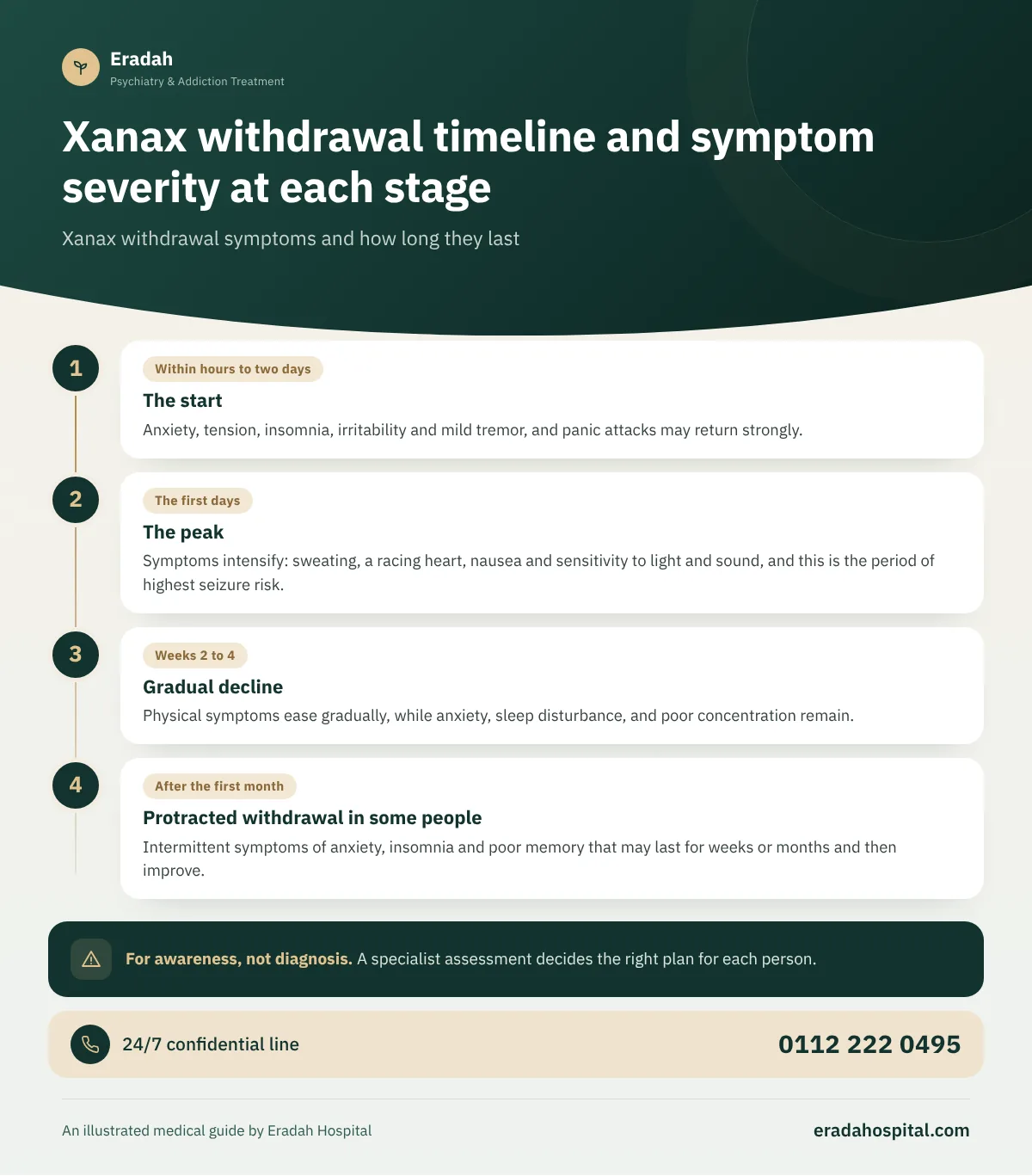
The timeframes are approximate and vary widely with the length of use, the amount, the presence of other substances and the way the drug is stopped. Gradual reduction under medical supervision changes this timeline and makes it much milder.
What are the symptoms of Xanax withdrawal?
| Type | Symptoms |
|---|---|
| Psychological | Severe anxiety, panic attacks, irritability, depression, difficulty concentrating, a feeling of detachment from reality. |
| Physical | Tremor, sweating, headache, muscle tightness, palpitations, nausea, loss of appetite. |
| Sensory | Extreme sensitivity to light, sound and touch, and numbness or tingling in the limbs. |
| Sleep | Severe insomnia and disturbing dreams. |
| Severe and dangerous | Seizures, delirium and confusion, hallucinations, high temperature. |
Is Xanax withdrawal dangerous?
Yes, and it can be life-threatening. Benzodiazepine withdrawal, like alcohol withdrawal, is one of the few types of withdrawal that can cause seizures and delirium. The US Food and Drug Administration has explicitly warned that abrupt discontinuation or rapid reduction can cause life-threatening reactions.
The risk is higher in people who used Xanax for a long time or in large amounts, people with a history of seizures, people who use alcohol or other sedatives with it, and older adults.
Rebound anxiety or the original anxiety returning?
After stopping, strong anxiety may appear, and it is sometimes hard to tell three things apart: temporary rebound anxiety stronger than the original because the drug was withdrawn, withdrawal symptoms, and the return of the original anxiety disorder that Xanax had been covering. This distinction is very important because each calls for different handling, and the psychiatrist makes it through follow-up over time.
What is protracted Xanax withdrawal?
Some people have symptoms that continue after the acute phase ends, and these may extend for weeks or months, and the FDA has described them as lasting up to 12 months in some. They include anxiety, depression, insomnia, and poor memory and concentration, and sometimes sensory symptoms such as tingling and tinnitus.
These symptoms usually improve with time, and often come in waves between good days and harder ones. Knowing this in advance helps the patient not to despair, and not to go back to the drug thinking that recovery has failed.
Groups for whom Xanax withdrawal is more dangerous
Withdrawal may appear in them as confusion, disorientation and falls, and they need slower tapering and closer follow-up.
Abrupt discontinuation is dangerous to mother and fetus, and any change should be a joint decision between the psychiatrist and the obstetrician.
Combined alcohol and sedative withdrawal raises the risk of seizures and delirium, and often requires residential care.
Someone who has had epileptic seizures or seizures in a previous withdrawal is more likely to have them again.
What happens to someone who tries to stop on their own?
Many people try to quit Xanax all at once after a sudden decision, or after the prescription runs out. At best the experience is hard enough to push them back to it within days, so they wrongly become convinced they cannot live without it. At worst, seizures or delirium occur at home with no preparation.
So the most important message on this page is: if an attempt to stop suddenly fails, the problem is the method, and recovery is still possible. Structured gradual tapering succeeds for many people whose individual attempts failed.
It is also common for a person to try to reduce Xanax by splitting pills or spacing out the times themselves. This may seem logical, but because Xanax is short-acting, any long gap between doses causes repeated waves of withdrawal during the day. That is why doctors prefer a considered plan to individual improvising.
Why is medical supervision needed in Xanax withdrawal?
The doctor sets an individual gradual reduction plan that suits your case, instead of abrupt discontinuation.
Tracking vital signs and intervening quickly at any sign of seizures or delirium.
Telling withdrawal apart from the return of anxiety, and starting suitable treatment for the original disorder.
Support on hard days so the person does not go back to the drug looking for relief.
You can find the full treatment plan, from gradual tapering to psychotherapy and relapse prevention, on the Xanax addiction treatment page.
How can the family support someone going through Xanax withdrawal?
- Understand that irritability and insomnia are part of withdrawal and are not aimed at you.
- Help them keep to the doctor's appointments and the reduction plan exactly as set.
- Provide a calm environment, regular sleep, and fewer stimulants such as caffeine.
- Watch for any seizure or severe confusion, and call an ambulance (123) immediately if it happens.
- Encourage them to continue psychotherapy even after the physical symptoms improve.
Signs of Xanax poisoning: call an ambulance (123) immediately
- Deep sleep from which the person cannot be woken by calling or shaking, or loss of consciousness
- Slow, shallow or irregular breathing, especially if they have been drinking alcohol or using opioids
- Blue lips or nails and cold skin
- Severe confusion, very slurred speech and inability to stand
- Seizures or an epileptic fit, especially within days of stopping suddenly
Call an ambulance on 123 immediately, place the person on their side so they do not choke, and stay with them. Do not try to wake them with water or coffee. Keep the medicine box or any pills you find to give to the doctor.
Call the ambulance 123