“He swears it’s the last time, and two days later he’s back as if he never said anything.” One of the hardest things a family lives through is watching a son or husband clearly act against his own interest and then defend it passionately. To talk to him in a way that reaches him, you need to understand how a person with addiction thinks from the inside, not how you wish he would think.
How Does a Person Think When His Brain’s Priorities Have Changed?
The US National Institute on Drug Abuse (NIDA) explains that the decision to use is often voluntary at first, but with continued use the ability to control oneself becomes severely weakened, and this weakening is the core feature of addiction. The changes involve three main circuits in the brain:
- The basal ganglia: the reward and habit-forming circuit, which loses sensitivity to natural pleasures, so enjoying anything other than the substance becomes difficult.
- The extended amygdala: responsible for anxiety, stress and discomfort, which becomes more sensitive, so he uses to escape distress, not to feel a high.
- The prefrontal cortex: the center for planning, decision-making and curbing impulses, whose role weakens in the face of the other two circuits.
A review published in the New England Journal of Medicine in 2016 confirms that these changes explain why use continues despite awareness of the harm, and why the risk of relapse remains after stopping. The role of the reward system is detailed on the page Dopamine and Addiction.
Why Does a Person with Addiction Deny It Despite an Obvious Problem?
A review published in Trends in Cognitive Sciences in 2009 begins by noting that more than 80% of people with addiction do not seek treatment, and it offers an important explanation: what looks like deliberate “denial” may partly reflect a dysfunction in the brain networks responsible for insight and self-awareness. In other words, he may not see the size of the problem as you see it, not because he is always lying, but because the very tool of seeing has been affected.
That is why proving to him with evidence that he is addicted is often not helpful. It is more useful to talk about specific events you saw and their effect on you, and let him reach the conclusion himself.
How a Person with Addiction Thinks: The Present Moment Beats the Future
Psychologists measure what they call “delay discounting,” the tendency to choose a small reward now over a larger reward later. An analysis published in Psychopharmacology in 2011 pooled the results of 46 studies and found that this tendency is clearly stronger in people with addictive behavior, especially those who meet the criteria for a substance use disorder. So the sentence “you’ll lose your job in a year” seems distant and faint to him, while the craving right now is present and strong.
The Cycle of Thoughts from Trigger to Regret
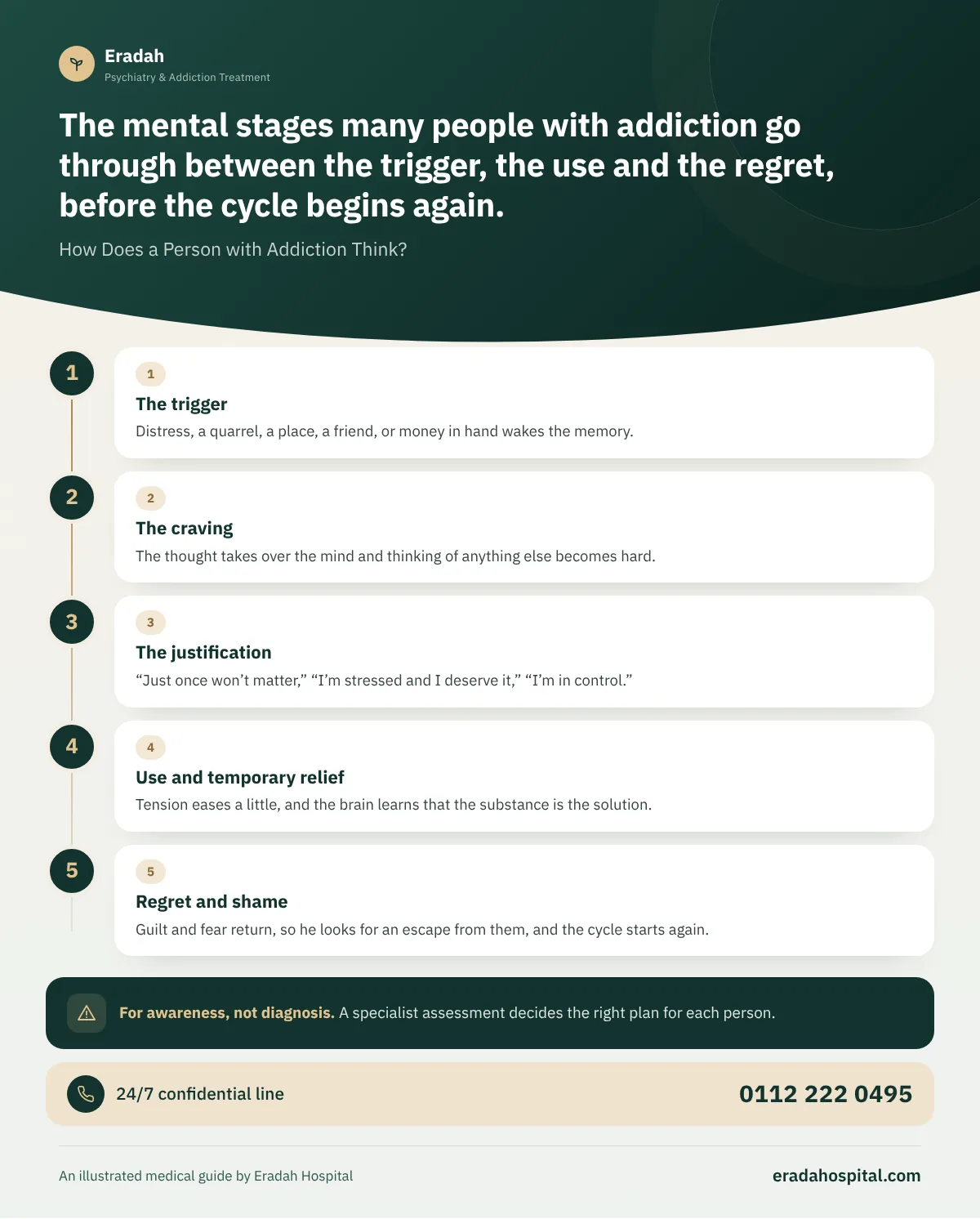
- 1The trigger
Distress, a quarrel, a place, a friend, or money in hand wakes the memory.
- 2The craving
The thought takes over the mind and thinking of anything else becomes hard.
- 3The justification
“Just once won’t matter,” “I’m stressed and I deserve it,” “I’m in control.”
- 4Use and temporary relief
Tension eases a little, and the brain learns that the substance is the solution.
- 5Regret and shame
Guilt and fear return, so he looks for an escape from them, and the cycle starts again.
We explain cravings, what triggers them and the role of stress in relapse in the guide Relapse in Addiction.
Is a Person with Addiction a Liar by Nature?
Lying in addiction is mostly a way to protect drug use and to avoid shame and punishment, not a fixed personality trait. It declines a great deal with abstinence and treatment. This does not mean you should believe everything or ignore actions, but that you should rely on behavior, not words, and build trust gradually through observable actions.
How Does a Person with Addiction Feel About His Family?
Many people with addiction truly love their families, and live a conflict between that love and the desire for the substance. Many are dominated by shame and a sense of being a burden, and these feelings may push them toward isolation or toward using more. So harsh criticism and insults feed the cycle, while calm firmness with respect opens a door to talking. If signs of depression or talk of death appear, this needs urgent assessment, and we explain the relationship between them on the page Dual Diagnosis.
How Do You Talk to a Person with Addiction in a Way That Reaches Him?
- Talk when he is conscious, at a calm time, not in the middle of a crisis.
- Describe a specific situation and its effect on you, instead of general judgments like “you’re a failure.”
- Ask him what he wants for his life, and tie treatment to his goals, not yours.
- Reward any small step toward treatment, and do not reward drug use with money or cover-ups.
- Set clear boundaries and enforce them calmly, without making threats you will not carry out.
These principles are the foundation of the CRAFT approach that we explain in the guide How to Convince a Person with Addiction to Get Treatment.
Does a Person with Addiction Think Normally Again After Treatment?
NIDA notes that some brain changes may last a long time after stopping, which explains why the risk of relapse persists. But the brain is able to recover gradually, and psychotherapy helps the person notice his justifying thoughts and deal with cravings instead of giving in to them. At Eradah this begins with a free, confidential assessment, then residential treatment for men or outpatient treatment depending on the case, with cognitive behavioral therapy, which targets these thoughts directly.