“My son used to tell me everything. Now he closes his bedroom door and answers with one word.” This complaint is repeated in every home with a teenager. Most of it is normal, since adolescence is a stage in which the brain reorganizes itself. But parents need to know where normal ends and where the signs that should not be ignored begin.
Why do psychological changes happen in teenagers?
The US National Institute of Mental Health (NIMH) explains that the brain keeps developing and maturing until the mid-to-late twenties, and that the prefrontal cortex, which is responsible for planning, setting priorities, and making good decisions, is one of the last areas to mature. At the same time, the brain areas linked to social relationships become very active, so teenagers care more about their friends and may take more risks because the social gain seems bigger to them than the consequences.
NIMH adds that at this stage the brain is highly capable of learning and adapting, which means it is an opportunity and not only a risk. Positive experiences and a safe relationship with parents leave a large mark.
Normal psychological changes in adolescence
- Mood swings: happiness and distress on the same day, and heightened sensitivity to criticism and embarrassment.
- Searching for independence: a wish for privacy and for making their own decisions, and stubbornness over small matters.
- Friends first: friends’ opinions become very important, and time with them is a priority.
- Preoccupation with appearance and identity: attention to looks and questions such as “Who am I?”
- Staying up late: NIMH notes that the sleep hormone melatonin stays high late into the night in teenagers and drops late in the morning, which explains why they stay up and find it hard to wake early.
The difference between teenage ups and downs and signs of a problem
| Usually a normal change | A sign that calls for attention | |
|---|---|---|
| Mood | Distress or irritability that passes within hours or days | Sadness or anger that lasts most of the day for weeks |
| Relationship with parents | More privacy and less talking | Complete withdrawal from both family and friends |
| Sleep | Staying up late and finding it hard to wake on days off | Severe insomnia, or sleeping most of the day with constant exhaustion |
| School and activities | Fluctuating interest | Suddenly giving up what they loved, and a sharp decline in school performance |
| Eating and the body | Appetite changes with growth | Obvious weight loss, an unhealthy preoccupation with eating, or unexplained wounds |
| Friends | New friends within a known circle | A mysterious new crowd, with secrets and missing money |
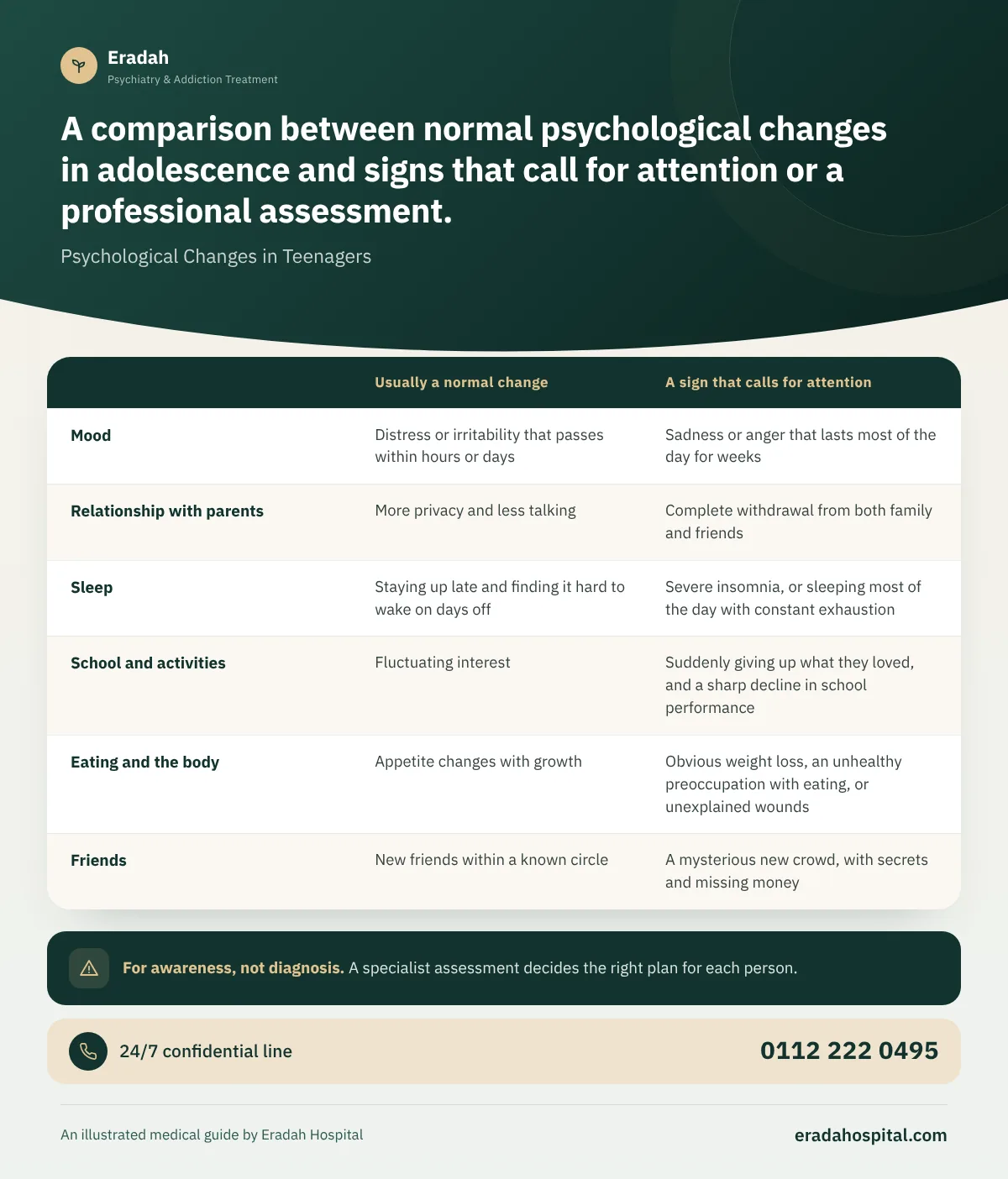
The practical rule: pay attention to duration (weeks, not days), severity, and disruption of daily life. Signs of substance use in particular are covered in our guide to teen addiction.
The most common psychological problems in adolescence
The World Health Organization estimates that about 1 in 7 young people aged 10 to 19, or 14.3%, have a mental disorder, and that depression, anxiety, and behavioral disorders are among the leading causes of illness and disability at this age. NIMH notes that many mental illnesses, such as anxiety, depression, bipolar disorder, and schizophrenia, can begin to appear during adolescence.
The UK National Health Service (NHS) describes teenage depression through symptoms that include persistent sadness or low mood, irritability and intolerance of others, feeling hopeless, and no longer enjoying what they used to love. We explain its symptoms and treatment in our guide to depression, anxiety in generalized anxiety, and attention difficulties in ADHD (attention-deficit/hyperactivity disorder).
Psychological changes and substance use: a two-way relationship
An anxious or depressed teenager may turn to smoking, hashish, or pills to calm themselves, and substance use itself can cause mood swings, irritability, and withdrawal that look like “adolescence.” Because the brain is not yet fully developed, it is more affected by substances. So if you suspect it, do not assume it is “a phase that will pass,” and read our guide to the signs of drug use.
How do you deal with a teenager’s emotional world?
- Listen more than you talk, and do not turn every conversation into a lecture.
- Choose ordinary moments to talk, such as in the car or on a walk, instead of formal sit-downs.
- Respect their privacy, with clear safety rules that they know in advance.
- Praise effort, not only results, and avoid comparing them with siblings or relatives.
- Help them keep a regular sleep schedule and cut back on screens at night, since good sleep supports mental health, according to NIMH.
When should you seek help for your teenager?
Outside emergencies, if the worrying signs last for weeks, start with the doctor or a psychologist. The World Health Organization notes that suicide is the third leading cause of death among people aged 15 to 29, and that leaving adolescent mental health problems untreated carries their effects into adulthood. At Eradah, a family can book a free, confidential first consultation to assess the situation and make a plan, and the family program helps parents communicate with their children.