What is serotonin?
Serotonin, whose scientific name is 5-hydroxytryptamine, is one of the oldest and most widespread signaling substances in biology. In the brain it works as a neurotransmitter that carries messages between nerve cells, and outside the brain it acts as a signaling substance in the gut, blood vessels and platelets.
It was first discovered in the blood as a substance that constricts blood vessels, and that is where its name came from (from "serum," the fluid part of blood, and "tonic," meaning tightening). It was later found to be present in the brain and to take part in mood, sleep and behavior, and it became one of the best-known chemicals in psychiatry.
Many people confuse serotonin with hormones. More precisely, it is mainly a neurotransmitter, but in the blood and gut it plays roles similar to those of hormones. So references sometimes describe it as "a neurotransmitter and a hormone," although the brain and the gut use it in two different ways.
Where is serotonin made in the body?
Making serotonin starts from tryptophan, an essential amino acid that the body cannot make and gets from protein in food. Tryptophan is converted to serotonin in two enzyme steps, and the slower of these is controlled by the enzyme tryptophan hydroxylase, which is why this enzyme is considered the rate-limiting step of production.
| Setting | Approximate share | Main role |
|---|---|---|
| Cells lining the gut | About 90% | Regulating gut movement, secretions and the sensation of nausea |
| Platelets | They store what they take up from the blood | Helping blood clot and vessels constrict at wounds |
| Raphe nuclei in the brainstem | A small proportion | Sending fibers to most of the brain and the spinal cord to regulate mood, sleep and pain |
| Pineal gland | A limited amount | Converting it into melatonin, the sleep hormone, at night |
The important point is that serotonin itself does not cross the blood-brain barrier, so serotonin from the gut or blood does not travel to the brain. Tryptophan, however, does cross, and the brain makes what it needs from it. That is why any product claiming to "supply the brain with serotonin" directly from food is overpromising.
How does serotonin work in the brain?
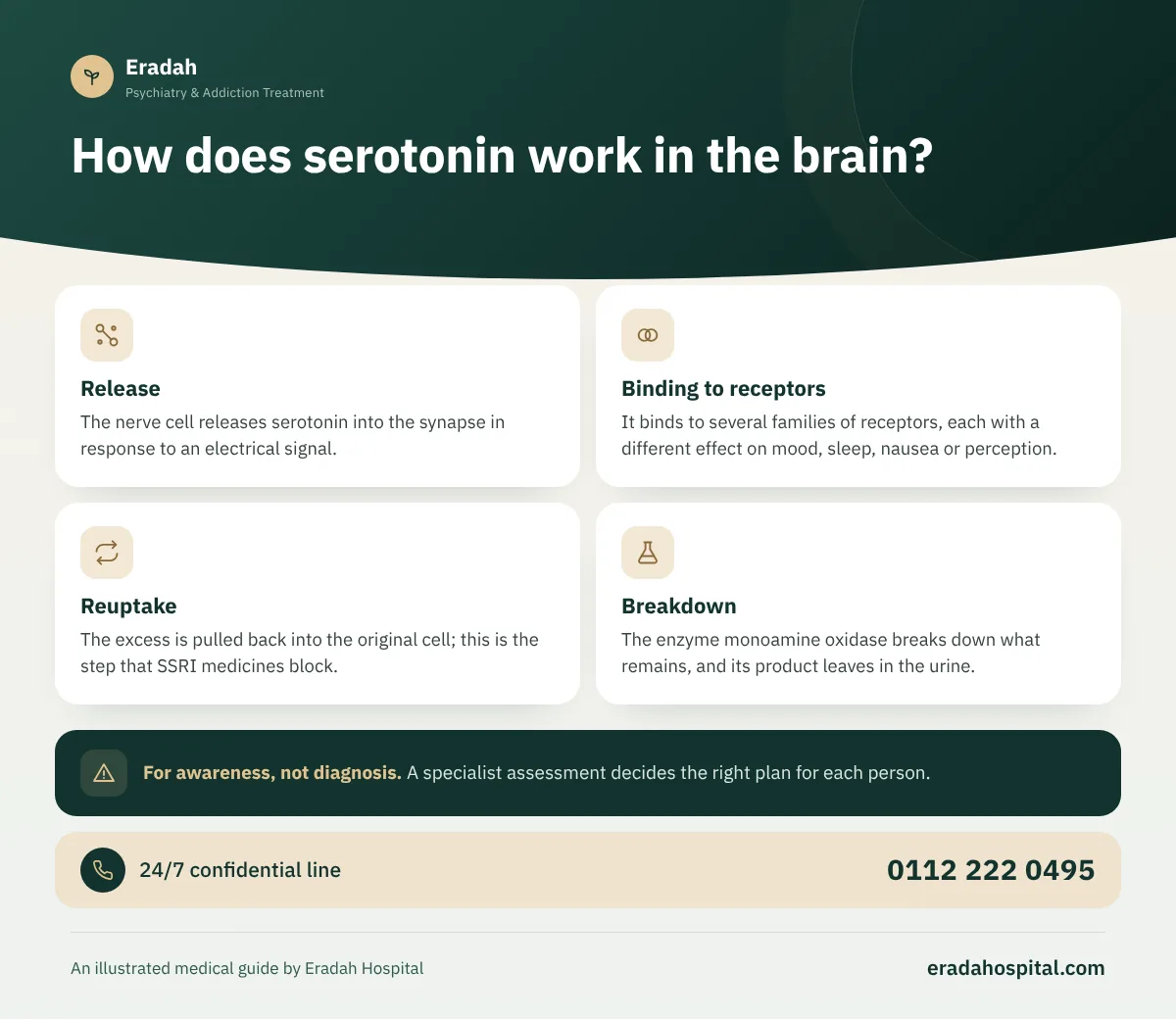
When a nerve cell that makes serotonin is activated, it releases serotonin into the narrow gap between it and the next cell (the synapse). Serotonin binds to receptors on the surface of the receiving cell and changes its activity, and then it is either taken back up into the original cell by the "serotonin reuptake transporter," or broken down by an enzyme called "monoamine oxidase."
The nerve cell releases serotonin into the synapse in response to an electrical signal.
It binds to several families of receptors, each with a different effect on mood, sleep, nausea or perception.
The excess is pulled back into the original cell; this is the step that SSRI medicines block.
The enzyme monoamine oxidase breaks down what remains, and its product leaves in the urine.
Serotonin has seven families of receptors that include more than ten subtypes, and this is the secret of the variety of its effects: the receptor that hallucinogens such as LSD act on differs from the receptor blocked by anti-nausea medicines used after chemotherapy, and differs again from the receptors linked to anxiety. So it is not right to talk about "raising" or "lowering" serotonin as if it were a single switch.
What are the functions of serotonin in the body and brain?
It helps regulate mood, anxiety and the response to stress, as part of a network that includes other neurotransmitters.
It regulates sleep stages, and at night it is converted to melatonin in the pineal gland.
It contributes to the feeling of fullness and the regulation of eating.
It regulates gut movement and sends signals of nausea and vomiting when harmful substances are present.
Platelets release it at a wound, which helps vessels constrict and a clot form.
It is linked to the ability to wait and to control hasty and aggressive actions.
It affects sexual function, which is why some medicines that act on it cause sexual side effects.
It takes part in modulating the sensation of pain and in some learning and memory processes.
References also mention roles for it in bone density, wound healing, and heart and respiratory function. This breadth explains why medicines that affect it cause a variety of side effects, from stomach upset in the first days to changes in sleep and sexual desire.
How does serotonin balance with other neurotransmitters?
Serotonin does not work alone. It is in constant dialogue with dopamine, the drive and reward messenger, with norepinephrine, the alertness messenger, and with GABA, the calming messenger. Researchers see serotonin as often acting as a "modulator" that adjusts the intensity of other signals rather than as a direct source of pleasure.
| Neurotransmitter | Most prominent role | Popular nickname | Why is the nickname inaccurate? |
|---|---|---|---|
| Serotonin | Regulating mood, sleep, appetite and impulsivity | The happiness hormone | Its role is broadly regulatory, and it does not create happiness on its own |
| Dopamine | Drive and learning from reward | The happiness or pleasure hormone | It is linked to wanting and seeking more than to pleasure itself |
| GABA | Calming the activity of nerve cells | The natural calming agent | Its balance with glutamate is what matters most |
| Endorphins | Pain relief | The body's natural painkiller | It works within a wider pain and reward system |
Why is serotonin called the "happiness hormone"? And is that accurate?
The nickname spread because medicines that raise serotonin activity at the synapses are used to treat depression and anxiety, so many concluded that serotonin is the "happiness chemical." But this is an oversimplification for three reasons: most serotonin is in the gut, not the brain; its effect depends on the type and location of the receptor; and mood is the product of a complex network of neurotransmitters, hormones, experiences and circumstances.
Can serotonin be measured with a blood test?
The honest answer: there is no routine test that measures the serotonin level in the brain. Serotonin in the blood comes mainly from the gut and is stored in platelets, and it does not reflect what is happening at the nerve synapses. That is why psychiatrists do not use a serotonin test to diagnose depression or anxiety or to choose a treatment.
As for the known test of serotonin's breakdown product in urine, doctors order it in specific situations, chiefly when a rare tumor of the digestive tract that releases large amounts of serotonin is suspected. Any commercial offer of a test that "reveals serotonin deficiency" and builds treatment or supplements on it has no scientific basis.
Common myths about serotonin and the facts
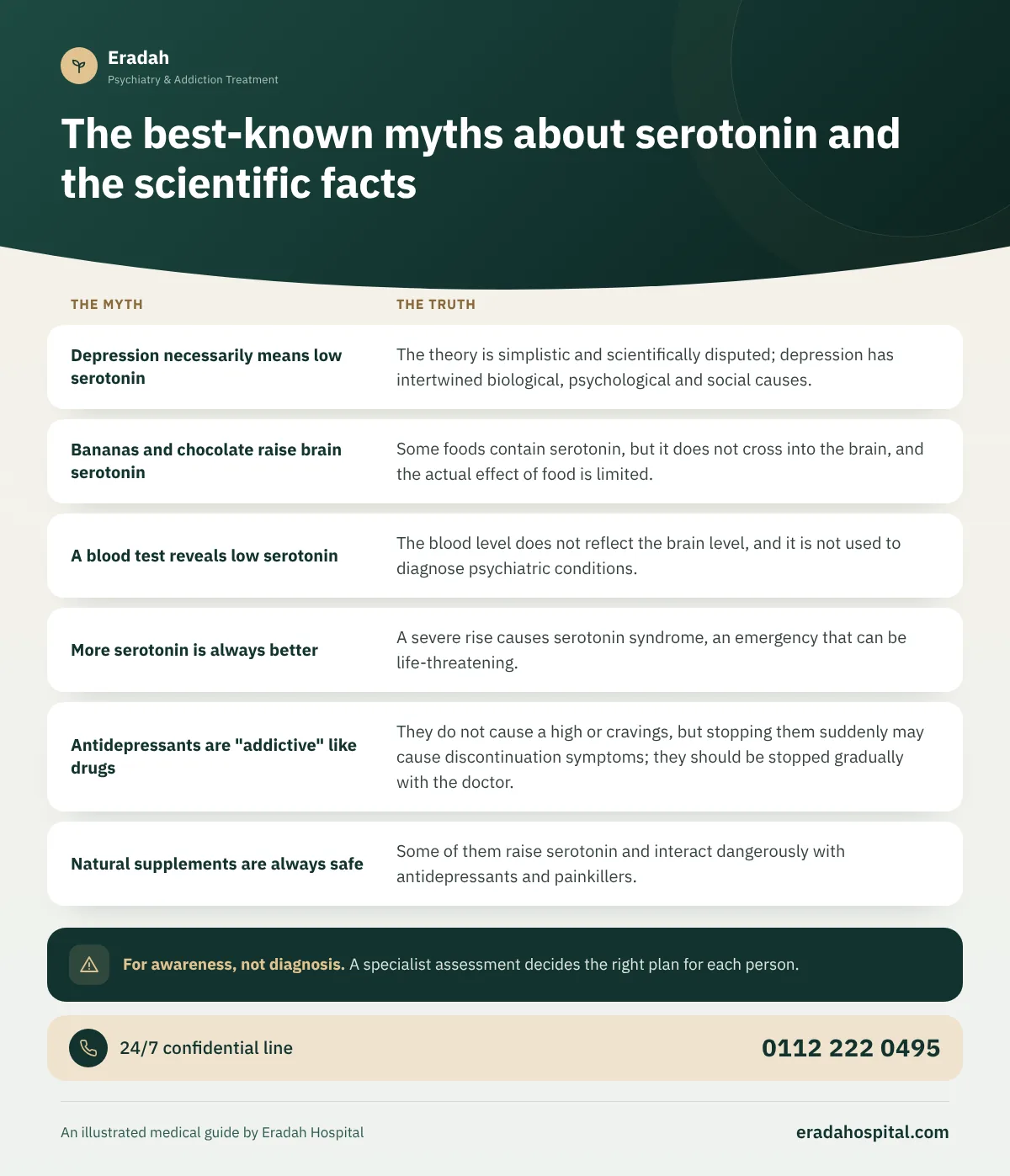
| The myth | The truth |
|---|---|
| Depression necessarily means low serotonin | The theory is simplistic and scientifically disputed; depression has intertwined biological, psychological and social causes. |
| Bananas and chocolate raise brain serotonin | Some foods contain serotonin, but it does not cross into the brain, and the actual effect of food is limited. |
| A blood test reveals low serotonin | The blood level does not reflect the brain level, and it is not used to diagnose psychiatric conditions. |
| More serotonin is always better | A severe rise causes serotonin syndrome, an emergency that can be life-threatening. |
| Antidepressants are "addictive" like drugs | They do not cause a high or cravings, but stopping them suddenly may cause discontinuation symptoms; they should be stopped gradually with the doctor. |
| Natural supplements are always safe | Some of them raise serotonin and interact dangerously with antidepressants and painkillers. |
The bottom line is that serotonin is a pivotal and important substance, but understanding it correctly protects against two mistaken extremes: those who see it as the explanation for every psychological problem and look for a "magic pill," and those who deny the value of medication simply because the popular theory is oversimplified.
Serotonin guide: everything you need to know
We have gathered everything about serotonin into 4 pages, each answering one question in detail. Choose what you are looking for:
Serotonin deficiency: symptoms and causes
The signs attributed to low serotonin in mood, sleep, appetite and digestion, its possible causes, the truth about its relationship to depression, and when to see a doctor.
High serotonin: symptoms and causes
Serotonin syndrome caused by mixing medicines or drugs: its mild and severe signs, the medicines and supplements that cause it, the rare tumors that release it, and when to go to the emergency room.
Ways to increase serotonin naturally
What research shows about light, exercise, sleep, diet and relationships, with a frank assessment of the strength of evidence, and why supplements should not be taken without a doctor.
Serotonin and addiction
How ecstasy, hallucinogens, stimulants and tramadol disrupt serotonin, its role in mood after stopping, in impulsivity and in relapse, and how the brain recovers.
Serotonin syndrome: call the ambulance (123) immediately
- Sudden agitation, confusion or severe anxiety after starting a new medicine, increasing a medicine or mixing substances
- High body temperature with heavy sweating and a racing heart
- Repeated involuntary muscle twitching or jerking, especially in the legs, or involuntary eye movements
- Severe muscle rigidity, or seizures
- Diarrhea and vomiting with altered consciousness or difficulty responding
Call the ambulance on 123 or go to the nearest emergency room immediately, and do not wait for the symptoms to go away on their own. Take with you the packaging of all the medicines and supplements the person has taken, do not give them any other medicine or supplement at home, and tell the doctor about any drug they used without fear; the information can save their life.
Ambulance 123 Mental health support line 16328