What is body dysmorphic disorder?
“My nose looks crooked in every picture, I can't leave the house like this.” Family and friends reply that they see nothing, but reassurance doesn't help. This painful preoccupation with a flaw that no one else notices, which consumes hours of your day, may be body dysmorphic disorder, a real and treatable mental health condition.
The UK's National Health Service (NHS) defines body dysmorphic disorder as a mental health condition in which a person spends a lot of time worrying about flaws in their appearance, flaws that others often do not notice. The American diagnostic manual classifies it with obsessive-compulsive disorder and related disorders. The MSD Manual estimates its prevalence at 2% to 3% in large population studies, and says it usually begins in adolescence and may be slightly more common in women, while the NHS stresses that it affects both men and women and that it does not mean vanity or self-love.
Which body parts does the patient focus on?
According to the MSD Manual, the preoccupation is usually centered on the face or head, but it can involve any part, and may move from one part to another over time: thinning hair, acne, wrinkles, scars, skin color, or the shape of the nose, eyes, or ears. The patient describes the part they hate as ugly or deformed. Insight is often poor, as most patients genuinely believe the flaw is real.
Symptoms of body dysmorphic disorder
Looking in the mirror a lot, or avoiding it completely, or switching between the two.
Comparing one's looks with others on the street, in photos, and on social media.
Growing a beard to hide a scar, wearing a cap to hide hair, or spending hours on makeup.
Picking at the skin to make it “smooth,” or pulling out hair.
Repeatedly asking “do I look bad?” without feeling at ease with the answer.
Avoiding people and photos, and going out only at night in severe cases.
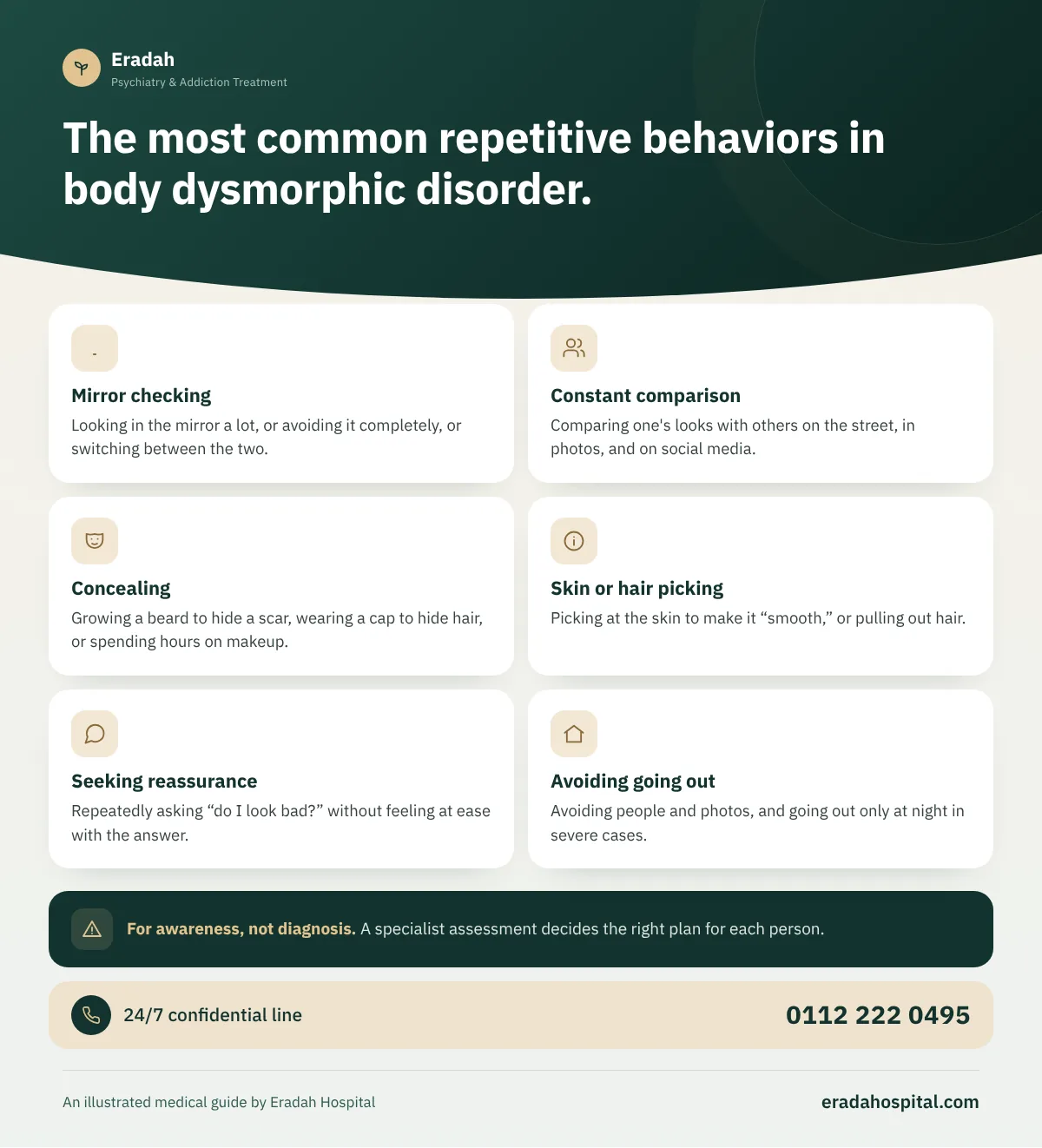
Skin picking or hair pulling may be linked to this disorder, and the MSD Manual notes that patients spend hours a day thinking about their flaws and wrongly believe that people notice them or mock them.
Body dysmorphic disorder in men: muscle obsession
The MSD Manual describes a form that mostly affects men, called muscle dysmorphia, in which the person believes their body is not muscular or lean enough, no matter how large their muscles grow. The manual warns that some turn to anabolic steroids and to drugs and supplements to build muscle or burn fat, a practice that can be dangerous. This differs from eating disorders, in which the preoccupation centers on weight and food.
Does cosmetic surgery solve the problem?
The MSD Manual notes that many patients turn to dermatological treatments, dental work, or cosmetic surgery, but these usually do not work and may increase the preoccupation. It points out that the disorder is more common in cosmetic clinics: about 11% in dermatology clinics, 13–19% among people seeing cosmetic surgeons, and about 20% among those seeking rhinoplasty. For this reason, a psychological assessment before cosmetic procedures is recommended if the preoccupation with appearance is severe and persistent.
Risks of body dysmorphic disorder
- Clear impact on study, work, and relationships.
- Social isolation and avoiding going out.
- Depression, one of the most common complications.
- Self-harm and suicidal thoughts, which the MSD Manual says are higher in this disorder than in many other mental health conditions.
- Risks of steroids and repeated surgeries.
Treatment of body dysmorphic disorder
The NHS stresses that symptoms improve with treatment, and that they usually do not go away on their own and may get worse. Treatment depends on severity: cognitive behavioral therapy for mild cases, which usually includes exposure and response prevention, meaning gradually facing the situations that trigger the preoccupation with appearance without turning to rituals. For moderate cases, cognitive therapy or an SSRI antidepressant is offered, and for severe cases the two are combined. The NHS notes that fluoxetine is the most commonly used, and that its effect may take up to 12 weeks. The doctor decides the type, dose, and duration, and stopping is done gradually under their supervision, so never start or stop any medication without a doctor. You can start with an assessment in Eradah's outpatient clinics, or hospital residential treatment if there is a risk.
How do you help someone with body dysmorphic disorder?
- Don't tell them “you're just being dramatic” or “there's nothing wrong”; they genuinely see the flaw.
- Don't take part in repeated reassurance, as it feeds the cycle.
- Talk about the effect of the preoccupation on their life instead of arguing about their looks.
- Encourage a psychological assessment before any cosmetic procedure.
- Pay attention to any talk of despair or self-harm.
Despair about appearance or thoughts of self-harm? Get help now
- Saying they can't stand how they look or see no point in living
- Complete isolation and stopping going out, studying, or working
- Repeatedly harming the skin or body, or talking about hurting themselves
- Using anabolic steroids or muscle-building drugs with worrying symptoms such as chest pain or severe palpitations
- Increased preoccupation and despair after a cosmetic procedure that did not change their sense of the flaw
Do not leave the person alone. Ask them calmly and frankly what they are thinking, and listen without blame or mockery; asking does not plant the idea, it opens the door to help. Call an ambulance (123) or take them to the nearest emergency room, or call the mental health support line 16328 (24 hours), and keep medications and other things they could harm themselves with out of their reach.
Ambulance 123 Mental health support line 16328