What are sports hormones and performance enhancers?
“Just one cycle before summer and then I'll quit.” This is how the story starts for many young people in gyms. An injection or tablets recommended by a trainer or friend, a quick result in the mirror, then a second and third cycle, then the discovery that stopping hormones and sports performance enhancers is not as easy as they said.
By hormones or sports performance enhancers, people usually mean “anabolic-androgenic steroids,” meaning synthetic substances similar to testosterone. The US National Institute on Drug Abuse (NIDA) explains that they have two effects: an “anabolic” effect that builds skeletal muscle, and an “androgenic” effect that produces male characteristics in men and women.
The term “sports performance enhancers” sometimes includes other substances such as growth hormone, insulin, thyroid hormones and fat burners, and the institute notes that steroid users take about 11 different substances a year on average to improve appearance or performance. This guide focuses on steroids because they are the most widespread and best studied. They are entirely different from the stimulants that stimulate the brain such as Captagon and crystal meth.
Do anabolic hormones have a medical use?
Yes. NIDA notes that these compounds are used medically to treat delayed puberty, muscle weakness caused by some diseases, and testosterone deficiency in men with a medical condition that causes it. In these cases the doctor sets the dose and follows the test results.
The problem begins when they are taken without a prescription to build muscle or improve appearance, in doubled doses and with multiple formulations, and sometimes with veterinary or adulterated preparations whose contents are unknown.
How do sports hormones affect the brain and body?
Steroids bind to androgen receptors in muscle, heart and brain cells, changing gene activity and how cells work. The institute notes that animal research found they raise serotonin in mood-related areas and dopamine in the reward circuit, and that chronic use disrupted this circuit.
In the body, the glands sense “excess male hormone” and shut down their own natural production. That is why natural testosterone production falls and the testicles shrink during use, and on stopping there is a hormonal gap that explains a large part of the fatigue, depression and low desire.
Forms of hormones and their names in the gym
NIDA divides the most misused steroids into tablets taken by mouth and intramuscular injections, including internationally known compounds such as Dianabol, Winstrol and Anavar as tablets, and Deca-Durabolin and testosterone as injections. It notes that many start with tablets and then move to injections because they are less harmful to the liver.
- Cycle: a period of injections or tablets followed by a break and then a new cycle.
- Stacking: combining two or more hormones, sometimes with veterinary compounds.
- Pyramiding: gradually increasing the dose and then lowering it over a cycle lasting 6 to 12 weeks.
The institute stresses that these patterns have not been scientifically shown to reduce harm, although many users believe they do.
Why do young people turn to sports performance enhancers?
- The wish for bigger muscles quickly, or the feeling that training alone has “reached its limit.”
- The pressure of comparison with social media images and champions.
- A pathological preoccupation with muscle size known as muscle dysmorphia, a form of body dysmorphic disorder.
- A recommendation from a trainer or friend who presents them as “strong supplements.”
- Improving performance in strength sports and competitions.
The institute notes that most users say hormones helped them reach the “ideal body,” and that is precisely what makes stopping hard. Steroids also usually start later in life than most drugs; in an analysis published by Harrison Pope and colleagues in 2014, only 22% of users began before age 20.
Harms of sports hormones and performance enhancers to the body
NIDA says most side effects go away if the person stops, but some are permanent or nearly so, and the serious harms may not appear until after years. These are the most important:
| System | Harm | Does it go away on stopping? |
|---|---|---|
| Heart | High blood pressure, weakened heart muscle, heart attacks and blood clots even before age 30, due to high LDL (bad) cholesterol and lowered HDL (good) cholesterol | Some may improve, while a heart attack or stroke is permanent damage |
| Liver | Liver damage and tumors, and a rare condition called “peliosis hepatis” in which blood-filled cysts form and may rupture | Depends on severity |
| Hormones | Low sperm count, testicular shrinkage and low testosterone, breast enlargement and baldness in men, and a deeper voice and hair growth in women | Reduced fertility often improves, while breast enlargement and baldness may last |
| Skin | Severe acne, cysts and excess oiliness, and abscesses at injection sites | Often improves |
| Immune system | HIV and hepatitis B and C infection from shared or non-sterile needles | The infection may become chronic |
| Muscles | Stiffer tendons and a higher risk of tearing, and early stunting of growth in adolescents | Short stature is permanent |
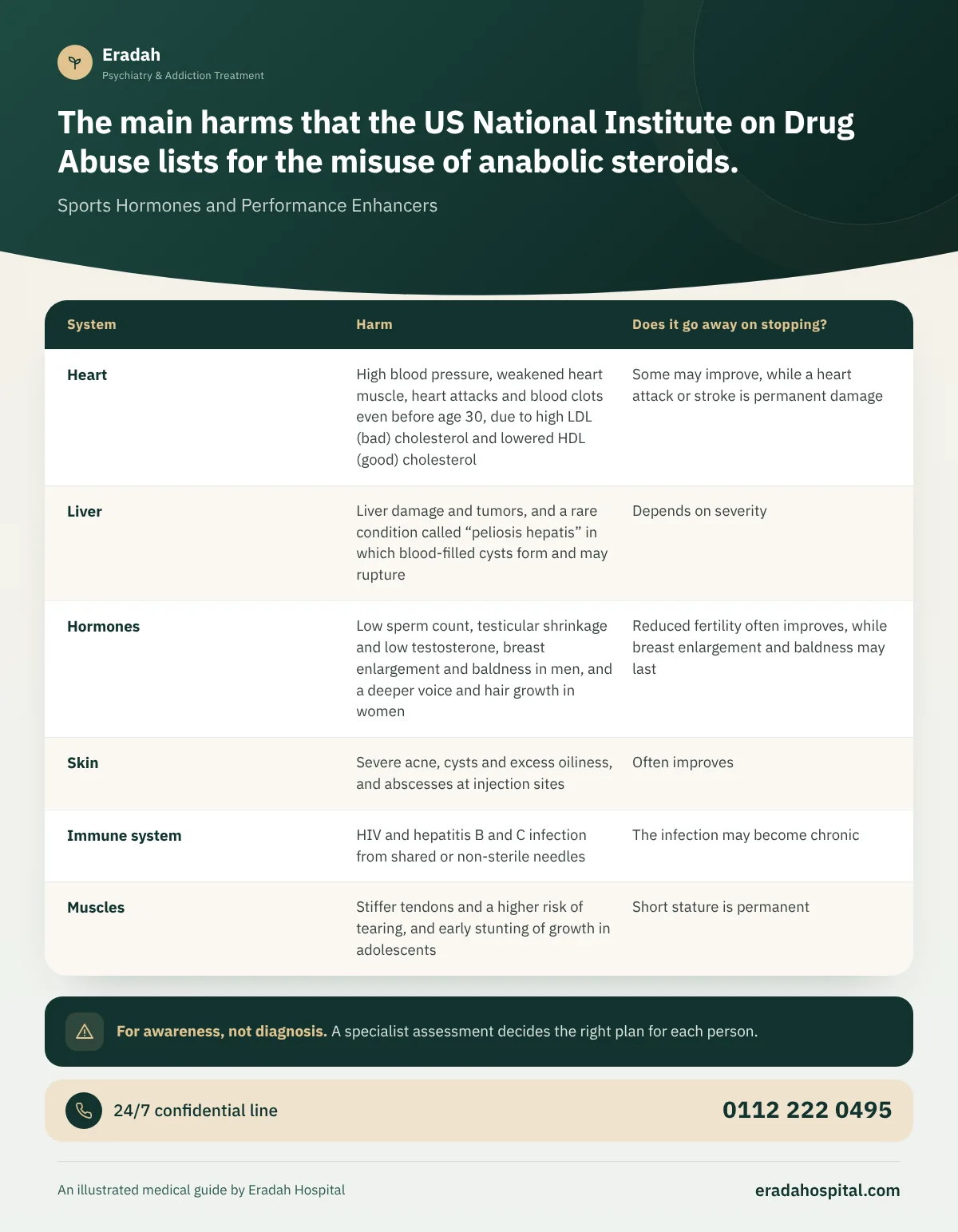
The table summarizes what the US National Institute on Drug Abuse reports, and most long-term harm data come from case reports, not large studies.
Sports hormones and mood: irritability and depression
The institute describes increased irritability and aggression in some users, which some call “roid rage,” noting that results vary between people. Moderate and high doses are also linked to anxiety, manic episodes and severe depression. The picture gets more complicated when combined with anger outbursts or other substances.
Do sports hormones cause addiction?
Yes, in a not-small share of people. Steroids do not give a “high” like typical drugs, but the institute notes that a review of research estimated that about 32% of people who misuse them develop dependence. Signs include needing larger doses, continuing despite harm, spending a great deal of time and money to obtain them, and failing to stop because of fear of losing muscle or because of depression.
The institute notes that withdrawal symptoms include fatigue, restlessness, loss of appetite, insomnia, low sex drive and craving for the hormones. The StatPearls review presents this pattern as a separate disorder called anabolic steroid use disorder.
Sports performance enhancers in numbers
Hormones and the gateway to other drugs
The institute notes that steroid users are more likely to use hashish, opioid painkillers, cocaine and heroin, that some first learned about opioids from gym friends and bought them from the same person who sold them hormones. Some turn to them to treat insomnia, irritability and depression caused by the hormones.
This overlaps with nalbuphine, well known in Egypt; a study published in the American Journal on Addictions in 1999 described dependence on nalbuphine injections among steroid users, mostly beginning to relieve the pain of weightlifting injuries, with its use spreading within their gyms.
The legal status of sports hormones in Egypt
Anabolic steroids are hormonal medications dispensed by prescription, and using them to build muscle without a prescription and outside the medical framework is illegal, and much of what is sold outside pharmacies is adulterated or of unknown origin. In competitive sport they are banned by the World Anti-Doping Agency, and NIDA notes that modern tests detect their by-products for longer periods than before.
How is dependence on sports hormones treated?
- A comprehensive medical assessment of the heart, liver, lipids and hormones before any plan.
- A stopping plan set by a doctor, with medical treatment of the hormonal disturbance after stopping when needed.
- Psychological therapy for body image, depression and anxiety, which are often the real reason for going back.
- Treatment of any accompanying addiction such as painkillers or sedatives, within dual diagnosis care if a psychiatric disorder is present.
- A realistic exercise and nutrition plan that preserves the person's relationship with training without hormones.
Tips for families: your son goes to the gym and suddenly changed
- Watch for very rapid changes in muscle size, severe acne and unusual irritability.
- Ask about “supplements” and injections without accusing, because many young people do not know that what they are taking is a hormone.
- Do not dismiss sadness and flatness after a “cycle” ends, as it may be depression that needs a doctor.
- If use of painkillers or other injections alongside them appears, seek a specialist assessment quickly, and start with the signs of drug use.
Danger signs after using hormones and sports performance enhancers: call the ambulance on 123 immediately
- Chest pain or pressure, or sudden shortness of breath.
- Weakness or numbness on one side of the body, slurred speech or a drooping mouth.
- Swelling and pain in one leg, or coughing up blood.
- Severe abdominal pain with yellowing of the skin or eyes.
- Suicidal thoughts or severe depression after stopping hormones.
Call the ambulance on 123 immediately and do not wait for the pain to improve on its own, because chest pain and signs of a stroke cannot tolerate delay, even in young athletes. Have the person sit or lie in a comfortable position, and if they lose consciousness while breathing, place them on their side and stay with them until the paramedics arrive. Tell them the names of the hormones and injections used and any other substances taken with them. If suicidal thoughts appear, do not leave them alone, and call the ambulance on 123 or the mental health support line 16328.
Call the ambulance 123