What is delusional disorder?
“He’s fine at work and with people, but for two years he’s been convinced the neighbors are spying on him and putting something in the water.” This is how many families describe the start of delusional disorder: a person who seems ordinary but holds an unshakable certainty about an idea no one else sees. Because their life does not fall apart, seeking help is delayed for years.
A delusion is a fixed false belief that does not change despite clear evidence that it is untrue, and that is not explained by the person's religion or culture. In delusional disorder the delusion is the main symptom and lasts a month or more, without the full picture of schizophrenia. According to the MSD Manual, the delusions are often “non-bizarre,” meaning they concern situations that could happen in real life, such as being followed, poisoned, or deceived by a partner, rather than impossible things.
This differs from passing paranoia that many people experience under stress; those are thoughts that can be reviewed and questioned, whereas a delusion is a certainty that does not accept discussion.
Types of delusional disorder
The disorder is classified by the dominant theme of the delusion, and Cleveland Clinic notes that the persecutory type is the most common:
A certainty that someone is plotting against, watching, or trying to harm them, and they may file many complaints and reports.
A certainty that the partner is unfaithful, with searching, tracking, and repeated accusations with no real evidence.
A belief that a famous or high-status person is secretly in love with them, and they may try to contact or follow that person.
A conviction of an exceptional talent, a great discovery, or a special status that no one acknowledges.
A certainty of having a disease, parasites, or a foul odor in the body despite normal test results.
More than one type together, with none clearly dominant.
The jealous type in particular overlaps with what we explain on the pathological jealousy page, and it is among the most painful types for families.
What is life like with delusional disorder?
- Repeated talk about one particular subject, with intense emotion when it is approached.
- Interpreting ordinary events as proof that confirms the delusion.
- Rejecting any opposing view, even from the closest people or from doctors.
- Actions based on the delusion: changing locks, searching a phone, moving house, or filing lawsuits.
- Irritability, suspicion, and gradual withdrawal from people.
- Reasonable functioning at work and in daily life away from the subject of the delusion.
The difference between delusional disorder and schizophrenia
| Delusional disorder | Schizophrenia | |
|---|---|---|
| Main symptom | One or more delusions, usually about a specific theme | Delusions with hallucinations and disorganized thinking and speech |
| Hallucinations | Absent or not prominent | Common and prominent |
| Daily functioning | Relatively preserved away from the delusion | Clearly affected in work, relationships, and self-care |
| Typical age of onset | Middle age or later | Usually late adolescence and early adulthood |
| How common | Rare | More common |
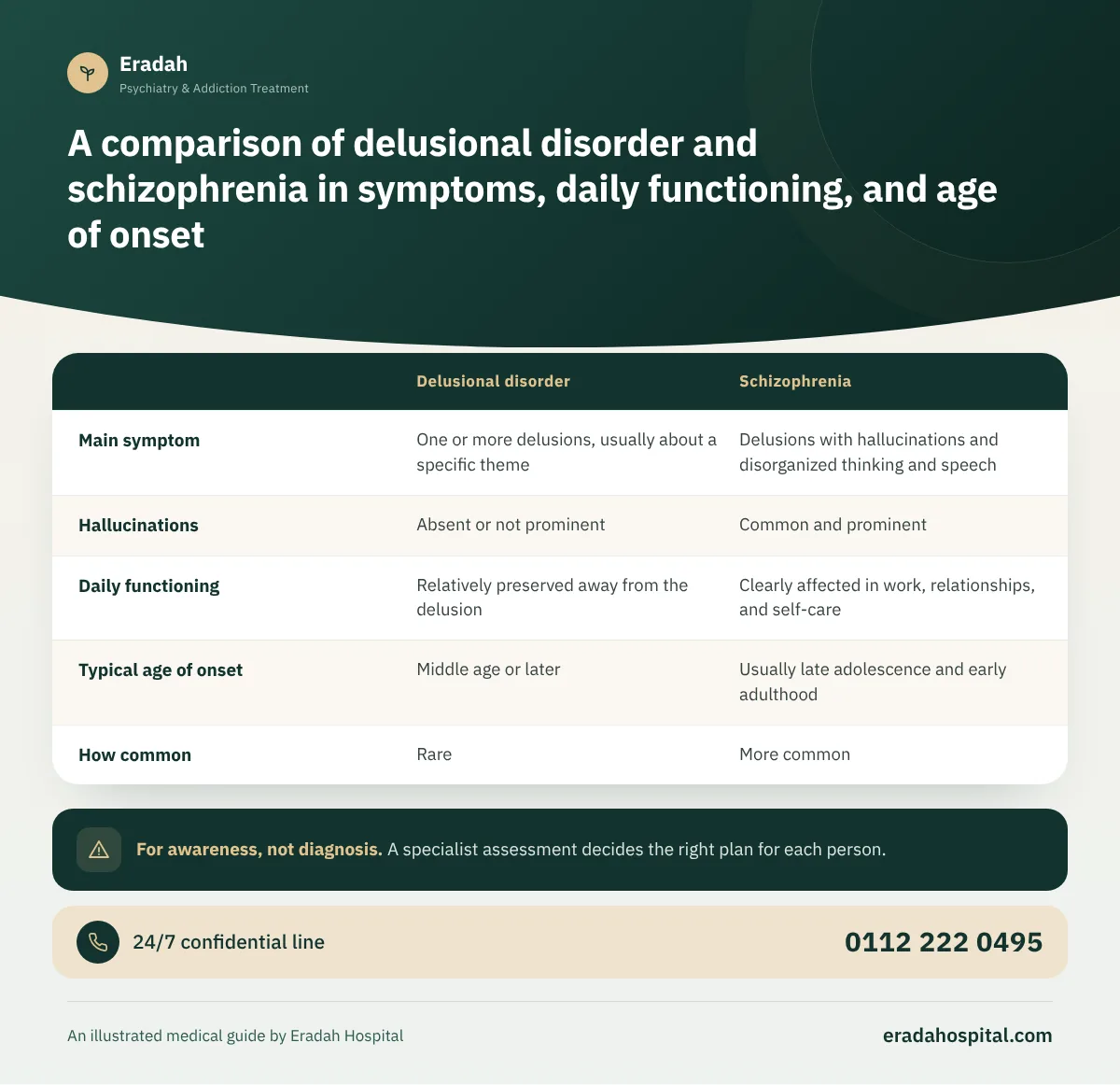
The doctor must also make sure the delusion is not part of severe depression or mania, the result of a physical illness or dementia, or caused by a substance such as stimulants, which we explain in drug-induced psychosis.
Causes and risk factors of delusional disorder
No single cause is known, and it is most likely an interaction between genetic predisposition, brain chemistry, and surrounding circumstances. Cleveland Clinic notes that it occurs more often in people with a family history of psychotic disorders and in people who are socially isolated, such as expatriates facing a language barrier, people with hearing or vision impairment, and older adults. Severe stress may trigger the disorder in someone who is predisposed.
How is delusional disorder diagnosed?
- A detailed psychiatric interview with the patient, and with the family if possible, to understand the delusion, its history, and its impact.
- Confirming that it has lasted at least a month and that other symptoms of schizophrenia are absent.
- Ruling out physical causes with tests the doctor decides on, especially in older adults.
- Asking about alcohol, drugs, and medications that can cause similar symptoms.
- Assessing risk: is there an intent to confront, take revenge, or harm themselves?
Treatment of delusional disorder
The hardest step is the first, because the patient usually does not see that they are ill. This is why treatment starts with building a relationship of trust with the doctor, and the way in is often the distress the person feels, such as insomnia, anxiety, or stress, not the delusion itself. After that, treatment includes:
- Antipsychotic medication: the doctor prescribes it according to the case, and it may reduce the intensity of the delusion and the patient's preoccupation with it. Never start or stop any medication without a doctor.
- Cognitive behavioral therapy: helps the person deal with the delusion more flexibly and reduce its impact on decisions and relationships.
- Treating accompanying symptoms: such as depression, anxiety, or insomnia.
- Involving the family: to understand the condition, reduce conflict, and encourage commitment to treatment.
A Cochrane review published in 2015 acknowledges that scientific trials on this specific disorder are few, and recommends offering the treatments proven effective in other psychotic disorders. Even so, the outcomes are encouraging: Cleveland Clinic notes that about half of patients who stick with treatment recover fully, and more than 20% improve partially. Treatment can often be delivered through outpatient clinics, while high-risk cases need a stay in a psychiatric hospital for a period.
How should a family deal with a person who has delusional disorder?
- Do not argue about whether the delusion is true, and do not agree with it; listen and acknowledge their feelings.
- Focus on what truly hurts them: “I can see you’re worn out and not sleeping; let’s go see a doctor who can help you.”
- Avoid searching their things, deceiving them, or putting medication in their food without their knowledge; this destroys trust.
- Keep a record of any threats or dangerous behavior to show the doctor.
When is it an emergency?
Threats, stalking, or danger to themselves? Step in now
- Threatening to harm a person the patient believes is a source of danger or betrayal
- Stalking or constantly watching a particular person
- Carrying a weapon or tool “for self-defense”
- Talking about revenge or about ending their life
- Refusing to eat or drink for fear of being poisoned
Do not argue about the idea, and do not leave the person alone if a threat appears. Speak calmly about their fear and exhaustion, and remove weapons and dangerous objects without a violent confrontation. Call ambulance (123) or go to the nearest emergency department immediately, and the mental health support line 16328 (24 hours) is available for advice.
Ambulance 123 Mental health support line 16328