What is pathological jealousy?
“He goes through my phone every night,” “She calls my workplace twenty times a day to make sure I'm there,” “He accused me of cheating with our 70-year-old neighbor.” This is a different kind of jealousy from the jealousy of love celebrated in songs; it is daily suffering for both partners, a condition with a name, causes and treatment.
Jealousy is a normal human feeling that protects a relationship when a person senses a real threat. But it becomes pathological when it loses its connection to reality: the suspicion rests on flimsy evidence or none, continues despite reassurance, and controls the person's behavior and their partner's life. Pathological jealousy does not mean infidelity is impossible; it means the reaction does not depend on what is actually happening.
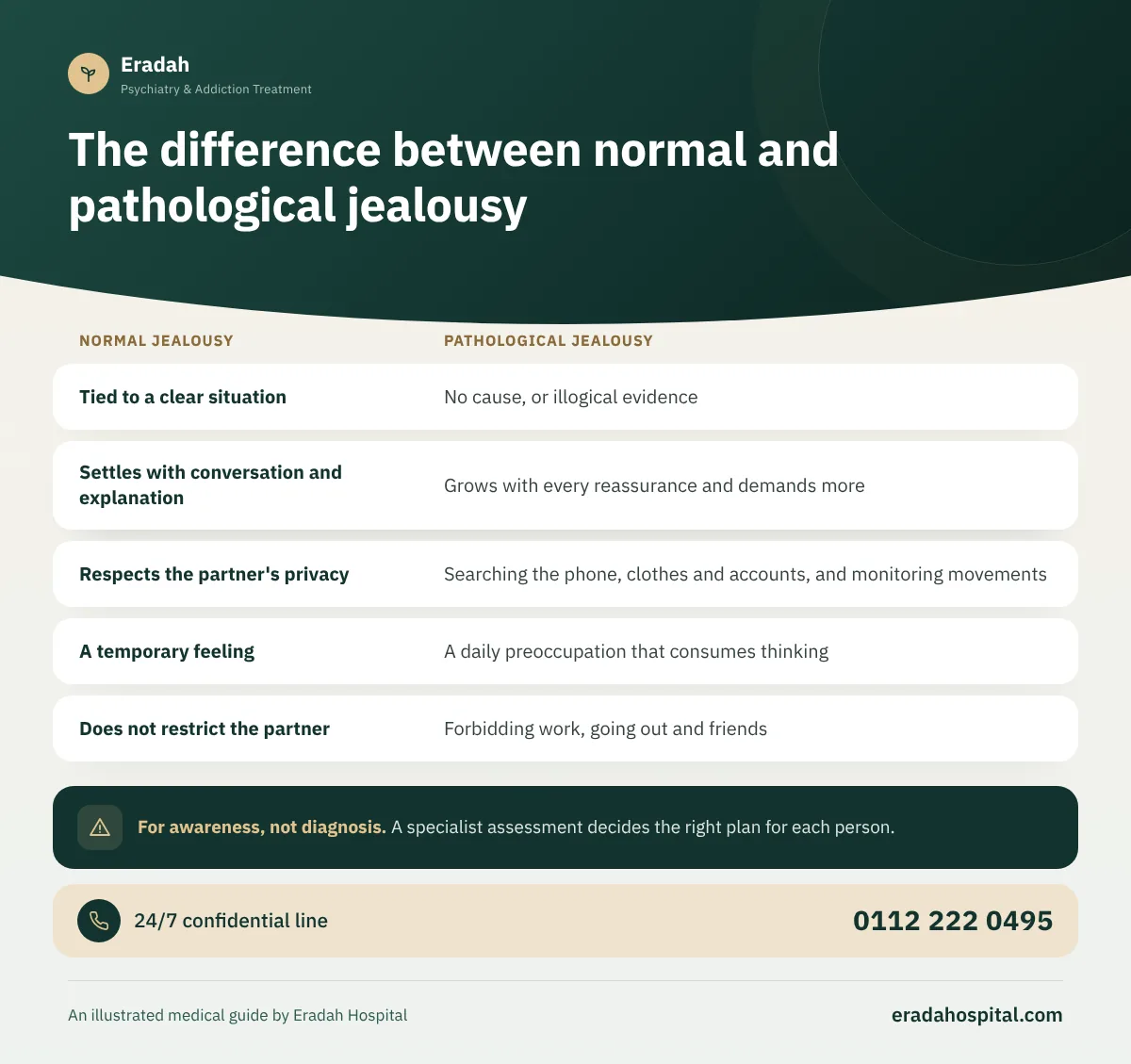
| Normal jealousy | Pathological jealousy |
|---|---|
| Tied to a clear situation | No cause, or illogical evidence |
| Settles with conversation and explanation | Grows with every reassurance and demands more |
| Respects the partner's privacy | Searching the phone, clothes and accounts, and monitoring movements |
| A temporary feeling | A daily preoccupation that consumes thinking |
| Does not restrict the partner | Forbidding work, going out and friends |
Forms of pathological jealousy
- Obsessional jealousy: intrusive thoughts of infidelity that the person knows are exaggerated, followed by repeated checking to calm the anxiety; it resembles obsessive-compulsive disorder (OCD).
- Delusion of infidelity (Othello syndrome): a fixed belief that the partner is unfaithful that no evidence can shake; it may be part of a delusional disorder or psychosis.
- Personality-related jealousy: in disorders such as borderline, narcissistic and paranoid personality disorders, with fear of abandonment or a need for control.
Signs of pathological jealousy
- Repeatedly searching the phone, messages and accounts.
- Monitoring movements through constant calls, tracking or surprise appearances.
- Long interrogations about the details of the day and the people involved.
- Reading ordinary things as proof of infidelity, such as an item moved in the house.
- Preventing the partner from working, going out, or seeing friends and family.
- Accusations of infidelity with implausible people.
- Rejecting any explanation or evidence to the contrary.
- Threats, insults or violence when suspicious.
Causes of pathological jealousy
Psychological and biological factors overlap, chiefly:
Long-term alcohol use is one of the best-known causes of delusions of infidelity, long known as “alcoholic jealousy.”
Crystal meth (shabu) and cocaine cause suspicion and paranoia that may focus on the partner.
Low self-esteem, fear of abandonment and anxious attachment.
Delusional disorder, schizophrenia, depression and obsessive-compulsive disorder (OCD).
Dementia, brain injuries, and some Parkinson's disease medications.
A real past betrayal, or growing up in a home full of infidelity and suspicion.
So when intense jealousy appears suddenly in someone who was not jealous before, especially with increased drinking or use of crystal meth (shabu) or cocaine, or in an older person, it calls for a medical assessment, not a marital argument.
When does pathological jealousy become dangerous?
Studies indicate that delusions of infidelity are among the psychiatric symptoms most strongly linked to violence within the family, especially with alcohol and drugs. This is why they should not be treated as a “character trait” to be put up with.
How do you deal with a partner who is pathologically jealous?
- Do not get drawn into the daily cycle of proving yourself; every piece of proof you give is followed by a demand for new proof.
- Set clear boundaries calmly: respect, privacy and freedom from violence are red lines.
- Talk about his suffering, not his accusations: “You seem exhausted and uneasy; we need to talk to a specialist.”
- If he refuses the idea of psychiatry, suggest seeing a doctor about sleep, stress or drinking.
- Seek support for yourself too, from family or a therapist.
- And if any threat or violence appears, safety comes before any attempt at repair.
Treatment of pathological jealousy
Treatment depends on its type and cause. In obsessional jealousy, cognitive behavioral therapy helps by reducing checking and searching and modifying thoughts, and antidepressants from the serotonin reuptake inhibitor group may be used. In a delusion of infidelity, antipsychotics are the basis of treatment, along with psychological follow-up. When alcohol or drugs are the cause, there is no improvement without treating the addiction itself, and the delusions may disappear after stopping. Couples therapy helps in non-violent cases after the individual condition has been treated; where there is violence, safety and a temporary separation take priority.
Threats or violence because of suspicion? Safety first, get help now
- Threats to kill or harm the partner, the accused person or the children
- Physical violence even once, or possession of a weapon together with suspicion
- Talk of “punishing” the partner or taking revenge on them
- Escalating suspicion and aggression with drinking or use of crystal meth (shabu) or cocaine
- Talk of death or self-harm if infidelity is “confirmed” or the relationship ends
Do not confront the person alone, and do not argue to prove your innocence while they are angry; move with your children to a safe place and ask family for help. Call the police emergency line on 122 for threats or violence, and an ambulance on 123 if there is an injury or danger to life. If either person has thoughts of self-harm, call the mental health support line 16328, available around the clock.
Ambulance 123 Mental health support line 16328