What is dissociative identity disorder?
Cinema has turned “multiple personalities” into material for thrillers and horror, so many people think of it as either a myth or a dangerous madness. The reality is very far from that: these are people who endured more in childhood than anyone can bear, so their minds learned to “disconnect” in order to carry on, and later this disconnection became a problem in their adult lives.
Dissociation is a break in the normal connection between memory, consciousness, identity and perception. We know mild forms of it from everyday life, such as driving home and not remembering the road. In dissociative identity disorder, the dissociation goes so far that distinct identity states form, each with its own way of feeling like a self, thinking and behaving. They may have a different name, age or voice, and they take turns controlling the person.
Symptoms of dissociative identity disorder
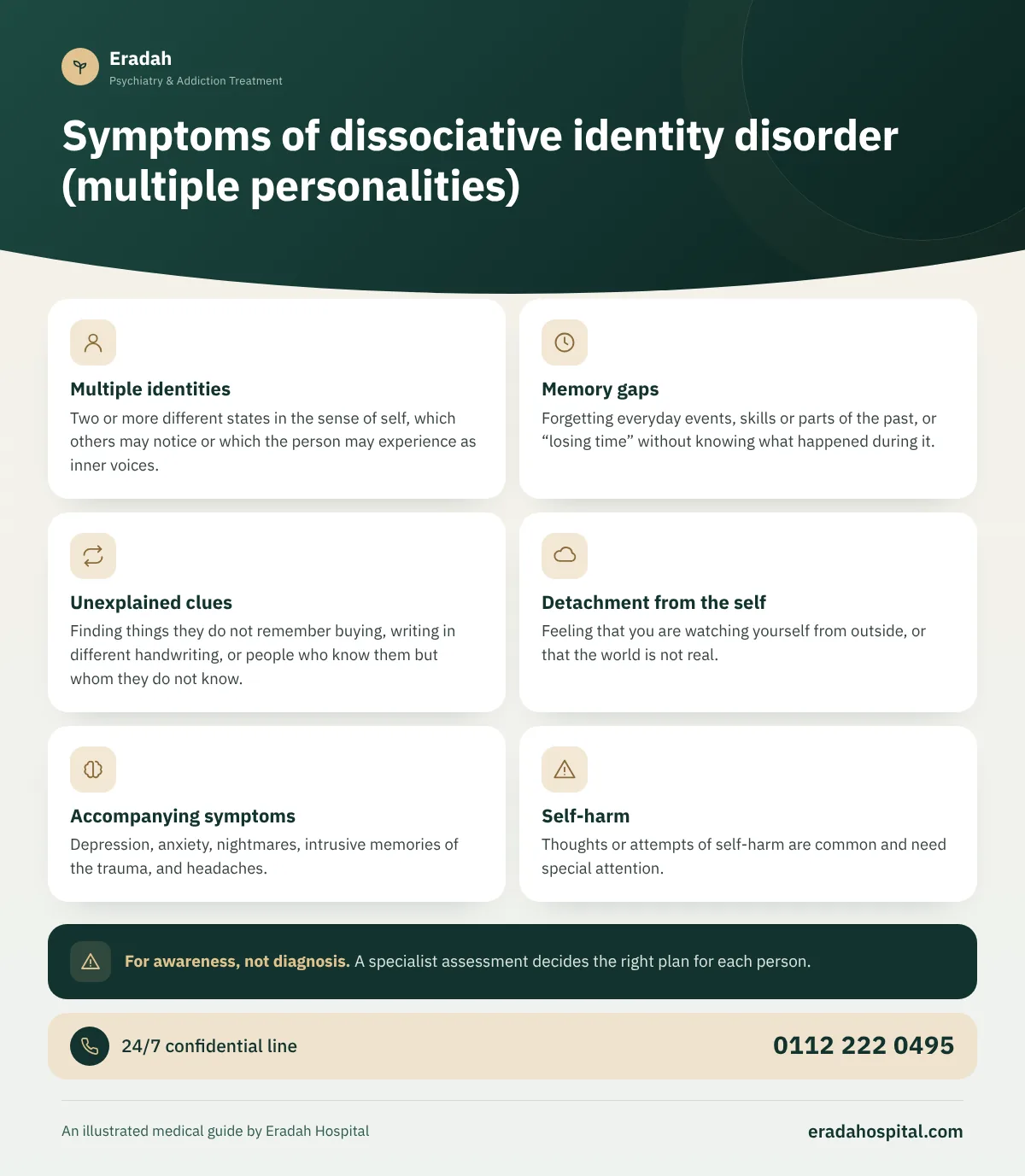
Two or more different states in the sense of self, which others may notice or which the person may experience as inner voices.
Forgetting everyday events, skills or parts of the past, or “losing time” without knowing what happened during it.
Finding things they do not remember buying, writing in different handwriting, or people who know them but whom they do not know.
Feeling that you are watching yourself from outside, or that the world is not real.
Depression, anxiety, nightmares, intrusive memories of the trauma, and headaches.
Thoughts or attempts of self-harm are common and need special attention.
Causes of multiple personalities
Most studies indicate that the great majority of people with the disorder experienced severe, repeated abuse or neglect in early childhood, usually before the age of nine and often from someone who was supposed to protect them. The idea is that the child’s identity was not yet fully formed, so when facing pain they could not escape, the mind “walled off” the experience in a separate part so the child could keep going. With repetition, these parts developed into independent identity states. The disorder is often linked with post-traumatic stress disorder (PTSD).
The difference between multiple personalities and schizophrenia
| Dissociative identity disorder | Schizophrenia |
|---|---|
| Its strongest cause is childhood trauma | Greater genetic and biological factors |
| Multiple identities and memory gaps | Hallucinations, delusions and disorganized thinking |
| Voices are usually internal and have a “personality” | Voices are usually external and comment or give commands |
| Contact with reality is usually present | Loss of contact with reality during episodes |
| Core treatment is psychotherapy | Antipsychotics are the core of treatment |
The widespread phrase “split personality” is a double mistake: it is used to describe schizophrenia, which has nothing to do with multiple personalities, and it adds to the confusion between the two disorders.
Common myths
- “People with it are dangerous”: they are more likely to harm themselves or be harmed than to harm others.
- “The switching is dramatic like in the movies”: it is often subtle, and people spend years with the disorder before being diagnosed.
- “It’s just acting”: the symptoms are involuntary, and the person often hides them for fear of being called mad.
- “It can’t be treated”: specialized treatment clearly improves symptoms and quality of life for many people.
Treatment of dissociative identity disorder
International guidelines recommend phased psychotherapy with a therapist who specializes in trauma:
- Stage 1Safety and stabilization
Gaining control over self-harm, regulating emotions, building trust with the therapist, and improving daily life.
- Stage 2Processing the trauma
Working with trauma memories carefully and gradually, without overwhelming the person.
- Stage 3Integration and rebuilding
Improving communication and cooperation among the identity states, and returning to life, relationships and work.
There is no medication that treats the disorder itself, but the doctor may prescribe medication for the accompanying depression, anxiety or nightmares. Some people with the disorder use alcohol or substances to numb memories, and then they need dual diagnosis treatment.
Self-harm or suicidal thoughts? Get help now
- Talking about death or wanting to end the pain
- Self-harm, or finding signs of self-harm without remembering the cause
- Intrusive trauma memories that cause a breakdown or severe panic
- Repeated loss of time while ending up in dangerous places or situations
- Increased use of alcohol or substances to numb memories
Do not leave the person alone. Ask them calmly and frankly what they are thinking, and listen without blame or mockery; asking does not plant the idea, it opens the door to help. Call an ambulance (123) or take them to the nearest emergency room, or call the mental health support line 16328 (24 hours), and keep medications and other things they could harm themselves with out of their reach.
Ambulance 123 Mental health support line 16328