What is depersonalization-derealization disorder?
“I feel like I’m not me, like I’m watching myself in a movie, and the world around me is dull and not real.” This sentence may be what frightens people most, and they think they are about to go mad. In truth, this feeling has a well-known medical name, depersonalization, understandable causes, and ways that help you come back.
Depersonalization-derealization disorder is one of the dissociative disorders, and the World Health Organization classifies it in ICD-11 under code 6B66. It is marked by persistent or recurrent episodes of depersonalization, derealization, or both. The MSD Manual stresses that the patient remains aware that what they feel is “just a feeling” and not a fact, meaning their reality testing is intact.
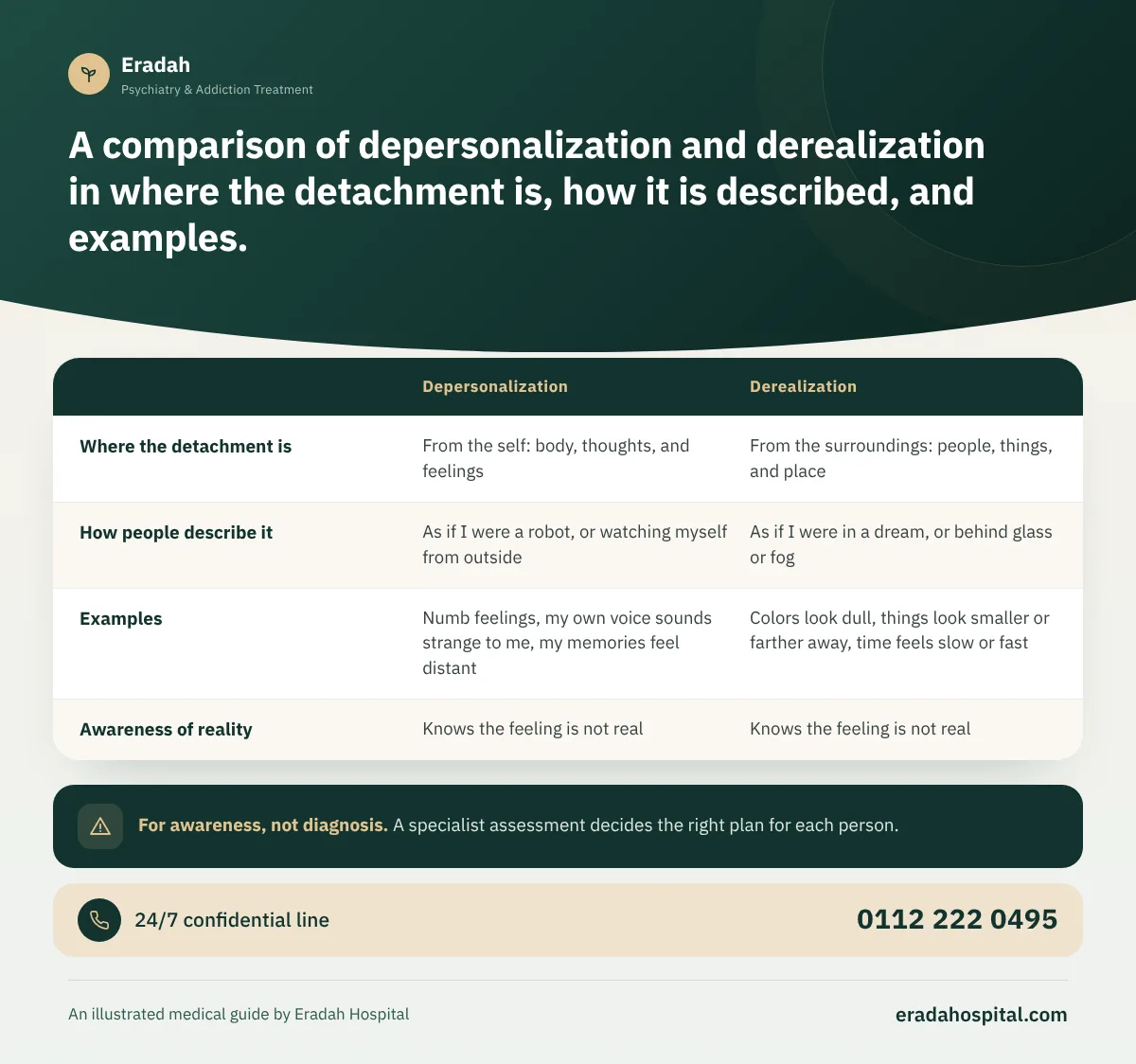
What is the difference between depersonalization and derealization?
| Depersonalization | Derealization | |
|---|---|---|
| Where the detachment is | From the self: body, thoughts, and feelings | From the surroundings: people, things, and place |
| How people describe it | As if I were a robot, or watching myself from outside | As if I were in a dream, or behind glass or fog |
| Examples | Numb feelings, my own voice sounds strange to me, my memories feel distant | Colors look dull, things look smaller or farther away, time feels slow or fast |
| Awareness of reality | Knows the feeling is not real | Knows the feeling is not real |
What are the symptoms of depersonalization and derealization?
- The feeling of being an outside observer of your life and actions.
- The feeling of being a machine that does not control what it says and does.
- Emotional numbness, or difficulty recognizing and describing your feelings.
- The feeling that your memories are distant and unclear.
- Seeing the world as lifeless, colorless, or artificial.
- Distorted perception of sounds, the size of objects, or the passing of time.
- Worry about going mad or having permanent brain damage.
- Repeated checking to make sure what you see is real.
The MSD Manual lists all these symptoms, and adds that they are almost always distressing and can be unbearable in their intensity. Anxiety and depression often accompany them.
Is depersonalization common?
The MSD Manual explains that the disorder affects men and women equally, may begin in childhood, and rarely begins after age 40. In other words, a passing feeling is part of the human experience under stress or exhaustion, and the problem is when it settles in and persists.
Is depersonalization madness or the start of schizophrenia?
No. The essential difference is that a person with depersonalization knows the feeling is not real, so they say “I feel as if,” not “the world has actually changed.” In psychosis, the patient loses this awareness and believes what they see or hear. The MSD Manual confirms that some patients fear developing psychosis, but keeping awareness of reality is what distinguishes the disorder. And the fear of madness itself feeds the anxiety, and the anxiety feeds the detachment, in a closed loop.
What are the causes and triggers of depersonalization?
Emotional neglect or abuse is among the most common causes, according to the MSD Manual.
Stress in relationships, work, or money, or the sudden death of a relative.
Depersonalization may begin during a panic attack and then continue.
Often accompanies the detachment and deepens the feeling of numbness.
As does ketamine; among the best-known triggers of onset.
Witnessing domestic violence, or a parent with a severe mental illness.
How is hashish linked to depersonalization?
In a study of 117 patients published in the Journal of Clinical Psychiatry in 2003, the most common direct triggers of onset were severe stress, depression, panic attacks, and use of hashish and hallucinogens. The MSD Manual lists ketamine and hallucinogens such as LSD among the triggers. This is why stopping these substances completely is an indispensable step, even if the detachment seems to continue after the last use.
What makes depersonalization worse or better?
| Makes symptoms worse | Eases them |
|---|---|
| Negative emotions and stress | Warm contact with people you feel comfortable with |
| Threatening social situations | Strong sensory or emotional stimulation |
| Unfamiliar places | Relaxation |
The MSD Manual describes the course of symptoms as episodes of fluctuating intensity that may last hours, days, weeks, months, and sometimes years, while in some patients the symptoms are continuous at a steady intensity for years.
Is depersonalization treatable?
Yes. Treatment relies on psychotherapy of various kinds, sensory grounding techniques, addressing the stress and trauma that preceded the onset, and treating accompanying anxiety and depression. There is no medication of proven effectiveness for depersonalization itself. We present these options and what studies say about them in depersonalization treatment.
When should you see a doctor about depersonalization?
- The feeling has lasted for weeks or recurs often.
- It has disrupted your work, studies, or relationships.
- It comes with severe anxiety, depression, or thoughts of self-harm.
- It began after using hashish, hallucinogens, or ketamine.
- It began after age 40, or comes with headache, seizures, or confusion.
The MSD Manual notes that the doctor may order an MRI and an EEG to rule out physical causes, especially if the symptoms are unusual or began after age 40, and may order a urine drug test. If the detachment is linked to substance use, a dual diagnosis program treats both together.
Depersonalization Guide: Everything You Need to Know
We have gathered everything about depersonalization on 1 page, which answers one question in detail. Choose what you are looking for:
Severe detachment from reality or thoughts of self-harm? Get help now
- Talking about death, that life is meaningless, or a wish to harm themselves
- Losing the sense of reality so that the person believes the world has actually changed, or hears voices that others do not hear
- Sudden confusion, a seizure, or loss of consciousness
- Severe detachment after using hashish, hallucinogens, or ketamine, with panic or risky behavior
- Complete inability to eat, sleep, or look after themselves for days
Stay with the person, speak calmly in short sentences, and help them feel the present by focusing on your voice or the texture of something in their hand; do not argue with their feelings. If there is danger to their life, or confusion or a seizure, call ambulance (123) or go to the nearest emergency department, or call the mental health support line 16328 (24 hours), and do not leave them alone if they talk about harming themselves.
Ambulance 123 Mental health support line 16328