Is schizophrenia the same as split personality?
“My cousin has a split personality.” We hear this sentence often in Egypt, and it usually means he has schizophrenia. But medicine says otherwise: schizophrenia is not a split personality, and a person with schizophrenia does not turn into someone else with a different name and different memories.
The NHS says clearly that people with schizophrenia do not have a split personality, and that schizophrenia does not usually make a person violent. As for “split personality” in its literal sense, meaning more than one identity within a person, it is an old name for a completely different disorder: Cleveland Clinic notes that dissociative identity disorder was formerly known as “multiple personality disorder” and “split personality disorder.”
Where did this confusion come from?
The Swiss psychiatrist Eugen Bleuler coined the term “schizophrenia” at the start of the twentieth century, as a review published in Dialogues in Clinical Neuroscience in 2015 explains. The word combines two Greek roots meaning “split” and “mind,” and it was meant to describe the separation of mental functions from one another, such as thinking, feelings, and behavior, not the division of a person into personalities.
But the literal meaning of the word left a long-lasting mark. A recent review published in Current Opinion in Psychiatry in 2025 on the debate over renaming schizophrenia notes that the term wrongly suggests a “split” and that this contributes to common misconceptions and to stigma. The same review points out that renaming “multiple personality disorder” as “dissociative identity disorder” was done without disrupting care. In Arabic the matter got more complicated when some translated the illness as “split personality,” and the wrong name stuck to it.
What is schizophrenia really?
According to the NHS, schizophrenia is a long-term mental health condition that causes symptoms such as hallucinations, like hearing or seeing things that are not there, delusions, meaning beliefs not based in reality, confused thoughts and speech, losing interest in daily activities, neglecting self-care, avoiding people, and feeling disconnected from emotions. You can find details of the symptoms in schizophrenia symptoms.
In other words, the “split” in schizophrenia, if we may put it that way, is a split between the mind and reality: the person remains himself with his memory, name, and history, but his perception of his surroundings is disturbed.
What is dissociative identity disorder (multiple personalities)?
The NHS describes dissociative identity disorder as a condition in which a person may feel uncertain about who they are and may feel they have other identities, each with its own name, voice, personal history, and traits, and its two main symptoms are gaps in memory about everyday events and personal information, and having several distinct identities. Cleveland Clinic notes that its causes are often linked to childhood trauma and abuse, as a way of psychologically distancing oneself from the trauma.
It is an uncommon disorder: Cleveland Clinic notes that a small American study estimated its prevalence at about 1.5%, though estimates vary with the diagnostic criteria. By contrast, the World Health Organization estimates that schizophrenia affects about 1 in every 300 people worldwide.
What is the difference between schizophrenia and dissociative identity disorder?
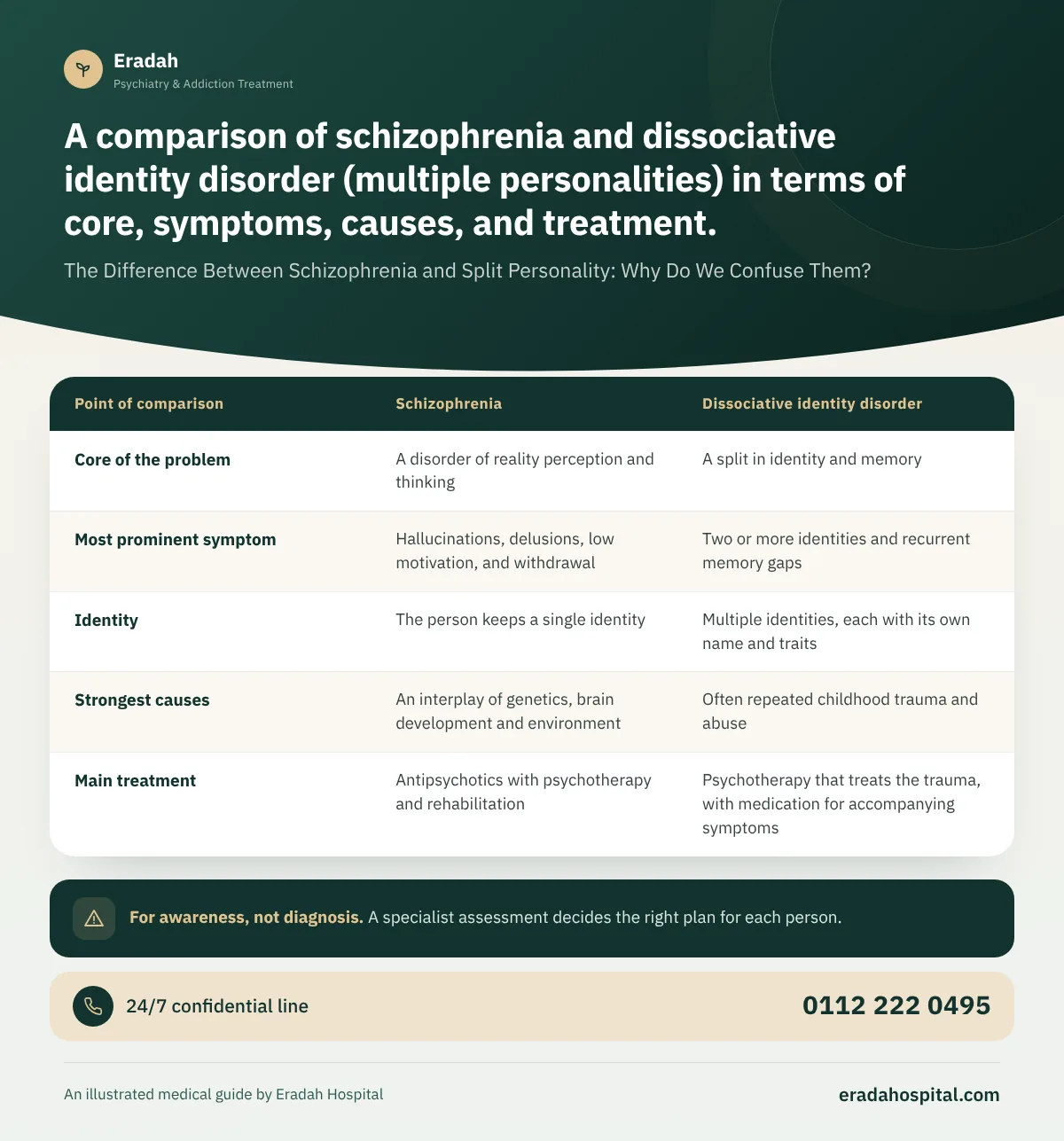
| Point of comparison | Schizophrenia | Dissociative identity disorder |
|---|---|---|
| Core of the problem | A disorder of reality perception and thinking | A split in identity and memory |
| Most prominent symptom | Hallucinations, delusions, low motivation, and withdrawal | Two or more identities and recurrent memory gaps |
| Identity | The person keeps a single identity | Multiple identities, each with its own name and traits |
| Strongest causes | An interplay of genetics, brain development and environment | Often repeated childhood trauma and abuse |
| Main treatment | Antipsychotics with psychotherapy and rehabilitation | Psychotherapy that treats the trauma, with medication for accompanying symptoms |
For more on the second disorder, its causes and treatment, see the guide to multiple personalities.
Why does telling them apart need an experienced psychiatrist?
Because the picture is not always as clear as in the table. A person with dissociative identity disorder may describe other identities “with their voices,” as the NHS notes, and this may be understood as auditory hallucinations. The NHS also notes that dissociative disorders may be accompanied by depression, anxiety, panic attacks, mood swings, and self-harm. Conversely, a person with schizophrenia may feel disconnected from their emotions and seem “a stranger to themselves.”
That is why the diagnosis is not built on one sentence or one scene, but on a detailed interview, a history of childhood and trauma, the pattern of symptoms over time, and ruling out drugs and physical causes. The NHS recommends seeing a doctor as soon as possible when schizophrenia symptoms appear, because early treatment is better.
How does this confusion harm patients?
- It reinforces the image of the “dangerous, unpredictable person” that films promote, while the NHS confirms that schizophrenia does not usually make a person violent.
- It delays seeking treatment: a family may wait for a “second personality” that never comes and ignore the hallucinations and withdrawal.
- It increases stigma: the World Health Organization notes that stigma, discrimination, and violations of the rights of people with schizophrenia are common.
- It confuses the patient too: he thinks he will “turn into” someone else, and fears his diagnosis more than he should.
What should you do if you suspect either one?
Do not try to diagnose from an online video. Observe what happens in detail and write it down: the voices, the strange ideas, memory gaps, changes in sleep and work, and any drug use. Then take it to a psychiatrist. If there is danger to the person or others, call ambulance (123).
At Eradah you can get a free, confidential first consultation to assess the condition, with residential treatment for men in the psychiatric hospital when needed, and outpatient follow-up afterward. Learn about the options in schizophrenia treatment.
Acute psychotic episode or suicidal thoughts? Get help now
- Voices commanding him to harm himself or others
- Severe agitation or threatening those around him out of suspicion or fear
- Memory gaps, with the person found in a dangerous place without knowing how he got there
- Talk of death or suicide, or self-harm
- Refusing food and drink, or severe neglect that threatens his health
Speak calmly in short sentences, do not argue with him or mock what he says, and remove sharp objects and medications without confrontation. Call ambulance (123) or go to the nearest emergency department if the danger is imminent. If he talks about death, do not leave him alone, and contact the mental health support line 16328, available around the clock.
Ambulance 123 Mental health support line 16328