Why do some people develop narcissistic personality disorder?
Personality disorders are understood today as the result of a temperament a person is born with, interacting with the environment of their upbringing and early experiences, producing a lasting way of seeing oneself and others. In narcissism, the pattern that forms protects the self-image at any cost.
Researchers describe the disorder as fragile self-esteem surrounded by strong defenses. The question about causes is, at its core, the question of why this person did not develop a stable sense of their own worth that does not waver with every criticism.
Is narcissistic personality disorder hereditary?
Twin studies indicate that narcissistic traits, and the disorder itself, have a clear genetic component, and some medical references describe the disorder as highly heritable. But heredity here means a predisposition, not a destiny: a child inherits a certain temperament, and the environment determines which direction it develops in.
This is why one child may show clear narcissistic features while siblings raised in the same home do not, because each child is born with a different temperament and interacts with the family in a different way.
What is the role of temperament and the brain?
Studies link the disorder to temperament traits such as novelty and thrill seeking, low fear of consequences, and a strong need for reward and attention. Early brain imaging research also points to differences in brain regions linked to empathy and emotional regulation, but these remain research findings and are not used for diagnosis.
Does parenting create a narcissistic person?
Parenting is an important factor but not the only one. Medical references describe patterns that seem contradictory but share one thing: the child is not seen as they are.
Always telling the child they are better than others and special above everyone, without tying appreciation to real effort, so the child builds an inflated image that is hard to sustain.
Sparing the child any frustration or responsibility, so they never learn to tolerate disappointment or consider other people's needs.
A lack of warmth and genuine attention, so the child learns that their worth depends on impressing others.
Constant comparison and mockery, so the child builds a shield of grandiosity to protect themselves from feeling inadequate.
The common thread in these patterns is that the child's love becomes conditional on a certain image: being outstanding, impressive or obedient, rather than being loved for who they are.
How are childhood traumas linked to narcissism?
Some studies link the disorder to early experiences such as rejection, neglect, abuse or the loss of a parent, especially in the vulnerable form. This is understood to mean that a child who has suffered intense pain may build an inflated self-image as a way of surviving the feeling of weakness.
But trauma is not a requirement: many people with the disorder did not go through obvious trauma, and most people who did go through trauma do not develop it. This is why we speak of risk factors, not direct causes.
How does attachment theory explain this pattern?
Many psychological schools hold that a child builds their image of themselves from its reflection in the eyes of their caregivers. If the reflection is sometimes exaggerated and sometimes absent, the child does not develop a stable sense of their worth, and keeps looking for it in other people's admiration throughout life. This explanation helps us understand why people with the disorder are so pained by being ignored, and why treatment focuses on building an inner sense of worth.
Do society and culture play a role?
Some researchers believe that cultures that elevate appearance, status and individual success may reinforce narcissistic traits, and the same question is raised about social media, which rewards visibility and likes. But the evidence here is still limited, and it cannot be said that social media causes the disorder, although it may feed traits that already exist.
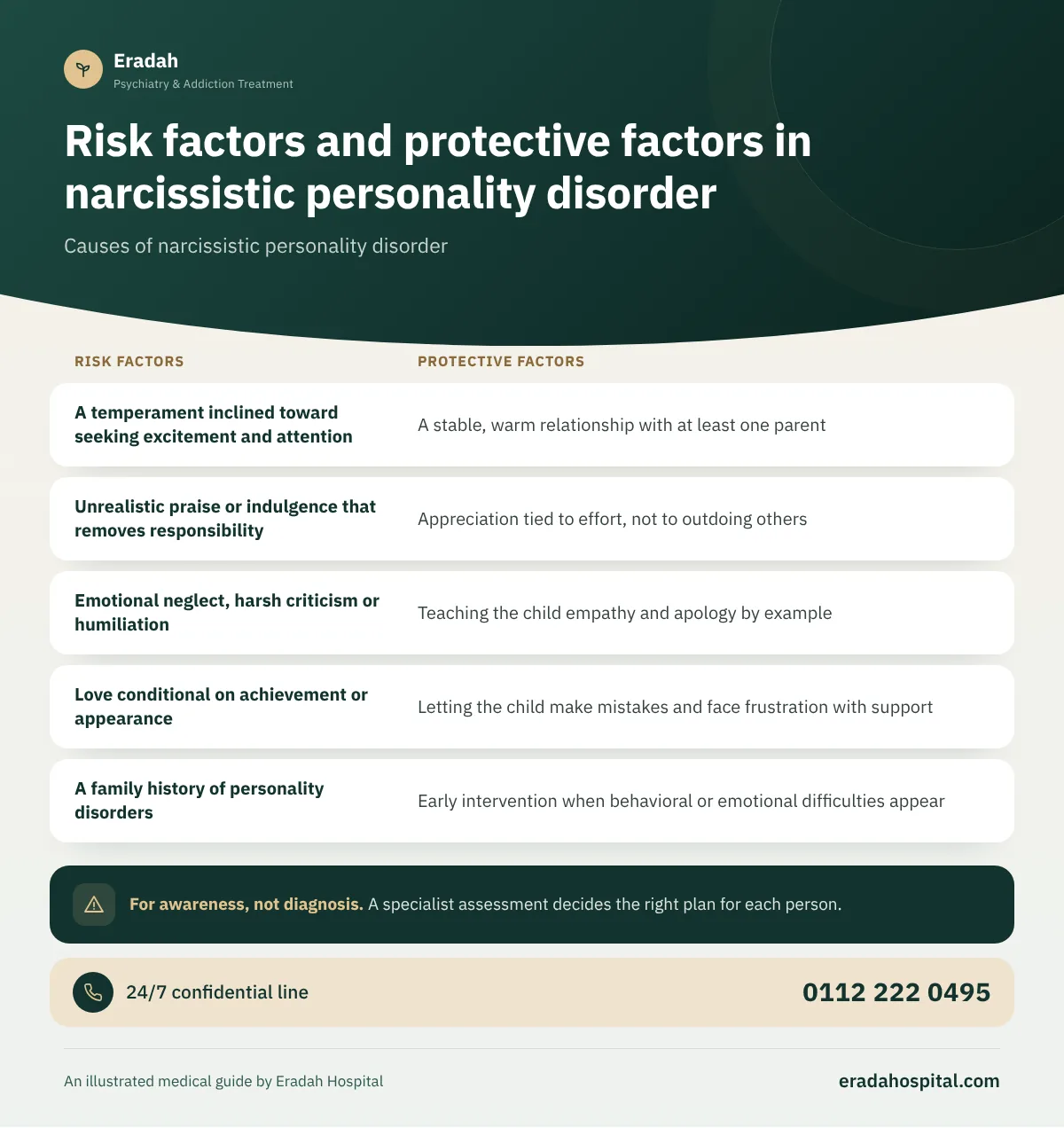
What are the risk factors and protective factors?
| Risk factors | Protective factors |
|---|---|
| A temperament inclined toward seeking excitement and attention | A stable, warm relationship with at least one parent |
| Unrealistic praise or indulgence that removes responsibility | Appreciation tied to effort, not to outdoing others |
| Emotional neglect, harsh criticism or humiliation | Teaching the child empathy and apology by example |
| Love conditional on achievement or appearance | Letting the child make mistakes and face frustration with support |
| A family history of personality disorders | Early intervention when behavioral or emotional difficulties appear |
What is the difference between a cause and a trigger?
The cause is what forms the pattern over the years, while a trigger is what makes the pattern show up strongly at a particular moment. Common triggers include losing a job or position, a breakup, aging, illness, or any situation that touches the self-image in front of others. Understanding triggers helps the family anticipate crises and prepare for them.
Common myths about the causes of narcissism
- “The mother is always to blame”: wrong. The causes are multiple and include genetics, temperament and circumstances, and blaming one party helps no one.
- “The narcissist chose to be this way”: the pattern forms gradually from childhood without a conscious decision, but the adult is responsible for their actions and for seeking treatment.
- “Narcissism is contagious”: it is not passed on through contact, although children do learn ways of dealing with others from the adults around them.
- “Social media created a narcissistic generation”: it may feed existing traits, but the evidence does not show that it causes the disorder.
Can narcissism be prevented in child-rearing?
There is no guaranteed recipe, but what specialists know about personality development suggests that a child needs unconditional love, realistic appreciation of their effort, clear limits, opportunities to tolerate frustration, and a role model in empathy and apology. If you notice persistent difficulty with empathy or accepting loss in your child, consulting a child psychologist is a helpful early step.