Why does the disorder cause so much harm?
The constant need to protect the self-image consumes enormous energy, and leads the person to see relationships through what they give them in admiration and security. Over time, both the person and those around them pay the price of this pattern.
The irony is that the behavior meant to protect self-esteem is the very thing that destroys it: relationships that collapse, jobs that are lost, and loneliness that grows all feed the inner sense of failure.
How does the disorder affect marriage and romantic relationships?
The relationship often begins with intense enthusiasm and admiration, then disappointment sets in when it becomes clear that the partner is a human being with their own needs and flaws. This can turn into constant criticism, coldness, jealousy and control, or infidelity in search of fresh admiration.
- Erosion of the partner's self-confidence: caused by constant belittling and blaming the partner for every disagreement.
- Isolation of the partner: when they are gradually pushed away from their family and friends.
- Cycles of breaking up and getting back together: which drain both people emotionally and financially.
- Psychological or physical abuse in some cases: this is not an inevitable part of the disorder, but it does happen and calls for protection.
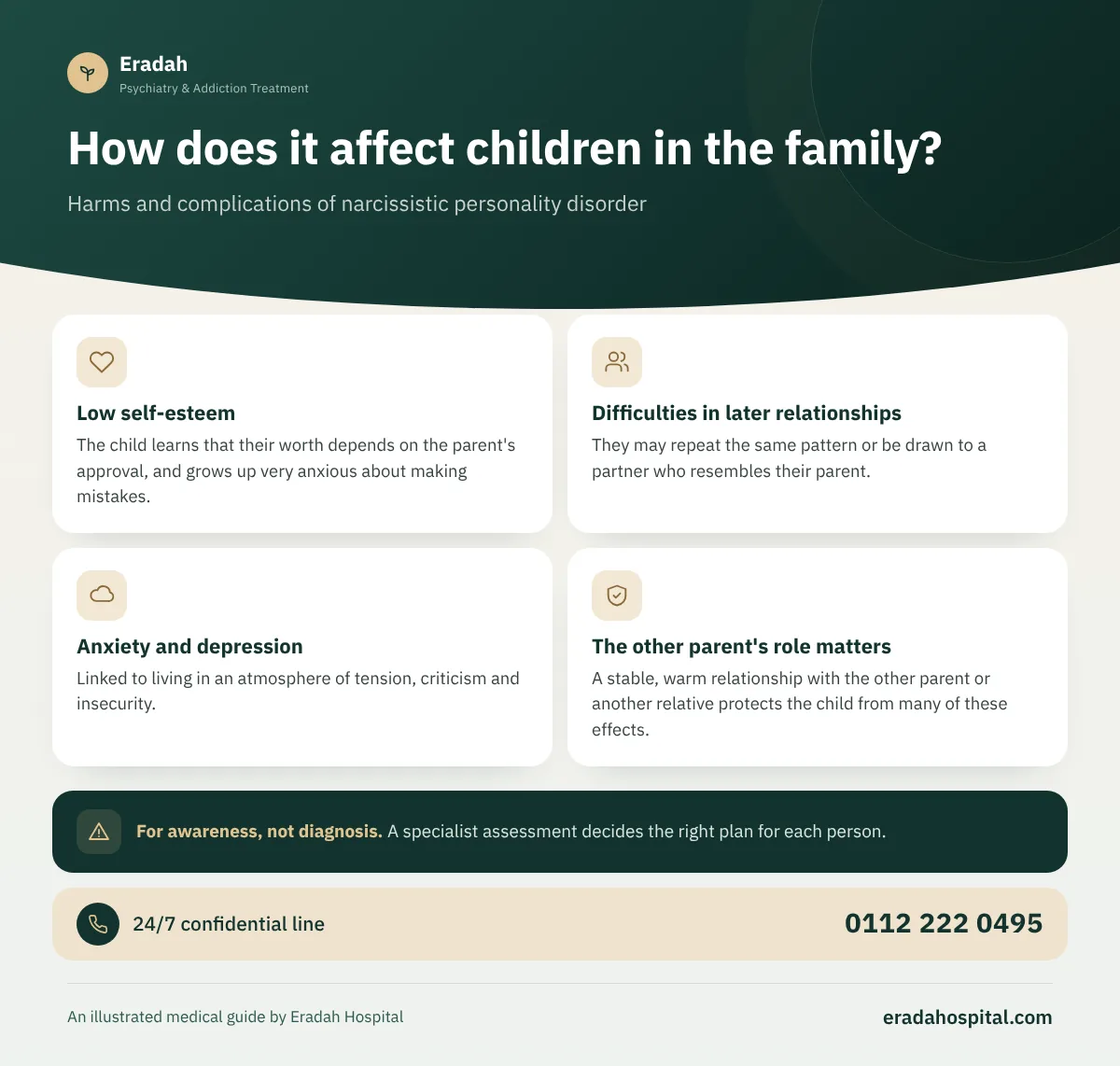
How does it affect children in the family?
Children who grow up with a parent who has this pattern and is untreated may face love that is conditional on achievement, disregard for their feelings, or being used as an extension of the parent's image in front of others. Siblings may be compared, so that one becomes “the favorite” and the other “always in the wrong.”
The child learns that their worth depends on the parent's approval, and grows up very anxious about making mistakes.
They may repeat the same pattern or be drawn to a partner who resembles their parent.
Linked to living in an atmosphere of tension, criticism and insecurity.
A stable, warm relationship with the other parent or another relative protects the child from many of these effects.
How does it affect work and money?
Some people with the disorder succeed professionally thanks to ambition and boldness, but many face clashes with managers and colleagues, difficulty working in a team, and leaving jobs after any sense of humiliation. A sense of entitlement can also lead to reckless financial decisions or spending on appearances beyond what they can afford, piling crises onto the family.
What psychological toll does it take on the partner and those close to the person?
Living for a long time with constant criticism and swings between admiration and belittling leaves a clear mark on the partner: constant anxiety, self-doubt and doubt about their own memory, insomnia, guilt, and sometimes depression. The partner often reaches the psychiatric clinic before the person with the disorder does, which is understandable and deserves attention in its own right.
Does a person with narcissistic personality disorder suffer from depression?
Yes. Depression is among the most common accompanying conditions, especially when the image of success collapses through professional failure, a breakup or aging. Depression may take the form of anger, bitterness and a sense of injustice more than obvious sadness, so the family may not notice it.
Anxiety, sleep problems and a chronic sense of emptiness also accompany it, and these co-occurring conditions can intensify reactions. Learn more about depression.
Does the disorder increase the risk of addiction?
Medical references indicate that substance misuse is common among people with the disorder, and some name cocaine and stimulants in particular, because they give a temporary sense of power and superiority that matches the inflated self-image. Others turn to alcohol or sedatives to dull the emptiness and shame after setbacks.
Addiction increases impulsivity and anger and weakens self-control, so family and work problems multiply. Treating both conditions together in a single dual diagnosis program is the most successful route, and it is one of Eradah's core areas of expertise.
Is there a risk of suicide among people with the disorder?
Despite the confident image, a person with the disorder may go through acute crises after a major loss, a public humiliation, a financial collapse or a breakup, because their self-image suddenly collapses. At such moments thoughts of death may appear, and alcohol or drugs can increase the risk.
These crises can be survived with the right help. If your relative talks about death or seems hopeless after a crisis, take it seriously, stay with them, and seek help right away through 123 or the mental health support line 16328.
What happens with age if the disorder is neglected?
| Aspect | Without treatment | With treatment |
|---|---|---|
| Relationships | Repeated breakups and growing isolation | More stable relationships and the ability to repair them |
| Work | Clashes and moving between jobs | A better ability to accept guidance and work as a team |
| Mood | Depression and bitterness with the loss of status or youth | Better acceptance of limits and change |
| Substances | Higher risk of misuse | Integrated treatment reduces relapse |
Can complications be avoided?
Yes, to a large extent. Early assessment when depression, addiction or relationship crises appear, commitment to psychological treatment, and clear boundaries within the family all reduce the harm to the person and to those around them. A family that has been harmed also deserves support, even if the person refuses treatment. Learn about the options on the treatment of narcissistic personality disorder page.
Suicidal thoughts or danger to yourself or others? Get help now
- Talk of wanting to die or that life is no longer worth it after a loss, failure or scandal
- Severe despair and a relentless sense of humiliation and shame, with sudden withdrawal from people
- Saying goodbye to loved ones, giving away important belongings, or writing farewell notes
- Overwhelming anger with an explicit threat to harm themselves, a partner or children
- Sudden heavy use of alcohol or drugs after a personal or professional crisis
Do not leave the person alone, listen calmly without arguing or blame, and generally keep dangerous items out of their reach. Call the ambulance on 123 or go to the nearest emergency room, or call the mental health support line on 16328, available around the clock. If the danger is directed at you or your children, first move to a safe place and then ask for help.
Ambulance 123 Mental health support line 16328
16How does it affect friendships and social life?
A person with the disorder may draw people in at first with their presence and confidence, but friendships wear away over time as friends feel the relationship runs in one direction only. With repeated breaks, they end up surrounded by a changing circle of acquaintances instead of old friends who know them well, which is among the things that most increase loneliness in midlife.
Relationships with parents and siblings may also become strained through rivalry or disputes over inheritance and status, and the family sometimes splits into camps, with children and grandchildren paying the price of this division.