Who is the narcissistic husband?
“In front of people he's the perfect husband, and at home everything is wrong because of me. If I talk about being upset, he says I'm imagining it or blowing things up, and if I criticize him, he turns the world upside down.” This is how many wives describe life with what is called a “narcissistic husband.”
The word “narcissist” has come to be used a lot on social media to describe any selfish or difficult person. But narcissistic personality disorder is a specific psychiatric diagnosis, which Cleveland Clinic estimates affects between 0.5% and 5% of people in the United States, and it notes that 50% to 75% of cases are male. Many husbands have narcissistic traits without reaching the level of a disorder. And you do not need a diagnosis for your husband to know that what you are living through is hurting you, nor to set boundaries.
You will find a general explanation of dealing with a narcissistic person at work and in the family in dealing with a narcissist. Here we focus on marriage specifically: the shared home, the children and the hard decision.
What are the traits of a narcissistic husband in daily life?
Cleveland Clinic lists these traits of the disorder: an inflated sense of importance, an excessive need for admiration, a sense of entitlement and expecting special treatment, anger when this is not met, exploiting others, and little empathy. At home it may look like this:
His needs, schedule and mood set the rhythm of the whole household.
Comments that put down your looks, intelligence or family, sometimes disguised as “joking.”
Any remark turns into an attack or a long punishing silence.
Your illness, sadness or exhaustion does not stir real concern in him.
Denying what he said or did, and convincing you that you remember wrongly.
Charming and likable outside, harsh at home.
Doubting your perception: why do you feel you are losing confidence in yourself?
Cleveland Clinic describes how some people with narcissistic personality disorder resort to what is known as gaslighting, that is, trying to convince you that you or they said or did something different from what happened, in order to undermine the boundaries you set. With repetition, the wife begins to doubt her memory and her judgment of things.
The same source advises keeping notes or a journal if you need to check later what was said or happened. Calm documentation is not meant for revenge but to protect your perception from confusion, and it may help when consulting a professional or a lawyer.
An ordinary marital dispute, a narcissistic pattern, or abuse?
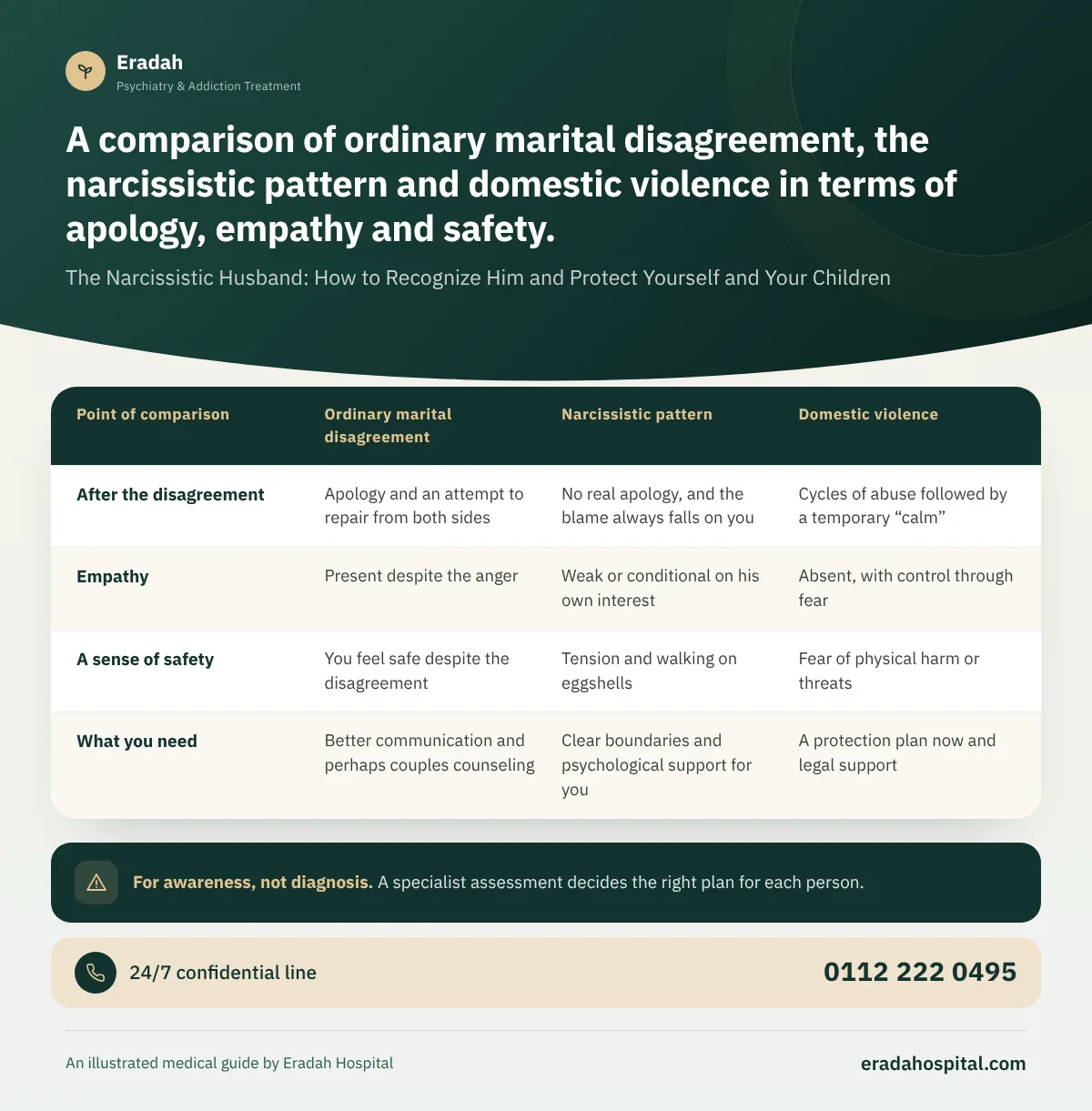
Every marriage has disagreements and moments of selfishness. The real difference shows in what happens after the disagreement:
| Point of comparison | Ordinary marital disagreement | Narcissistic pattern | Domestic violence |
|---|---|---|---|
| After the disagreement | Apology and an attempt to repair from both sides | No real apology, and the blame always falls on you | Cycles of abuse followed by a temporary “calm” |
| Empathy | Present despite the anger | Weak or conditional on his own interest | Absent, with control through fear |
| A sense of safety | You feel safe despite the disagreement | Tension and walking on eggshells | Fear of physical harm or threats |
| What you need | Better communication and perhaps couples counseling | Clear boundaries and psychological support for you | A protection plan now and legal support |
Is every narcissistic husband violent?
No, but the risk deserves attention. An analysis published in the journal Trauma, Violence, & Abuse in 2024 pooled the results of 22 studies covering 11,520 people and found a weak positive relationship between narcissistic traits and perpetrating intimate partner violence. It was clear for psychological and online abuse, while the relationship with physical violence was not statistically significant. That is, insults, control and stalking by phone are more closely linked to narcissism than hitting is, although hitting is possible.
The World Health Organization states that about a quarter of women (25.8%) aged 15 to 49 who have ever been in a relationship have experienced physical or sexual violence from a husband or partner at least once in their lives. If any threat or violence appears, this is no longer a difficult personal matter but a matter of safety.
How do you deal with a narcissistic husband day to day?
Cleveland Clinic advises anyone dealing with a person who has narcissistic personality disorder to set healthy boundaries, make clear what you will and will not accept, and stick to them, because giving in to their demands does not help and may make things worse. Practical steps include:
- Short, calm replies in disagreements, without long explanations or defending yourself on every point.
- Specific boundaries with a clear consequence: “If he raises his voice at me, I'll leave the room and we'll continue later.”
- Staying connected with your family and women friends, and having a source of income or a financial plan if possible.
- Not building your worth on his opinion of you, and holding on to what you know about yourself.
- Calm documentation of important incidents, with dates.
Children in a home with a narcissistic father
Children learn from the way people talk at home more than from what they are told. Try not to make them a party to the disagreement or messengers between you, and give them a safe space to express their feelings without having to choose a side. If you notice severe anxiety, withdrawal or aggression in one of them, consult a specialist. If the children are being harmed, you can contact the Child Helpline on 16000.
Does the narcissistic husband change? And when should you seek help for yourself?
Change is possible when he acknowledges the problem and accepts psychological treatment, which is the foundation of narcissistic personality disorder treatment. But Cleveland Clinic notes that people with the disorder are more likely to leave treatment early, and the UK's National Health Service (NHS) explains that personality disorders are mainly treated with psychotherapy over a long period. So do not leave your life hanging on waiting for a change he is not seeking.
The decision to stay or separate is yours, and it deserves calm thought with a professional and a lawyer before any step that concerns custody and alimony. This is general awareness information and not legal advice. At Eradah you can get a free, confidential first consultation to understand what you are going through, with guidance to the support that suits you. If your husband accepts help, he can start treatment in the outpatient clinics, or in residential treatment for men if addiction accompanies this.
Violence or threats at home? Your safety comes first
- Hitting, pushing, or threats to harm you or the children
- Being prevented from going out, contacting your family, or accessing documents and money
- Threatening suicide to pressure you or stop you from leaving
- Breaking things or holding a sharp object during anger
- A constant feeling of fear of his reaction
In immediate danger, call the police emergency line (122) or the ambulance (123), move to a safe place with the children, and tell someone you trust. You can contact the National Council for Women's complaints line on 15115, and the Child Helpline on 16000 for matters concerning children. If you yourself feel despair or have thoughts of death, contact the mental health support line 16328.
Ambulance 123 Mental health support line 16328