Can narcissistic personality disorder be treated?
Yes, it can improve noticeably, although treatment is longer and harder than for many other psychiatric conditions. Improvement means calmer relationships, better tolerance of frustration, and a greater ability to see other people.
Medical references describe the disorder as one that does not go away on its own, and say that treatment improves quality of life and functioning more than it erases the features completely. This realistic goal matters for the patient and the family, so that treatment is not judged a failure because of exaggerated expectations.
How does treatment begin?
Most patients come because of a crisis: depression, a collapsing marriage, a problem at work, or addiction. The doctor begins with a comprehensive assessment covering personal and family history, co-occurring conditions, substance use and level of risk. Then the doctor agrees with the patient on goals the patient themselves considers important, because feeling that treatment is imposed on them often leads them to quit.
What types of psychotherapy are used?
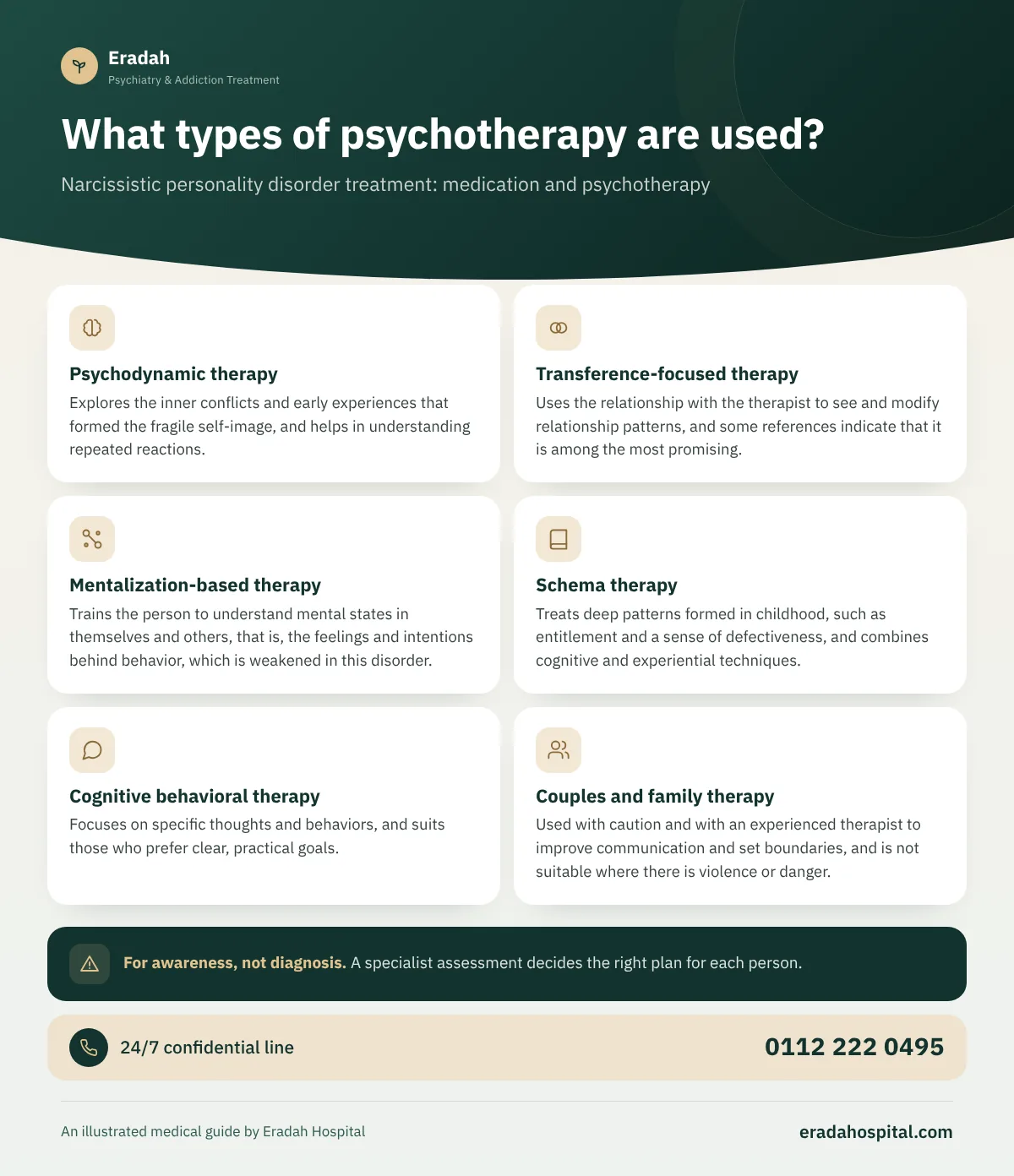
Explores the inner conflicts and early experiences that formed the fragile self-image, and helps in understanding repeated reactions.
Uses the relationship with the therapist to see and modify relationship patterns, and some references indicate that it is among the most promising.
Trains the person to understand mental states in themselves and others, that is, the feelings and intentions behind behavior, which is weakened in this disorder.
Treats deep patterns formed in childhood, such as entitlement and a sense of defectiveness, and combines cognitive and experiential techniques.
Focuses on specific thoughts and behaviors, and suits those who prefer clear, practical goals.
Used with caution and with an experienced therapist to improve communication and set boundaries, and is not suitable where there is violence or danger.
No single approach has been conclusively shown to be superior, and what matters most is the therapist's experience with this pattern and their ability to build a therapeutic alliance without confrontation or capitulation.
Are there medications to treat narcissism?
There is no approved medication for narcissistic personality disorder itself. But the psychiatrist may prescribe medication to treat what accompanies it:
- Antidepressants: when there is clear depression or anxiety.
- Mood stabilizers or others: in specific cases of severe mood swings or impulsivity, at the doctor's discretion.
- Addiction treatment medications: as part of the treatment plan for co-occurring substance use, if present.
How long does treatment take?
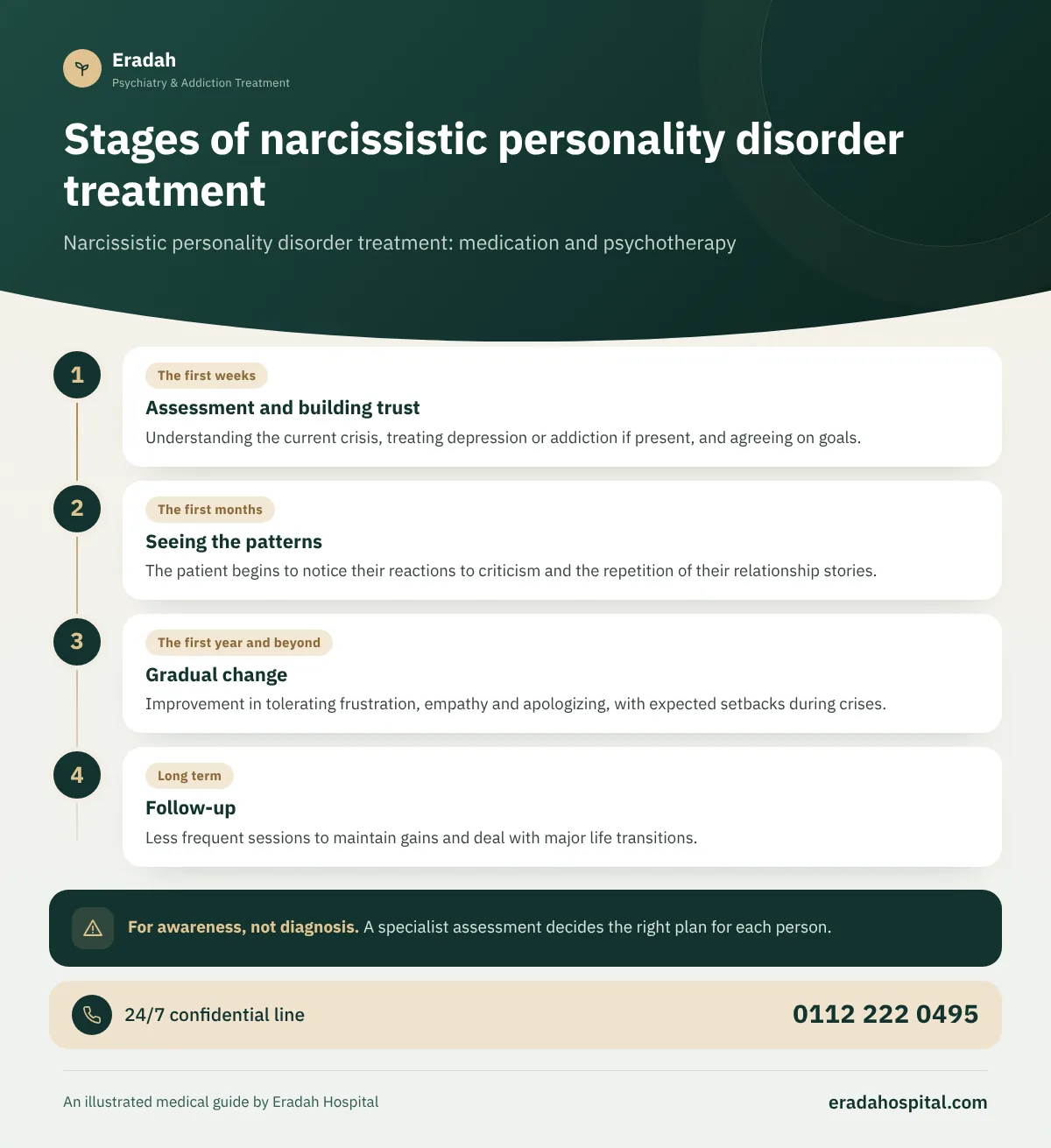
- The first weeksAssessment and building trust
Understanding the current crisis, treating depression or addiction if present, and agreeing on goals.
- The first monthsSeeing the patterns
The patient begins to notice their reactions to criticism and the repetition of their relationship stories.
- The first year and beyondGradual change
Improvement in tolerating frustration, empathy and apologizing, with expected setbacks during crises.
- Long termFollow-up
Less frequent sessions to maintain gains and deal with major life transitions.
Psychotherapy for personality disorders is usually long and may extend for a year or more. Treatment may be short and focused during crises, then continue for those who want deeper change.
What if there is co-occurring addiction or depression?
Treatment starts with whatever is most dangerous: severe depression, thoughts of death, or dependence on alcohol or stimulants is treated first or in parallel, because working on the personality pattern does not succeed in the middle of an acute crisis or ongoing substance use. Then psychotherapy for the personality continues to reduce the likelihood of relapse, because the feeling of humiliation or emptiness is among the strongest triggers for returning to the substance.
How do you know treatment is making progress?
- Apologizing becomes possible, even if late.
- The intensity and duration of anger after criticism decrease.
- They ask about the feelings of those close to them and remember details about them.
- A relationship or job lasts longer than usual.
- They talk about feelings of shame or fear instead of hiding them behind arrogance.
Why do many patients leave treatment, and how do we prevent that?
One of the biggest challenges of treatment is that the patient may feel insulted by the therapist's comments, or feel they no longer need treatment once the crisis passes. To reduce this:
- Linking treatment to goals the patient wants for themselves, such as saving their marriage or their professional success.
- An experienced therapist who respects the patient without flattering them or entering into conflict with them.
- Discussing feelings of frustration with treatment openly within sessions.
- Involving the family carefully when needed and with the patient's consent.
When does a patient need inpatient care?
Most patients are treated in outpatient clinics. But inpatient care may be necessary when there is a risk of suicide or violence, addiction that needs medically supervised detox, or severe depression that prevents the person from performing the simplest tasks. Egypt's Mental Health Care Law No. 71 of 2009 sets out in general terms the patient's rights and the rules for admission.
This is general educational information and not legal advice.
How can the family help with treatment?
The family's role is not to convince the patient that they are a “narcissist,” as this usually provokes them, but to encourage them to seek help for a difficulty they themselves acknowledge, such as stress, insomnia or disputes. It also helps the family to get psychological support of their own and to keep consistent boundaries. For more, see how to deal with a narcissistic person.
Choosing a hospital for narcissistic personality disorder treatment
The first difficulty in treating narcissistic personality disorder is not the type of treatment but staying in it; the patient is highly sensitive to criticism and may leave the therapist at the first sense of being belittled or unappreciated. For this reason, the right place is not measured by the luxury of its building but by the experience of its therapists in long-term personality treatment and their ability to build a stable therapeutic relationship that withstands moments of anger and withdrawal. When comparing providers, look for:
- Therapists trained in psychodynamic therapy, schema therapy or mentalization-based therapy, not general advice sessions.
- A plan that starts from the distress the patient acknowledges, such as insomnia, stress or disputes, rather than confronting them with the diagnosis.
- An assessment for depression and thoughts of death, since a collapse of self-image after a failure or loss can be a moment of danger.
- A clear approach to alcohol or stimulants, if present, before deep work on the personality.
- Continuity with the same therapist as far as possible, because switching undoes what has been built.
At Eradah, individual and group psychotherapy sessions are led by specialists, and the doctor follows any co-occurring depression or addiction within a dual diagnosis plan. Outpatient treatment suits most cases, while residential care is reserved for acute crises and is available to men only. The first consultation is free and confidential, and a family member can start it. To reach us around the clock: 01122220495 by phone or WhatsApp, or request your first consultation.
How does treatment work at Eradah?
At Eradah, treatment begins with a comprehensive psychiatric assessment by a psychiatrist, covering depression, anxiety, substance use and level of risk. An individual plan is then built that combines the appropriate psychotherapy and treatment for co-occurring addiction, if present, within the dual diagnosis program, with family sessions and follow-up after discharge, all in complete confidentiality.