What core features does the doctor look for?
Diagnostic guides such as the DSM-5 group the features of narcissistic personality disorder into nine items, and the doctor requires at least five of them to be present consistently since early adulthood and in multiple situations, not in a single relationship or a passing period of stress.
| Feature | What it looks like in real life |
|---|---|
| Exaggerated sense of importance | Inflates their achievements and expects to be treated as superior even without matching accomplishments |
| Preoccupation with fantasies of success and power | Talks a lot about success, influence, beauty or an ideal love that awaits them |
| Belief that they are special | Believes that only people or institutions of high standing can understand them |
| Excessive need for admiration | Constantly seeks praise and is upset when attention shifts to someone else |
| Sense of entitlement | Expects special treatment and that their wishes will be met automatically without waiting |
| Exploiting others | Uses people to reach their goals without much regard for what it costs them |
| Lack of empathy | Finds it hard to see or care about other people's feelings or needs |
| Envy | Envies others or believes they envy them |
| Arrogance and haughtiness | Acts superior or dismissive toward those they see as beneath them |
Having one or two features from this list is very common among people and means nothing on its own. What makes the difference is several features occurring together, their persistence, and their effect on the person's life and the people around them.
Emotional signs: what is happening beneath the surface?
- Extreme sensitivity to criticism: a simple remark may be taken as an insult, and they respond with anger, sarcasm or a punishing silence.
- A sense of emptiness and boredom: especially when admiration is absent or excitement fades.
- Hidden shame: it rarely shows openly, but it drives many defensive reactions.
- Fluctuating self-esteem: between a sense of grandeur and a sense of inadequacy, depending on what is happening around them.
- Difficulty apologizing: admitting a mistake threatens their self-image, so they look for a justification or someone else to blame.
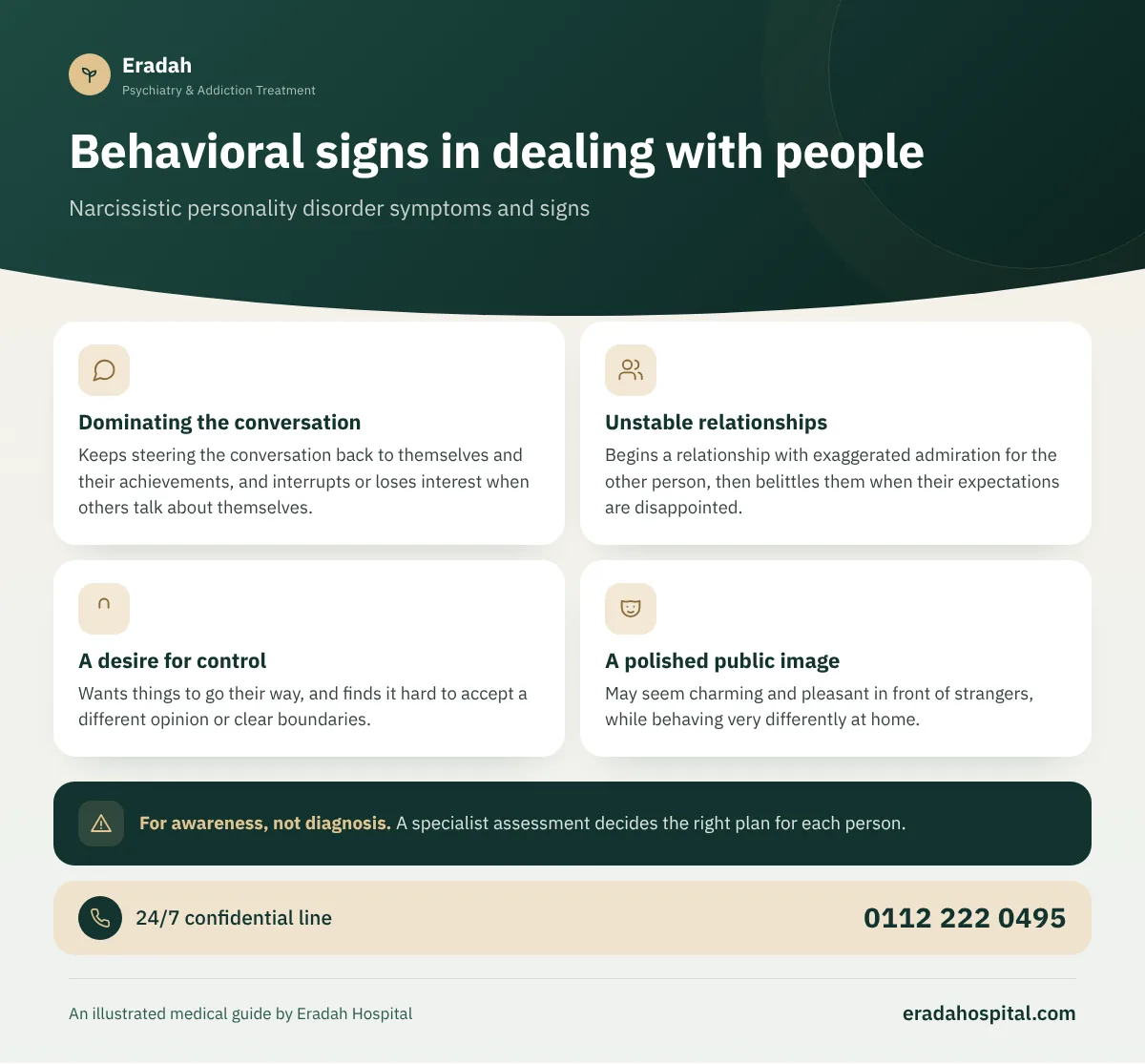
Behavioral signs in dealing with people
Keeps steering the conversation back to themselves and their achievements, and interrupts or loses interest when others talk about themselves.
Begins a relationship with exaggerated admiration for the other person, then belittles them when their expectations are disappointed.
Wants things to go their way, and finds it hard to accept a different opinion or clear boundaries.
May seem charming and pleasant in front of strangers, while behaving very differently at home.
How do the signs of grandiose narcissism differ from vulnerable narcissism?
| Aspect | Grandiose form | Vulnerable form |
|---|---|---|
| Social presentation | Confident, dominant, loves the spotlight | Shy, reserved or anxious |
| Reaction to criticism | Open anger or counterattack | Crushed, withdrawn, long-lasting bitterness |
| Need for admiration | Asks for it openly | Wishes for it in secret and suffers in its absence |
| Dominant mood | Enthusiasm and boasting | Sadness, distress or a sense of injustice |
| How others see them | Arrogant or domineering | Very sensitive or complaining |
The vulnerable form is often wrongly diagnosed as only depression or social anxiety, because the person does not seem arrogant. But a careful assessment reveals the same need for admiration and sense of entitlement behind the shyness.
What do the signs look like to family and partners?
Those close to the person often notice the signs before the person does, and they show up in the details of daily life more than in big moments:
- Feeling that you are “walking on eggshells” for fear of triggering their anger.
- Never being asked about your feelings or your day, while full attention to their feelings is expected.
- Reinterpreting disagreements so that you are always the one at fault.
- A completely different image in front of people than at home.
- Belittling your achievements or competing with you instead of being happy for you.
How do the signs show up at work and in studies?
At work the person may seem ambitious and persuasive and reach leadership positions, but repeated difficulties appear: taking credit for others' work, difficulty accepting guidance, clashes with colleagues, and a collapse in enthusiasm when the expected recognition is not received. They may suddenly leave jobs or projects if they feel humiliated.
Do the signs differ between men and women and across ages?
The grandiose form is diagnosed more in men, while in women the vulnerable form or an excessive focus on appearance and social standing may appear, and is sometimes missed. In teenagers it is better to speak of traits rather than a disorder, because many of them fade with maturity.
With age some of the outward features may calm down, but losing beauty, position or health can be especially hard on someone with this pattern, and depression, bitterness or withdrawal may appear.
When are the signs mild and when are they severe?
| Level | What it looks like | Effect |
|---|---|---|
| Mild | Clear narcissistic traits with an ability to apologize and adjust at times | Repeated disagreements, but relationships and work continue |
| Moderate | A stable pattern affecting most relationships, with sharp reactions to criticism | Troubled relationships and frequent job changes |
| Severe | Clear exploitation and repeated anger, which may come with violence, addiction or severe depression | Major harm to the family and crises that need urgent intervention |
Self-reflection questions: do I need an assessment?
These questions help you reflect on yourself, and are not a diagnosis and are not suitable for assessing another person:
- Does any criticism cause me pain or anger far greater than the situation deserves?
- Does the same story repeat in my relationships: great admiration, then disappointment, then a break?
- Is it hard for me to be genuinely happy about the success of people close to me?
- Do I feel a deep emptiness or boredom when no one notices me?
- Has more than one close person told me that I do not see their feelings?
If you answered yes to several questions and this has continued for years, talking to a doctor or therapist may open the door to calmer relationships and deeper satisfaction. Learn about the steps on the narcissistic personality disorder treatment page.
Suicidal thoughts or danger to yourself or others? Get help now
- Talk of wanting to die or that life is no longer worth it after a loss, failure or scandal
- Severe despair and a relentless sense of humiliation and shame, with sudden withdrawal from people
- Saying goodbye to loved ones, giving away important belongings, or writing farewell notes
- Overwhelming anger with an explicit threat to harm themselves, a partner or children
- Sudden heavy use of alcohol or drugs after a personal or professional crisis
Do not leave the person alone, listen calmly without arguing or blame, and generally keep dangerous items out of their reach. Call the ambulance on 123 or go to the nearest emergency room, or call the mental health support line on 16328, available around the clock. If the danger is directed at you or your children, first move to a safe place and then ask for help.
Ambulance 123 Mental health support line 16328