How is paranoia treated?
The hardest part of treating paranoia is that the person rarely asks for it; they do not see the problem in their thoughts but in “the people who are plotting against them.” This is why treatment often starts from a different entry point, such as insomnia, tension, or problems at work and at home, and is then built up gradually on trust.
The first rule is that paranoia is treated by treating its cause. There is no “medicine for suspicion” that suits everyone; the doctor first determines whether it is part of psychosis, a personality disorder, the effect of a drug, the result of insomnia and stress, or a sign of dementia, and then draws up a plan accordingly.
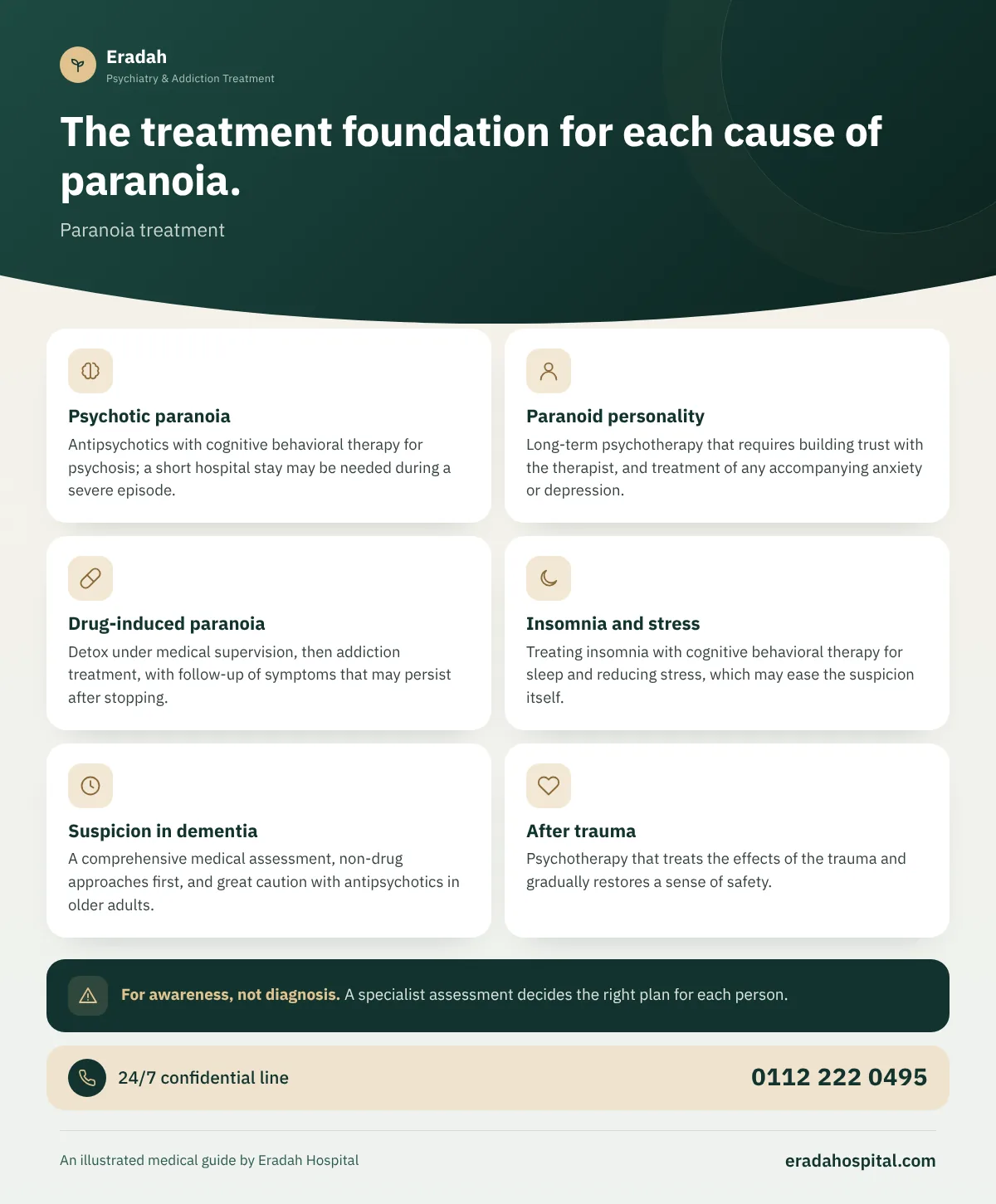
How is paranoia treated according to its cause?
Antipsychotics with cognitive behavioral therapy for psychosis; a short hospital stay may be needed during a severe episode.
Long-term psychotherapy that requires building trust with the therapist, and treatment of any accompanying anxiety or depression.
Detox under medical supervision, then addiction treatment, with follow-up of symptoms that may persist after stopping.
Treating insomnia with cognitive behavioral therapy for sleep and reducing stress, which may ease the suspicion itself.
A comprehensive medical assessment, non-drug approaches first, and great caution with antipsychotics in older adults.
Psychotherapy that treats the effects of the trauma and gradually restores a sense of safety.
How does cognitive behavioral therapy help with paranoia?
Researcher Daniel Freeman holds that persecutory delusions persist because of factors that can be worked on: excessive worry, low self-confidence, difficulty tolerating the feeling of anxiety, jumping to conclusions, and safety behaviors. So treatment is built on reducing these factors first, and then gradually entering feared situations so the person discovers for themselves that they are safe.
This approach was tested in a randomized trial published in Lancet Psychiatry in 2021 on 130 patients with persistent persecutory delusions. The “Feeling Safe Programme,” delivered over six months, led to a clear reduction in the strength and severity of the delusion compared with friendly supportive sessions given by the same therapists, and the researchers described this as one of the largest treatment effects recorded for these conditions.
In cognitive therapy the therapist does not tell the patient “you are wrong”; the two explore the evidence, the alternatives and the situations together, at a pace that suits the patient. British guidelines (NICE) recommend offering cognitive behavioral therapy to everyone with psychosis.
Does treating insomnia and anxiety ease paranoia?
Yes, in many cases. In the OASIS trial, which included 3,755 university students with insomnia at 26 British universities, digital cognitive behavioral therapy for insomnia reduced paranoid thoughts and hallucinations compared with usual care, and improved sleep was the mediator of this change. Although the effect on paranoia was small, the study supports giving insomnia treatment a higher priority.
Likewise, chronic anxiety feeds suspicion; a person who lives expecting the worst picks up signs of threat more easily. This is why treatment often includes training in reducing preoccupation with worry and accepting uncomfortable feelings without running from them.
What is the role of medication in treating paranoia?
When paranoia is part of psychosis or schizophrenia, antipsychotics are a core part of treatment, and the doctor decides the type, dose and duration according to the case. In paranoid personality disorder, psychotherapy remains the foundation, and the doctor may use medication for accompanying symptoms such as anxiety or depression at their discretion.
With older adults who have dementia, the Alzheimer’s Association cautions that antipsychotics are linked to an increased risk of stroke and death, and that non-drug approaches are the first line, so medication is used only when symptoms are severe and after weighing the risks with the doctor.
How is drug-induced paranoia treated?
If paranoia appears with crystal meth (shabu), cannabis or others, continuing to use means more paranoia and harder recovery. Treatment often begins with detox under medical supervision, then treatment of the addiction itself, with psychological follow-up because suspicions can last weeks after stopping. You will find the details of this path on the page about treating drug-induced psychosis, and when substance use coexists with a mental illness, the dual diagnosis program is the most suitable.
How do you deal with a person who has paranoia?
Dealing with someone with paranoia calls for patience and clarity more than arguments. These practical rules help families:
- Don’t argue about the idea itself: trying to prove they are wrong makes them see you as part of the plot.
- And don’t agree with it: agreeing strengthens the belief; it is enough to say, “I don’t see it that way, but I can see you are afraid.”
- Empathize with the feeling: the fear is real to them even if its cause is not real.
- Be clear and consistent: whispering, vagueness and unexplained actions feed suspicion, so explain what you are doing and why.
- Respect their space: do not search their belongings or watch them openly, as that confirms their sense of being targeted.
- Start from what troubles them: insomnia, tension or work problems are an easier way into seeing a doctor than “you have paranoia.”
With older adults, the Alzheimer’s Association advises not taking accusations personally, listening to what worries them, then reassuring them and giving a simple answer, and helping look for the “stolen” item instead of arguing.
What do you do if they refuse treatment?
Refusal is expected, and it is not the end of the road. Avoid confrontation when they are angry, pick a calm moment, and present treatment as a way to ease what they themselves are suffering from, such as insomnia or tension. If there is someone the patient trusts, such as an old friend or the family doctor, they may be better able to persuade them. The family can also begin the consultation alone to learn communication methods, as the guide on persuading a patient to accept treatment explains.
When does the patient need hospital care?
Most cases of paranoia are treated in outpatient care. But a short stay in a psychiatric hospital may be the safest option when symptoms are severe, when there is a risk to the person or others, or when the patient refuses food and treatment with rapid deterioration. At Eradah it starts with a confidential assessment with a psychiatrist, then a plan that combines medication, psychological treatment and family support according to the cause.
Is suspicion turning dangerous? Get help now
- Talk of “defending himself” against a specific person, or planning to confront them
- Refusing to eat or drink for fear of being poisoned
- Suspicion and persecutory beliefs that appeared suddenly with hallucinations or confusion, or after using stimulants
- Carrying a weapon or sharp object “for protection”
- Despair, or talk of death or self-harm
Stay calm; do not argue with his belief or threaten him. Give him space without cornering him, and quietly remove dangerous objects if you can, without confrontation. Do not stay alone with him in a closed space if he is angry. Call an ambulance on 123 or take him to the nearest emergency department, or call the mental health support line 16328 (24 hours) for advice, and tell the medical team about any substance he has used.
Ambulance 123 Mental health support line 16328