What are the core symptoms of paranoia?
Paranoia may begin with a small feeling that “something is not right,” then grow until it occupies the whole day. The person often does not know it by name, but sees it as fact: “I’m not imagining it, they really are plotting against me.” This is why family and friends often notice it before the person does.
Paranoia symptoms fall into three levels: thoughts that revolve around threat, feelings dominated by fear and anger, and behaviors meant to protect but that increase isolation. In the sections below we go through each level, then explain how the picture differs by cause.
Which thoughts point to paranoia?
The UK charity Mind lists common examples of paranoid thoughts, including believing that:
- People are talking about you or judging you behind your back.
- Others are trying to make you look bad or shut you out.
- You are at risk of physical harm.
- People are sending you veiled threats through hints.
- Your money or belongings are being targeted.
- Others are interfering with your thoughts.
- People or organizations are watching you.
Having one of these thoughts once under stress does not mean illness. What matters is: does it recur? Does it change if evidence against it appears? And has it come to control your decisions and relationships?
How does paranoia show up in feelings and behavior?
- Constant vigilance: watching faces, tones and details for signs of hostility.
- Safety behaviors: closing windows, changing routes, checking the phone, and hiding personal information.
- Difficulty trusting: even a spouse, children or the closest friends.
- Sensitivity to criticism: reading an ordinary remark as an insult, with a sharp defensive reaction.
- Holding grudges: difficulty forgetting or forgiving, and bringing up old incidents as evidence.
- Growing isolation: avoiding people and gatherings “for safety.”
- Exhausting feelings: fear, tension and anger, and sometimes loneliness and sadness.
The irony is that these safety behaviors, as researcher Daniel Freeman explains, keep a person from discovering that they are actually safe, so they feed suspicion instead of easing it.
How do you tell the degrees of paranoia apart?
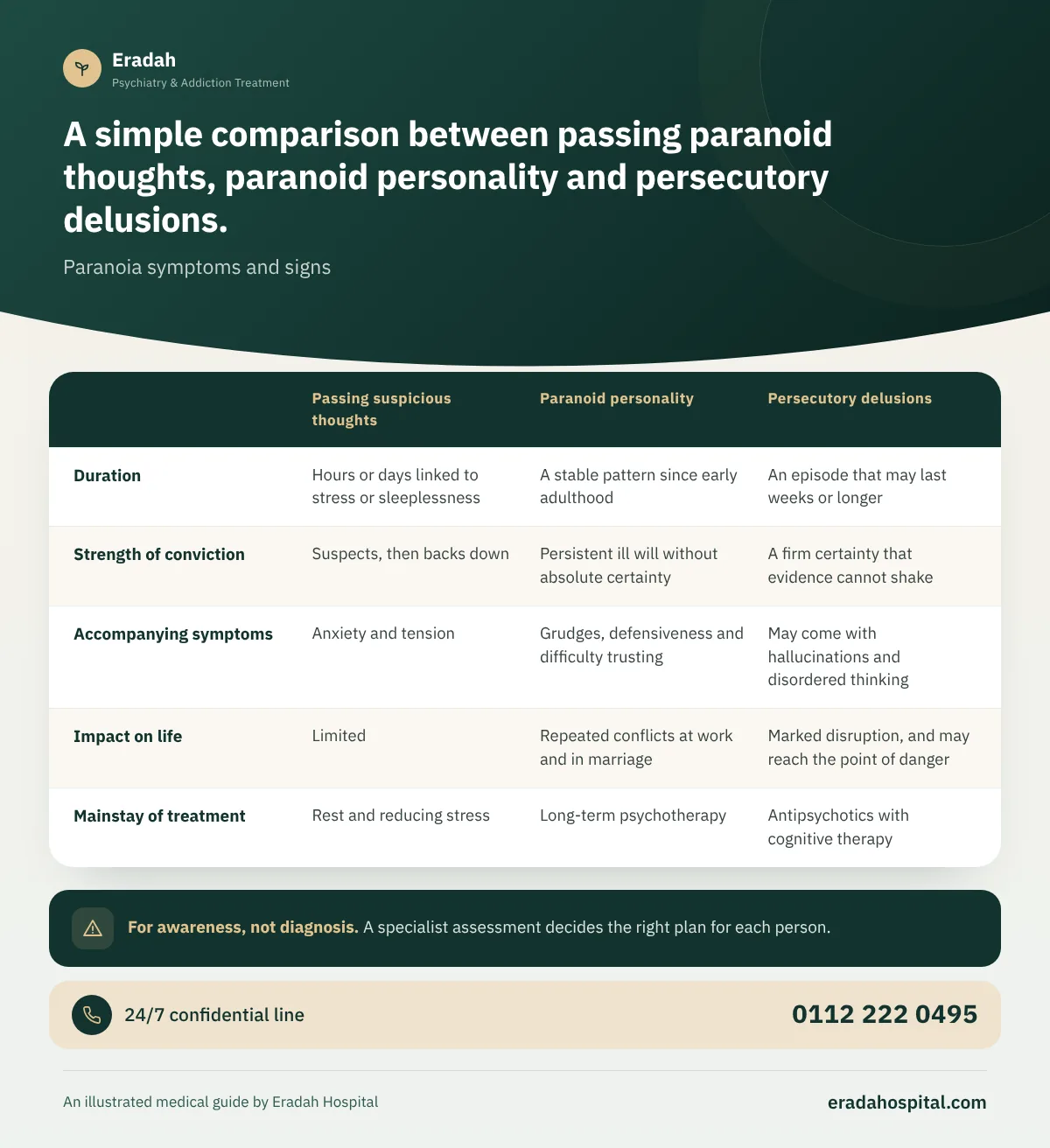
Research on the general population shows that suspiciousness runs along a gradient, from sensitivity in relationships and mistrust, to ideas of reference, up to persecutory ideas that only a few people reach. Here is a simplified table to tell them apart:
| Passing suspicious thoughts | Paranoid personality | Persecutory delusions | |
|---|---|---|---|
| Duration | Hours or days linked to stress or sleeplessness | A stable pattern since early adulthood | An episode that may last weeks or longer |
| Strength of conviction | Suspects, then backs down | Persistent ill will without absolute certainty | A firm certainty that evidence cannot shake |
| Accompanying symptoms | Anxiety and tension | Grudges, defensiveness and difficulty trusting | May come with hallucinations and disordered thinking |
| Impact on life | Limited | Repeated conflicts at work and in marriage | Marked disruption, and may reach the point of danger |
| Mainstay of treatment | Rest and reducing stress | Long-term psychotherapy | Antipsychotics with cognitive therapy |
What are the signs of paranoid personality disorder?
StatPearls describes paranoid personality disorder as a pervasive pattern of distrust and suspicion of others that usually begins in early adulthood and affects social and working life. Its signs include:
- Suspecting, without enough basis, that others are exploiting or deceiving them.
- Preoccupation with unjustified doubts about the loyalty and trustworthiness of friends and colleagues.
- Reluctance to confide any information for fear it will be used against them.
- Repeated, unjustified suspicions about a spouse’s or partner’s fidelity.
- Holding grudges, and excessive defensiveness in everyday conversation.
This disorder differs from psychosis in that the person does not usually experience hallucinations or fixed delusions. If the suspicion focuses specifically on a partner’s infidelity, our guide to pathological jealousy may help.
When is paranoia a sign of psychosis?
Paranoia becomes part of psychosis when it turns into a persecutory delusion: a fixed certainty that a person or organization is plotting to harm them, which evidence cannot shake. Signs that make this more likely include:
- Strange ideas that are hard to believe, such as devices implanted in the body or thought broadcasting.
- Hallucinations, such as hearing voices that threaten or comment on them.
- Disorganized speech or odd behavior that is out of character.
- A clear decline in self-care, studies or work.
If the suspicion is confined to a single subject while life otherwise seems normal, it may be a delusional disorder. Details of the other symptoms of psychosis are on the page about psychosis symptoms.
What does drug-related paranoia look like?
Paranoia is especially linked to crystal meth (shabu), cocaine, synthetic cannabis and high-potency cannabis. Its signs include appearing or getting worse after use, after nights of continuous sleeplessness, or during withdrawal. The person may peek out of the window, search the house for cameras, or accuse those around them of reporting them. You will find the signs for each substance on the page about drug-induced psychosis symptoms.
What are the signs of paranoia in older adults?
The Alzheimer’s Association says that a person with Alzheimer’s may become suspicious of those around them, accusing them of stealing, infidelity or improper behavior, or believing that the police are following them. The cause is often that they forget where they put their things and read the loss as theft. For this reason, new suspicions in an older person who was not suspicious before call for a medical assessment of memory and general health, not accusing them of having a “bad temper.”
Questions to help you review your suspicions
- Can you point to clear evidence of harm, or only a strong feeling?
- Do the people you trust see the situation the same way?
- Do these thoughts increase when you sleep little, use something, or go through stress?
- Have these thoughts made you avoid places or people, or stop working?
- Do they occupy your thinking for most of the day?
If your answers suggest that suspicion is consuming your life, your next step is a confidential psychological assessment, then a treatment plan suited to the cause, as we explain on the page about paranoia treatment.
Is suspicion turning dangerous? Get help now
- Talk of “defending himself” against a specific person, or planning to confront them
- Refusing to eat or drink for fear of being poisoned
- Suspicion and persecutory beliefs that appeared suddenly with hallucinations or confusion, or after using stimulants
- Carrying a weapon or sharp object “for protection”
- Despair, or talk of death or self-harm
Stay calm; do not argue with his belief or threaten him. Give him space without cornering him, and quietly remove dangerous objects if you can, without confrontation. Do not stay alone with him in a closed space if he is angry. Call an ambulance on 123 or take him to the nearest emergency department, or call the mental health support line 16328 (24 hours) for advice, and tell the medical team about any substance he has used.
Ambulance 123 Mental health support line 16328