“He started locking himself in his room all day, and when we talk to him he shouts, and sometimes we hear him talking to himself.” Many families live this scene, swinging between anger, fear and pity. Understanding what the behavior of a person with mental illness means does not excuse everything, but it changes how you respond and protects the family from needless clashes.
Why does the behavior of a person with mental illness seem strange?
The World Health Organization defines a mental disorder as a clinically significant disturbance in thinking, emotional regulation or behavior. In other words, changed behavior is part of the definition of the illness itself, not something separate from it. A person with depression is not being “lazy” on purpose, a person with psychosis is not “imagining things” to get attention, and a person with OCD does not enjoy washing their hands over and over. When you look at behavior as a symptom, the question becomes: what is this person going through inside to act this way?
The best-known behaviors in mental illness and what they may mean
May mean depression and loss of energy, social anxiety, or withdrawal at the start of psychosis.
May be part of depression, mania or anxiety, or of withdrawal from a drug.
May mean persecutory delusions in psychosis, paranoia, or the effect of stimulants or cannabis.
May be a response to voices heard in hallucinations, or an ordinary habit that does not indicate illness.
Long sleep in depression, and a reduced need for sleep without fatigue in mania.
May reflect loss of energy in depression, or the negative symptoms of schizophrenia.
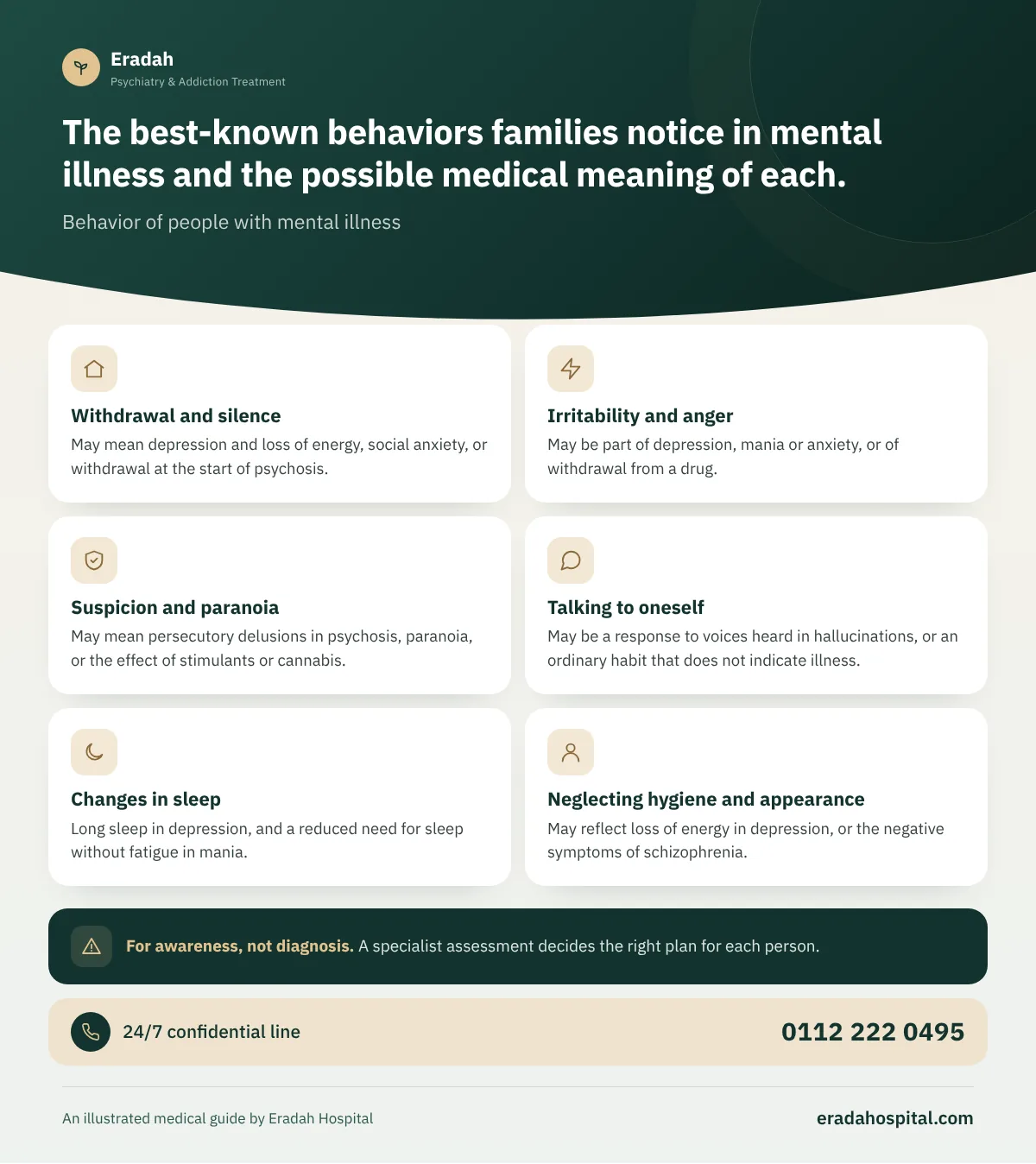
One behavior is not enough to conclude illness, since many healthy people talk to themselves or enjoy solitude. What matters is a change from the person's usual nature, how long it lasts, and its effect on their life.
Behavior in mental illness by type of disorder
| Disorder | Common behaviors | What is often misunderstood |
|---|---|---|
| Depression | Withdrawal, slowness, crying or irritability, and neglect of duties | Read as laziness or weak faith |
| Mania | Rapid speech, excessive spending, little sleep and excessive confidence | Read as “happiness” or a sudden improvement |
| Psychosis | Suspicion, withdrawal, incoherent speech or responding to voices | Read as lying or acting |
| Obsessive-compulsive disorder | Repeated washing or checking and seeking reassurance | Read as stubbornness or exaggerated cleanliness |
| Borderline personality | Sharp mood swings and intense fear of abandonment | Read as deliberate manipulation |
Does a person with mental illness know they are ill?
Not always. NAMI explains that a person's refusal of their diagnosis may not be conscious “denial” but a medical symptom called lack of insight (anosognosia), resulting from effects on the frontal lobe of the brain, which is responsible for updating a person's image of themselves. It notes that early studies estimated that about 30% of people with schizophrenia and 20% of people with bipolar disorder have a severe deficit in awareness of their diagnosis, that this awareness may fluctuate from time to time, and that it is the most common reason people stop taking medication. This is why it does not help to try to “convince” him by arguing that he is ill; instead, look for something that troubles him, such as insomnia or stress, and make it the way into treatment.
Is a person with mental illness dangerous? The truth about violence
The common image in films links mental illness with violence, and research says otherwise. In a large American study that followed about 34,000 people, violence was higher among people with severe mental illness, but markedly so only when substance use or addiction was also present, and severe mental illness alone did not predict violence after accounting for other factors such as previous violence, substance use, recent divorce, unemployment and exposure to victimization. In another study of 4,480 adults with mental disorders, the proportion who had been subjected to violence was 30.9% compared with 23.9% of those who had committed it, and the researchers concluded that they are more likely to be victims than perpetrators.
This does not mean ignoring danger when it exists. It means that real risk usually comes from the combination of illness with substance use, a history of violence, or stopping treatment, not from the diagnosis itself.
Does a person with mental illness do these things on purpose?
The answer is not always “yes” or “no.” Symptoms such as hallucinations, panic attacks and obsessions are not chosen by the patient. But many patients keep some control over their reactions, especially when their condition is stable, and they can take responsibility for treatment, apologize and learn. A healthy approach combines two things: understanding the symptoms and clear limits on harmful behavior. Legal responsibility has different rules, which we explain on the page about the legal responsibility of people with mental illness.
How do you respond to the behavior of a person with mental illness?
- Speak calmly in short sentences, and choose a time when he is not agitated.
- Do not argue with suspicious thoughts or hallucinations, and do not agree with them; talk about his feelings instead: “It's clear you're scared.”
- Do not take an insult during an episode as his real opinion of you.
- Set clear limits on harmful behavior, without threats or ridicule.
- Notice what comes before episodes, such as lack of sleep, stopping medication or substance use, and tell the doctor.
You will find broader steps for daily life, medication and a crisis plan in our guide to caring for a person with mental illness at home.
Behaviors that call for immediate action
When should you ask for an assessment?
Ask for an assessment if your relative's behavior has changed clearly for weeks, if it affects their work, sleep and relationships, if strange ideas or unjustified suspicion appear, or if they have started using substances. The NHS advises prompt medical assessment for symptoms of psychosis because early treatment is more effective. At Eradah the first consultation is free and confidential, and the family can begin it on their own, with residential treatment at Eradah Psychiatric Hospital for men when the doctor decides it is needed.