Where do you start when caring for a person with schizophrenia?
“He started locking himself in his room and saying the neighbors can hear him, and when we tell him it isn’t real, he shouts and accuses us of siding with them.” Many stories in our homes begin this way. The first step in dealing with a person with schizophrenia is to stop trying to convince him that what he is going through isn’t real, and to start understanding what he feels.
The US National Institute of Mental Health (NIMH) advises families to remember that the person’s beliefs and hallucinations seem completely real to him, and to treat him with respect, kindness, and support, without accepting any dangerous or inappropriate behavior. This balance, empathy with boundaries, is what this guide is about. For an explanation of the illness and its symptoms, see our guide to schizophrenia.
Why doesn’t a person with schizophrenia admit he is ill?
This is what puzzles and angers families most. The medical explanation is that poor insight into the illness is a core feature of schizophrenia, linked to the way the brain itself works, and some researchers call it “anosognosia.” A review published in Innovations in Clinical Neuroscience in 2014 reports that poor insight appears in between 57% and 98% of people with schizophrenia and is associated with poorer adherence to treatment and more frequent relapse.
In practice, this means that saying “You’re ill and you need treatment” usually hits a wall. It works better to look for something he himself admits is bothering him, such as insomnia, tension, exhaustion, or problems at work, and then suggest seeing the doctor for help with that. Agreeing on the goal matters more than agreeing on the name of the illness.
How do you talk with a person with schizophrenia without arguing?
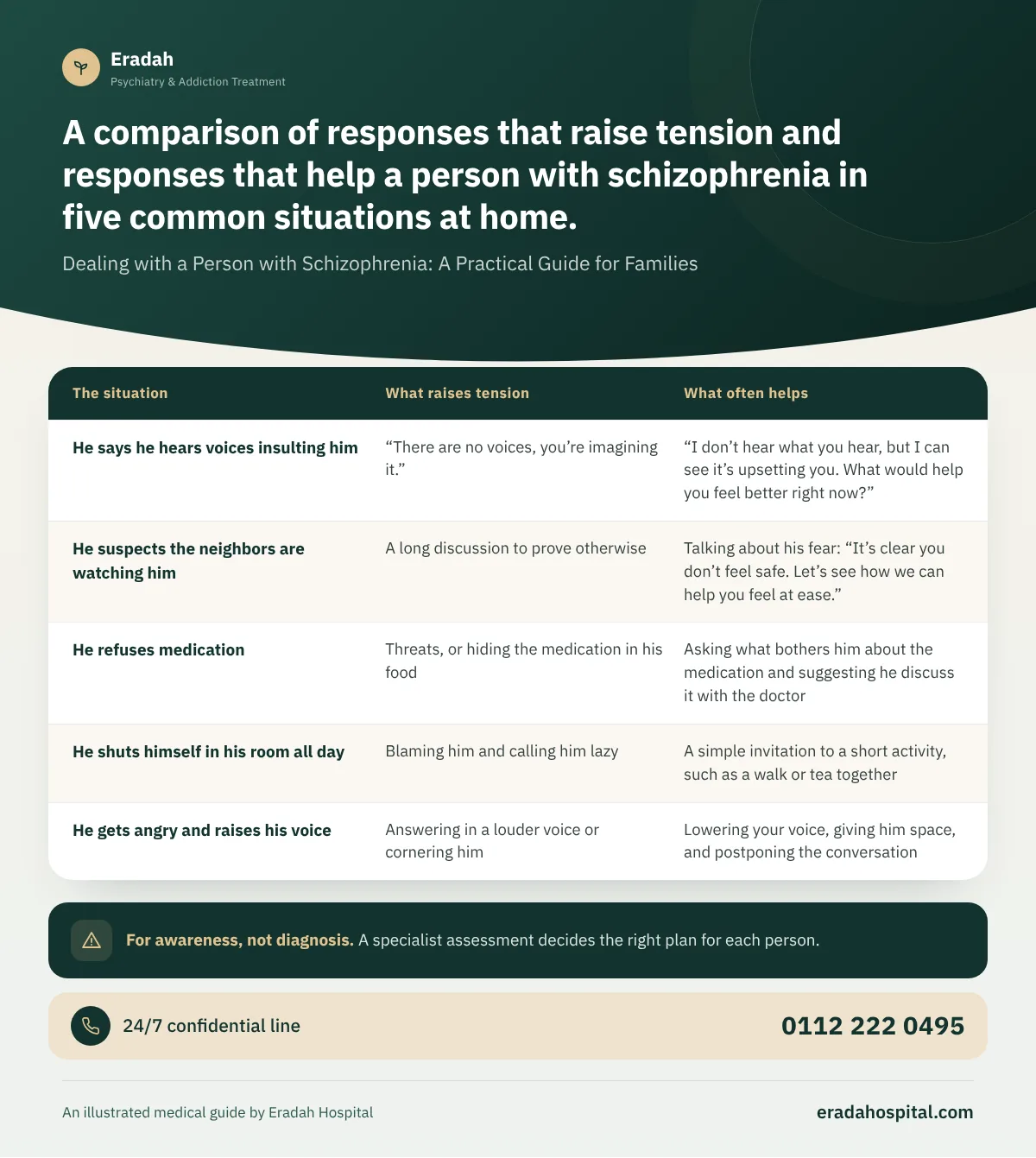
Do not try to prove that the voices do not exist, and do not agree that they are real. Acknowledge his experience and his feelings, speak in short sentences and a low voice, and make one request at a time:
| The situation | What raises tension | What often helps |
|---|---|---|
| He says he hears voices insulting him | “There are no voices, you’re imagining it.” | “I don’t hear what you hear, but I can see it’s upsetting you. What would help you feel better right now?” |
| He suspects the neighbors are watching him | A long discussion to prove otherwise | Talking about his fear: “It’s clear you don’t feel safe. Let’s see how we can help you feel at ease.” |
| He refuses medication | Threats, or hiding the medication in his food | Asking what bothers him about the medication and suggesting he discuss it with the doctor |
| He shuts himself in his room all day | Blaming him and calling him lazy | A simple invitation to a short activity, such as a walk or tea together |
| He gets angry and raises his voice | Answering in a louder voice or cornering him | Lowering your voice, giving him space, and postponing the conversation |
Avoid talking about him in the third person in front of him, gathering the family around him to confront him, and touching him suddenly. A frightened person reads these situations as a threat.
How can you help him stay on medication without conflict?
The UK’s National Health Service (NHS) stresses the importance of taking medication as prescribed even after feeling better, because continuing helps prevent relapse. But constant monitoring turns the home into a battlefield. Here are calmer approaches:
- Link the medication to a fixed daily habit such as breakfast, and use a weekly pill organizer that he can see himself.
- Ask him sincerely about any side effects that bother him, such as drowsiness, weight gain, or sexual dysfunction, and encourage him to tell the doctor about them instead of stopping.
- Praise him for sticking with it, and do not make medication the subject of every conversation.
- Never put medication in his food or drink in secret. Finding out destroys trust and feeds suspicion.
- If he keeps missing doses, ask the doctor about long-acting injections as an option to discuss with him.
The home atmosphere: what does research say about criticism and emotional intensity?
For decades, researchers have measured what they call “expressed emotion” within the family: frequent criticism, hostile comments, over-involvement, and excessive worry about the patient. An analysis published in Archives of General Psychiatry in 1998 pooled the results of 27 studies and concluded that this atmosphere is a strong and consistent predictor of relapse in schizophrenia. This does not mean the family causes the illness, but that the way people talk at home influences its course.
The good news is that this atmosphere can change. A 2010 Cochrane review covering 53 randomized trials found that structured family intervention may lower the risk of relapse by about 45% compared with usual care, reduce hospital admissions, improve adherence to medication, and lower the level of emotional intensity within the family. The UK’s NICE guidelines recommend that this intervention run for between 3 months and a year, in at least 10 planned sessions, and include the patient whenever possible. This is what we offer in Eradah’s Family Program.
- Reduce criticism: comment calmly on one specific behavior, not on his personality.
- Ease excessive worry: leave him space and small responsibilities he can manage.
- A calm routine: sleep and meals at fixed times, and less noise at home.
- Realistic expectations: returning to work or study should be gradual, and low motivation is part of the illness, not laziness.
Early warning signs of relapse and a written crisis plan
The NHS recommends that a written care plan include the possible signs that a relapse is starting, the steps to take, and emergency numbers. NICE asks the treating team to explain to the family how to get help in a crisis. Write this plan together with the patient while he is stable, and keep a copy somewhere everyone knows:
- His own personal signs that came before previous episodes, such as staying up at night, withdrawing, irritability, or the return of suspicion.
- The doctor’s name and number, the nearest psychiatric emergency service, and ambulance (123).
- Current medications and anything tried before that did not work.
- Who calls whom, who stays with him, and who looks after the children if there are any.
- What the patient would like to happen in a crisis and what he would refuse, as he said it while stable.
Pay special attention to any return to hashish, stimulants, or alcohol, which are among the strongest triggers of relapse. Details are on the page about schizophrenia and addiction.
Is a person with schizophrenia dangerous to his family? And how do you stay safe?
According to NIMH, most people with schizophrenia are not violent, and they are more likely to be harmed by others. The risk of harming themselves or others rises mainly when the illness is left untreated or accompanied by alcohol or drug use, and also with voices that command harm. Safety here is not an accusation against the patient but protection for him and for you:
- Keep medications and sharp objects in a safe place during unstable periods.
- Do not confront him when he is agitated, do not stand between him and the door, and leave yourself an exit.
- Take any talk of death or self-harm completely seriously. Asking about it directly does not plant the idea; it opens the door to help.
- In immediate danger, call ambulance (123). You can also call the mental health support line 16328, available around the clock.
If he refuses treatment completely: when is involuntary admission an option?
Always start with dialogue and patience. The family can also visit the doctor alone first to learn how to persuade him. But when refusal of treatment is combined with a serious danger to his life or others’ lives, or a severe and imminent deterioration in his condition, the Mental Patient Care Law No. 71 of 2009 regulates involuntary admission by medical decision, with safeguards for the patient’s rights. We explain the difference between voluntary and involuntary admission on the psychiatric hospital page, and the steps for treatment without the patient’s consent in the guide to involuntary treatment. This is general educational information, not legal advice.
Do not trick him by taking him “out for a drive” and then leaving him at the hospital. Deception destroys the trust you will need at every stage afterward.
Who takes care of the family?
The NHS notes that those who care for a person with schizophrenia may themselves need support to deal with their own feelings, and NICE points to carers’ right to clear information about the illness, recovery, and the kinds of support available to them. Constant exhaustion, insomnia, and sadness in a mother or brother are not weakness, but signals worth paying attention to.
Share responsibility among more than one person, take real breaks, and do not cut yourself off from your friends. If you feel the pressure has exceeded your capacity, it may be a sign of burnout that deserves support. At Eradah you can get a free, confidential first consultation to understand the situation and make a plan, with residential treatment available for men during acute episodes or when substance use is involved, followed by outpatient follow-up.
An acute psychotic episode, or danger to the person or others? Get help now
- Voices commanding him to harm himself or others, or him acting on them
- Threatening someone, or carrying a sharp object “to defend himself” against a person he thinks is plotting against him
- Refusing food or drink for days out of fear of poisoning, or severe self-neglect that threatens his health
- Talking about death or being a burden on his family, or saying goodbye and giving away his belongings
- Severe stiffness with fever and confusion after starting or changing a medication
Keep your voice calm and speak in short sentences. Do not argue about the voices or ideas, and do not mock them. Give him space and do not corner him in a closed room; if you can, quietly remove sharp objects and medications without confronting him. Call an ambulance on 123 or go to the nearest emergency department. If he talks about suicide, do not leave him alone; ask him calmly, listen to him, and contact the mental health support line 16328 (24 hours).
Ambulance 123 Mental health support line 16328