"Every morning it's the same story: crying and screaming at the school gate, clinging to my clothes, and I leave with my heart breaking." Many mothers know this scene. Sometimes it is a phase that passes within days, and sometimes separation anxiety is too big to be left to time.
What Is Separation Anxiety?
StatPearls describes separation anxiety as intense distress when separated from home or from an attachment figure, and explains that its normal form appears between 6 and 12 months of age and stays noticeable until about 3 years, then gradually fades as the child gains independence and understands that someone who goes away will come back. Separation anxiety disorder is an exaggerated form of this normal anxiety: more intense or longer than expected, or at an age that doesn't fit it, and it is one of the most common anxiety disorders in children. The World Health Organization lists it among the types of anxiety disorders.
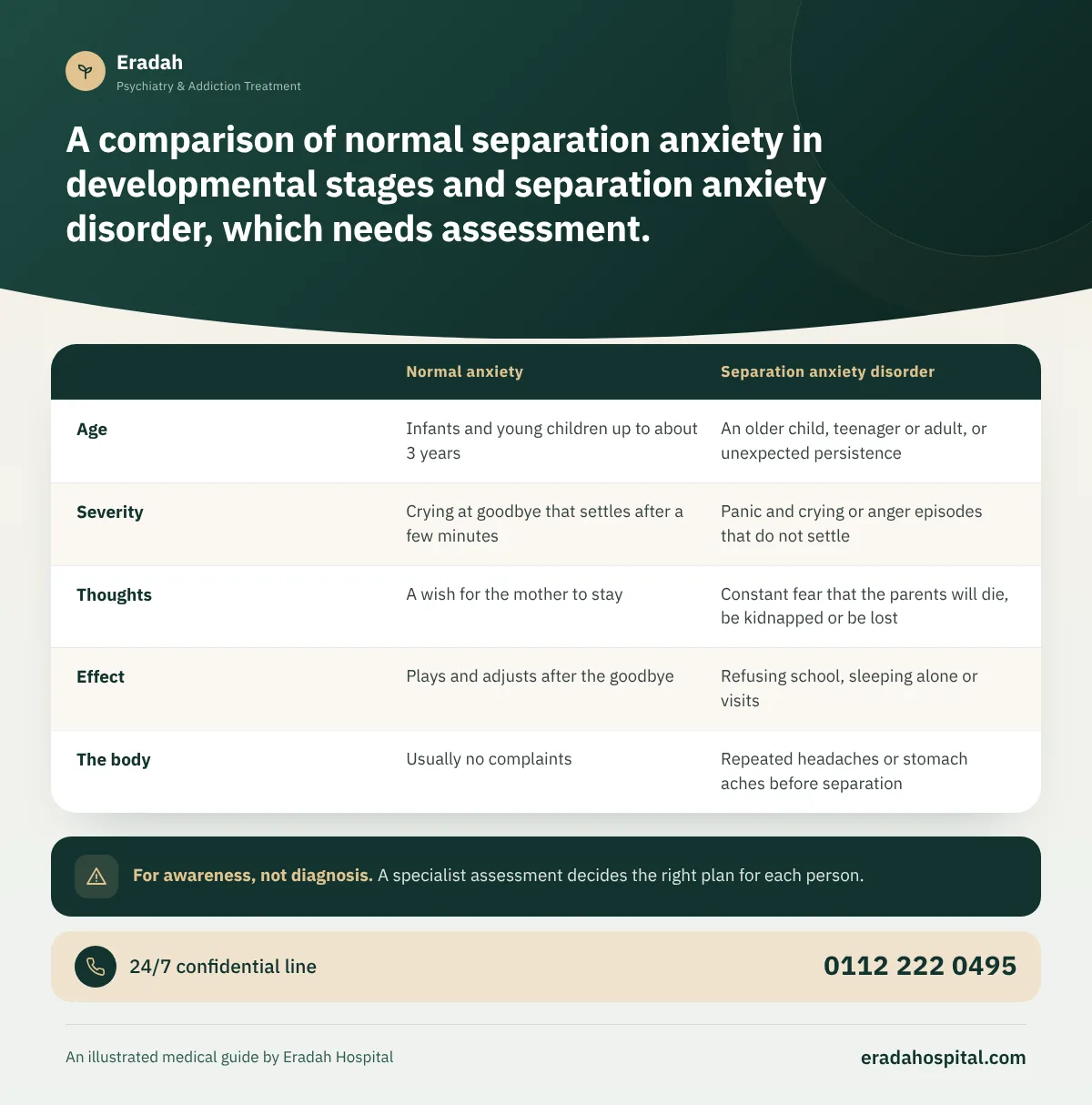
Normal and Disordered Separation Anxiety: How Do You Tell Them Apart?
| Normal anxiety | Separation anxiety disorder | |
|---|---|---|
| Age | Infants and young children up to about 3 years | An older child, teenager or adult, or unexpected persistence |
| Severity | Crying at goodbye that settles after a few minutes | Panic and crying or anger episodes that do not settle |
| Thoughts | A wish for the mother to stay | Constant fear that the parents will die, be kidnapped or be lost |
| Effect | Plays and adjusts after the goodbye | Refusing school, sleeping alone or visits |
| The body | Usually no complaints | Repeated headaches or stomach aches before separation |
Symptoms of Separation Anxiety in Children
- Excessive, persistent worry that something bad will happen to a parent, or that the child will be lost from them.
- Refusing to go to nursery or school, or calling the parents repeatedly during the day.
- Refusing to sleep alone or away from home, and nightmares about separation.
- Clinging to the mother at home and following her from room to room.
- Physical complaints such as headache, stomach ache and nausea on school mornings.
StatPearls notes that the disorder may be linked to sleep problems, poor school performance and physical complaints, and that it may be a gateway to other anxiety disorders later on. The US National Institute of Mental Health (NIMH) notes that a child who seems very afraid or anxious, or complains of repeated stomach or head pain without a medical cause, may benefit from assessment if this lasts for weeks and affects their life.
Separation Anxiety in Adults
The diagnosis used to be limited to children and adolescents, and then the fifth edition of the diagnostic manual (DSM-5) extended it to include adults. StatPearls explains that in adults the fear is usually for children, a spouse or a partner, not for parents. In the World Mental Health Surveys, which covered about 39,000 adults in 18 countries, the average lifetime prevalence of separation anxiety disorder was 4.8%, and 43.1% of cases began after age 18. Examples include a mother who cannot let her son travel to study, or a husband who calls his wife dozens of times a day out of fear for her, which is different from pathological jealousy, which is driven by suspicion, not by fear of loss.
Causes and Risk Factors of Separation Anxiety
The same global surveys found that among the best-established risk factors are female sex, childhood adversity and exposure to traumatic events, and that these factors are similar whether the disorder began in childhood, adolescence or after adulthood. Parents often notice that the anxiety appeared or got worse after a major change, such as starting school, moving to a new home, a parent's illness or the death of a relative. The disorder is also linked to other mental disorders appearing before or after it.
How Can Parents Deal with Separation Anxiety?
- Keep the goodbye short, clear and calm: a hug, a set phrase, then leave.
- Don't sneak away; your sudden disappearance confirms to the child that separation is dangerous.
- Keep your promise about when you will return, and start with short absences then lengthen them gradually.
- Don't allow staying home from school because of anxiety, since every day of absence makes returning harder, and work together with the school.
- Praise their courage after each successful separation, and don't mock their fear or compare them with their siblings.
- Pay attention to your own anxiety, because a child easily picks up on their parents' tension.
Treatment of Separation Anxiety
Treatment is based mainly on cognitive behavioral therapy with parental involvement, in which the child learns to recognize their frightening thoughts and face separation in small, gradual steps, and parents learn how to support them without reinforcing avoidance. The World Health Organization notes that anxiety disorders have an effective psychological treatment, and that medication may be considered depending on age and severity. The doctor decides this after assessment; never start or stop any medication without a doctor.
When Should You See a Doctor?
Ask for an assessment if the anxiety lasts for weeks and affects school, sleep or family life, if it appears at a later age or after a trauma, or if it comes with depression or panic attacks. Eradah receives children and adolescents for assessment and treatment of separation anxiety with the family's involvement, and you can start with a free, confidential first consultation for the child or the adult, with outpatient follow-up for men and appropriate referral for women.