What is a phobia?
A man climbs ten flights of stairs every day because he cannot bear the elevator, a young man turns down a job abroad because flying terrifies him, and a mother faints whenever she sees blood. Each of them knows their fear is “exaggerated,” but knowing alone does not switch it off. This is a phobia, which doctors also call by its clinical name.
A phobia is one of the anxiety disorders. At its core is fear or anxiety that appears almost immediately when facing a specific object or situation, or even when thinking about it or seeing a picture of it, followed by avoidance of that situation or enduring it with intense distress. Psychiatry calls the best-known form “specific phobia,” because the fear is focused on one clear source.
The key difference between a phobia and ordinary fear is that an adult usually realizes the fear is greater than the real danger, yet cannot control it. The person is not lacking information or courage; their internal alarm system has simply learned to sound loudly in the wrong place.
Are phobias common? Phobias in numbers
Specific phobia is one of the most widespread mental disorders in the world, but one of the least likely to be treated, because many people live with it through avoidance and assume it is an unchangeable “trait.” Large surveys reveal the following picture:
In the United States, the National Institute of Mental Health estimates that 12.5% of adults have a specific phobia at some point in their lives, and that the 12-month rate among women (12.2%) is more than double that among men (5.8%).
Sources: Wardenaar and colleagues in the World Mental Health Surveys (2017), and the US National Institute of Mental Health. No documented, published Egyptian figures on the prevalence of specific phobia in particular are available.
What is the difference between normal fear and a phobia?
Fear is at root a friend that protects us from danger, and it needs no treatment. A phobia begins when this friend becomes domineering, deciding for you where you work, how you travel and which doctor you see. These are the clearest differences:
| Point of comparison | Normal fear | Phobia |
|---|---|---|
| Proportion to the danger | Matches the real danger | Far greater than the actual danger |
| When does it appear? | When danger is present | Even when thinking about the situation or seeing a picture of it |
| Before the situation | Little or no worry | Anticipatory anxiety that may begin days before |
| Effect on life | Does not change your decisions | Avoidance that reshapes work, travel, relationships and medical care |
| Response to reassurance | Settles with explanation and logic | Does not go away with talk alone |
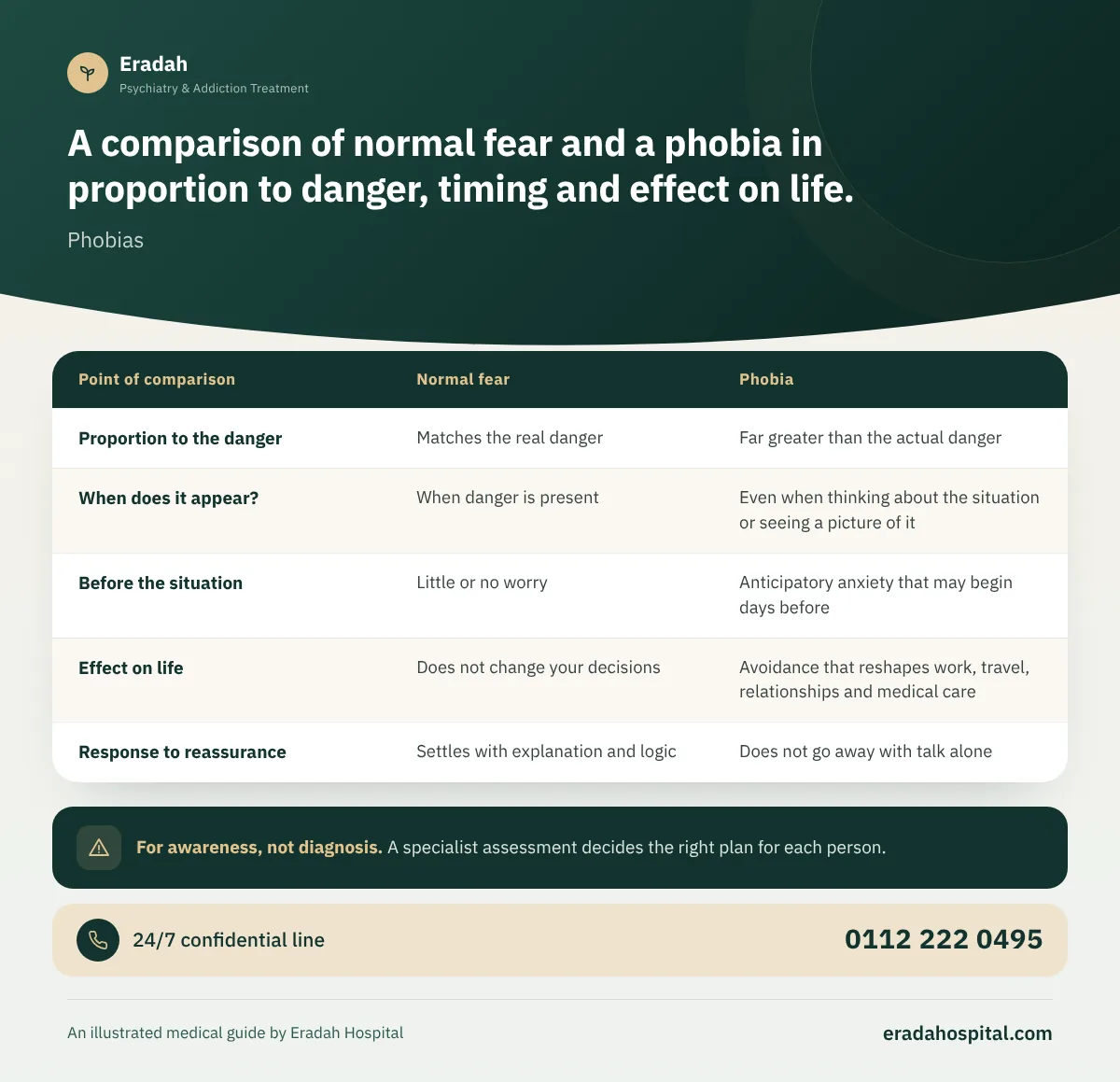
Note that intensity alone is not the measure; someone may be terrified of snakes and need no treatment because they live in a city where they never meet one, while another who fears elevators and works in a tall building does need it. The real test is: how much does this fear cost you in your life?
What does a phobia feel like from the inside?
Many people describe a phobia as a split between two minds: a calm mind that knows the elevator is safe, and another, faster one that sounds the alarm before the thinking is finished. At the moment of confrontation the heart races, breathing tightens, and escape becomes the only thinkable idea.
Then comes the suffering no one sees: planning ahead to avoid the situation, repeated excuses, and shame about admitting the fear in front of family or colleagues. Over time, the fear of the fear itself, of having an attack in front of people, can become a heavier burden than the original situation.
What are the symptoms of a phobia in brief?
A phobia combines physical symptoms such as palpitations, trembling, sweating, chest tightness and dizziness, psychological symptoms such as terror, a sense of impending danger and fear of losing control, and behavioral symptoms, chiefly avoidance and anticipatory anxiety. In blood and injection phobia, pulse and blood pressure may drop and cause fainting. The full details, symptoms in children, and the difference from a panic attack are on the page Phobia symptoms and signs.
What are the types of phobia in brief?
Doctors divide specific phobia into five groups: animals; the natural environment, such as heights, storms and water; blood, injections and injuries; situations, such as enclosed spaces, flying and elevators; and an “other” group, such as fear of vomiting or choking. Alongside it stand social phobia (social anxiety disorder) and agoraphobia as separate disorders. The full list with their clinical names is in Types of phobias and their names.
Why do phobias develop?
There is no single cause, but a mixture of a direct or witnessed frightening experience, learning from a parent's fear or from repeated frightening information, together with a genetic predisposition and an anxious temperament. Then avoidance keeps the fear going; every escape convinces the brain the danger was real. Details and risk factors are in Causes of phobias.
How do phobias differ from similar anxiety disorders?
More than one patient may avoid the same situation for completely different reasons, which is why the doctor always asks: what exactly are you afraid of?
| The situation | Focus of the fear | Difference from specific phobia |
|---|---|---|
| Panic disorder | Sudden attacks and fear of their recurring | Attacks come with no specific trigger, not from one particular thing |
| Social phobia | Being judged by others and embarrassment | Fear of how others see you, not of the situation itself |
| Obsessive-compulsive disorder | Intrusive thoughts such as contamination | Avoidance is part of obsessions and compulsive rituals |
| Post-traumatic stress disorder | Reminders of a past trauma | Accompanied by intrusive memories and nightmares |
| Illness anxiety | Having a serious illness | Preoccupation with illness, not fear of a specific situation |
Common myths about phobias and the facts
| The myth | The truth |
|---|---|
| “A phobia is pampering and weak character” | A medically recognized anxiety disorder that affects strong and successful people, and has nothing to do with manliness or faith |
| “Throw him into what he fears and he'll be cured” | Sudden forced confrontation can increase the terror; treatment is planned, gradual exposure with the patient's consent |
| “The solution is a sedative pill before the situation” | A sedative hides the fear temporarily without treating it, and with repetition carries a risk of dependence |
| “A phobia goes away by itself with age” | It lasts for years or decades in 10 to 30% of cases according to a review in The Lancet Psychiatry |
| “Treatment takes years” | Many cases of specific phobia improve in a limited number of sessions, and sometimes in one extended session |
Can phobias be treated?
Yes, and with encouraging results. An analysis pooling 33 randomized trials showed that exposure therapy clearly outperforms no treatment and other psychological therapies, and the MSD Manuals regard it as the preferred treatment, enough on its own in many cases. Medication plays a limited, supporting role. The steps, duration and the role of each medication, without doses, are in Phobia treatment.
When should you see a psychiatrist about a phobia?
- The fear makes you turn down a job, a promotion or an important trip.
- You postpone or refuse medical treatment, tests or vaccination because of a fear of needles, blood or doctors.
- You spend days worrying before a simple situation.
- You have started avoiding leaving home, transport or crowds.
- You need a sedative, alcohol or another substance to face the situation.
- The phobia comes with persistent low mood or repeated panic attacks.
You do not have to reach “rock bottom” before asking for help. A psychiatric consultation is confidential; the doctor starts with an assessment that identifies the type of phobia and what accompanies it, then a plan that suits you. You can start at Eradah Psychiatric Hospital with a free first consultation.
How can the family help someone with a phobia?
- Do not mock them or spring the source of their fear on them “as a joke” or to prove it does no harm.
- Do not always do tasks for them; overprotection brings comfort today and locks in avoidance tomorrow.
- Encourage small steps that they choose, and celebrate every bit of progress however small it seems.
- Watch for sedatives and alcohol if they start relying on them before situations.
- Go with them to the assessment if the phobia is disrupting their studies, work or medical care.
Phobia guide: everything you need to know
We have gathered everything about phobias into 5 pages, each answering one question in detail. Choose what you are looking for:
Phobia symptoms and signs
Learn about the physical, psychological and behavioral symptoms of phobias, why some people faint at the sight of blood, how they show up in children, the difference from a panic attack, and when to worry.
Causes of phobias
What causes phobias? How frightening experiences, learning from parents, genetics and an anxious temperament create a phobia, why avoidance keeps it going for years, and what the risk factors are and when it usually begins.
Types of phobias
Learn about the types of phobias: the five groups of specific phobia, the best-known phobia names such as enclosed spaces, heights, flying and injections, plus agoraphobia, social phobia and trypophobia.
Phobia treatment
How are phobias treated? Step-by-step gradual exposure therapy, cognitive therapy and virtual reality, the applied tension technique for blood phobia, the role of medication and sedatives without doses, and treatment length.
Claustrophobia: why elevators frighten you, and how to overcome the fear
Claustrophobia (fear of enclosed spaces): its symptoms in elevators, planes and MRI scanners, its causes, the difference from agoraphobia, and how it is treated with gradual exposure.
Fear accompanied by risk to yourself or dependence on a sedative? Get help now
- Thoughts of death or self-harm out of despair over the fear or from isolation.
- Repeated fainting with injury at the sight of blood or injections, or refusing necessary medical treatment out of fear of needles.
- Chest pain or severe shortness of breath that does not improve, especially in someone with heart disease or an older person.
- Taking increasing doses of sedatives or alcohol to face the situation, or mixing the two.
- Complete withdrawal from leaving the house for weeks, with neglect of eating, sleep and self-care.
If chest pain or severe shortness of breath appears, do not assume it is “just fear”; call an ambulance on 123 so a physical cause can be ruled out. If someone close to you talks about death or harming themselves, stay with them, ask calmly and without blame, remove medications and dangerous objects, and call an ambulance on 123 or go to the nearest emergency department, or call the mental health support line 16328, available around the clock.
Ambulance 123 Mental health support line 16328