Many people think an alcohol problem begins only with complete loss of control, but harm begins well before that. This scale puts drinking habits into clear numbers, so you know where you stand and decide your next step, and so you understand the harms of alcohol as they really are.
Start the alcohol addiction test
How is the score calculated?
Each answer to questions 1 to 8 scores from 0 to 4, while questions 9 and 10 have only three answers: “No” = 0, “Yes, but not in the past year” = 2, and “Yes, during the past year” = 4. The scores are added to give a number from 0 to 40, which the World Health Organization divides into four zones:
| Level | Area | Suggested step |
|---|---|---|
| 0 – 7 | Low risk | Education about the risks of alcohol |
| 8 – 15 | Risky drinking | Clear advice to cut down or stop |
| 16 – 19 | Harmful drinking | Advice, brief counseling and continued monitoring |
| 20 – 40 | Possible dependence | Referral to a specialist for assessment and alcohol addiction treatment |
The total score alone is not enough; the scale’s guidance notes that any score above zero on questions 4, 5 and 6 indicates the beginning or presence of dependence, and that scores on questions 7 to 10 mean drinking has already caused harm. Some studies also suggest a slightly lower cutoff for women and older adults, because their bodies are affected by smaller amounts.
What to do after your result
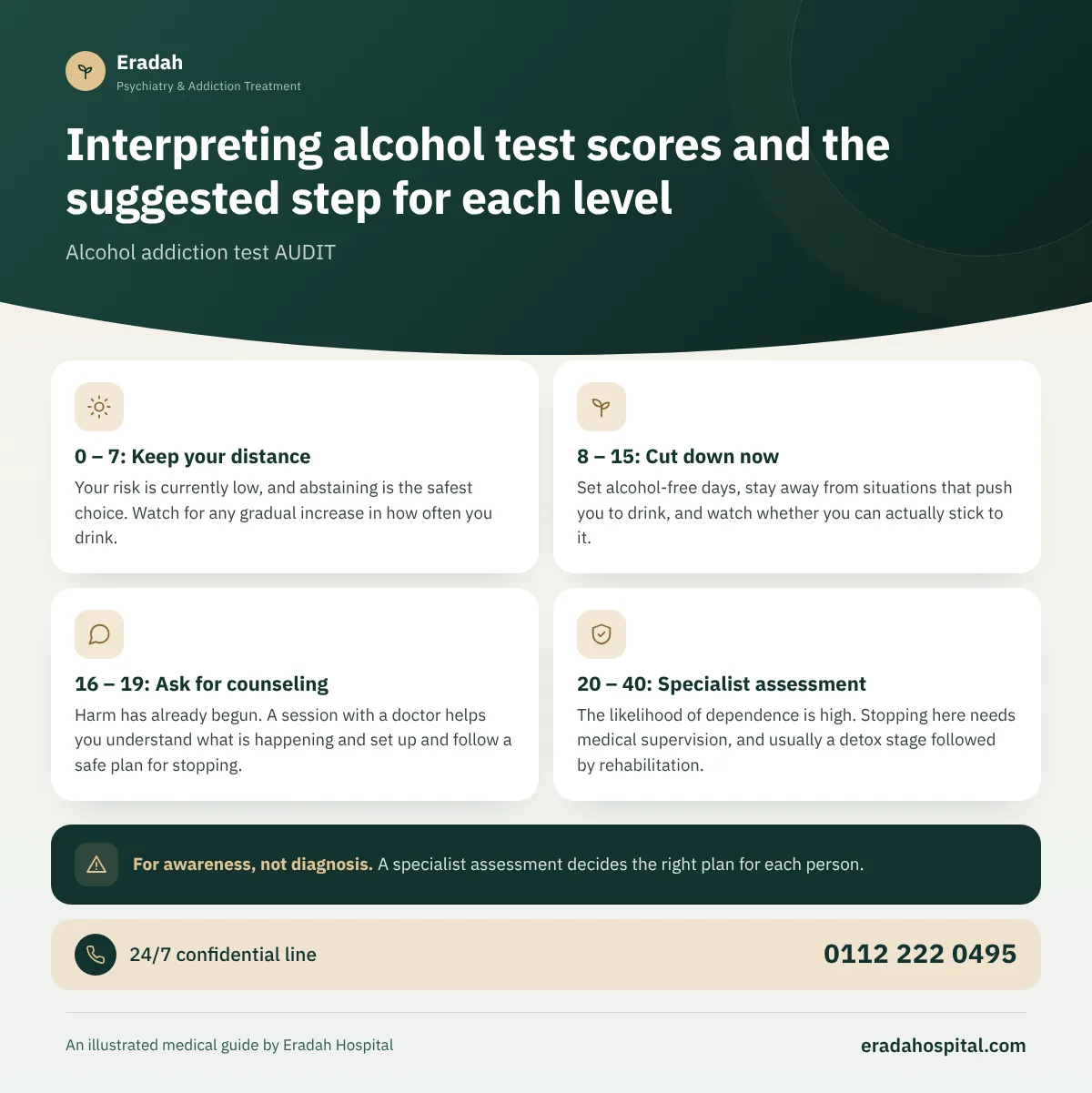
Your risk is currently low, and abstaining is the safest choice. Watch for any gradual increase in how often you drink.
Set alcohol-free days, stay away from situations that push you to drink, and watch whether you can actually stick to it.
Harm has already begun. A session with a doctor helps you understand what is happening and set up and follow a safe plan for stopping.
The likelihood of dependence is high. Stopping here needs medical supervision, and usually a detox stage followed by rehabilitation.
If you are worried about someone you love
You can answer the questions on behalf of a relative to form a first impression, bearing in mind that what you do not see of their habits may make the score lower than the reality. When talking with them, these steps can help:
- Choose a time when they are sober and calm, not right after a drinking episode or an argument.
- Talk about specific situations you have noticed and your concern for them, and avoid labels and accusations.
- Do not cover for the consequences of their drinking at work or with the family, as this delays their acknowledging the problem.
- Offer to see a doctor together, and be ready to repeat the offer more than once.
- Look after yourself too, because supporting someone needs energy and support from a professional.
If they show signs of withdrawal such as tremor, heavy sweating or confusion after stopping, do not wait for them to pass; seek medical help immediately.
What is the AUDIT scale?
AUDIT stands for “Alcohol Use Disorders Identification Test.” It was developed by the World Health Organization through a project spanning six countries, the study of its development was published in 1993, and the organization then issued its second guidance manual in 2001. It is distinguished by covering three aspects at once: the amount and frequency of drinking, signs of dependence, and resulting harms. Scientific reviews have shown its good accuracy in detecting hazardous and harmful drinking in clinics and emergency departments in different countries and cultures.
Limits of the test
- It does not diagnose alcohol use disorder; diagnosis needs an interview with a doctor.
- It depends on the honesty of your answers and the accuracy of your estimate of the number of drinks.
- The size of one drink differs from one type to another, so your estimate may fall short of the reality.
- It does not measure use of other substances along with alcohol, and mixing them raises the risk considerably.
- A low score does not rule out risk in pregnancy, when driving, or with medications that interact with alcohol.
Alcohol and mental health
Alcohol is often used to calm anxiety, escape sadness or get to sleep, and the temporary relief turns into an added cause of depression and insomnia. If your score is high and you also have psychological symptoms, treating both together is more successful. Residential care at Eradah is available for men, while women and adolescents receive assessment and follow-up services. You can also take the depression test.
If you want to understand your result or plan to stop safely, for yourself or someone you care about, contact us on 01122220495 for a free and completely confidential consultation.