Where do you start when dealing with someone addicted to alcohol?
“Every night he comes back in the same state, and in the morning he swears it’s the last time.” This sentence sums up what many families live through: promises in the morning, disappointment in the evening, and constant confusion between anger and pity. Dealing with someone addicted to alcohol does not call for a “magic word.” It calls for a calm plan that all family members stick to together.
The alcohol guide explains when drinking becomes addiction, and the symptoms of alcohol addiction page describes the signs families notice. Here we answer the practical question families ask: what do we do now?
The first rule is to separate the person from the time of drinking. Talking to someone under the influence of alcohol does not get through, and it can turn into a fight. The right time is the morning or a day when he is not drinking, when he is calm and worn out by the consequences of the night before.
How do you talk to him without him shutting the door?
- Choose a time when he is sober and a quiet place, away from children and guests.
- Start with concern, not accusation: “I’m worried about you” instead of “you’re a drunk.”
- Name specific incidents: “Yesterday you fell on the stairs,” or “The kids saw you when you were out of it.”
- Listen to his defense without interrupting, and do not get drawn into an argument about how much he drinks.
- Offer one small, clear step: “Will you come with me to a doctor, just to talk?”
- If he refuses, end the conversation calmly and come back to it at another time.
The page on how to persuade a person with addiction to accept treatment sets out practical phrases for this conversation.
Why does smart support work better than confrontation?
Many families rely on the “big confrontation”: relatives gather and put the person in front of a fait accompli. But in a randomized US trial published in 1999 with 130 family members of drinkers who refused treatment, three approaches were compared. The CRAFT approach, which trains the family to encourage sober periods and let the drinker face the consequences of drinking without protection, got 64% of drinkers into treatment, compared with 30% for group confrontation and 13% for encouraging the family to attend support groups alone. Notably, 70% of the families trained in confrontation decided in the end not to carry it out.
A systematic review published in 2010 confirmed the finding: this approach moved about two thirds of those who refused into treatment, often after four to six sessions with the family. Families can learn this approach through a family program or specialized counseling sessions.
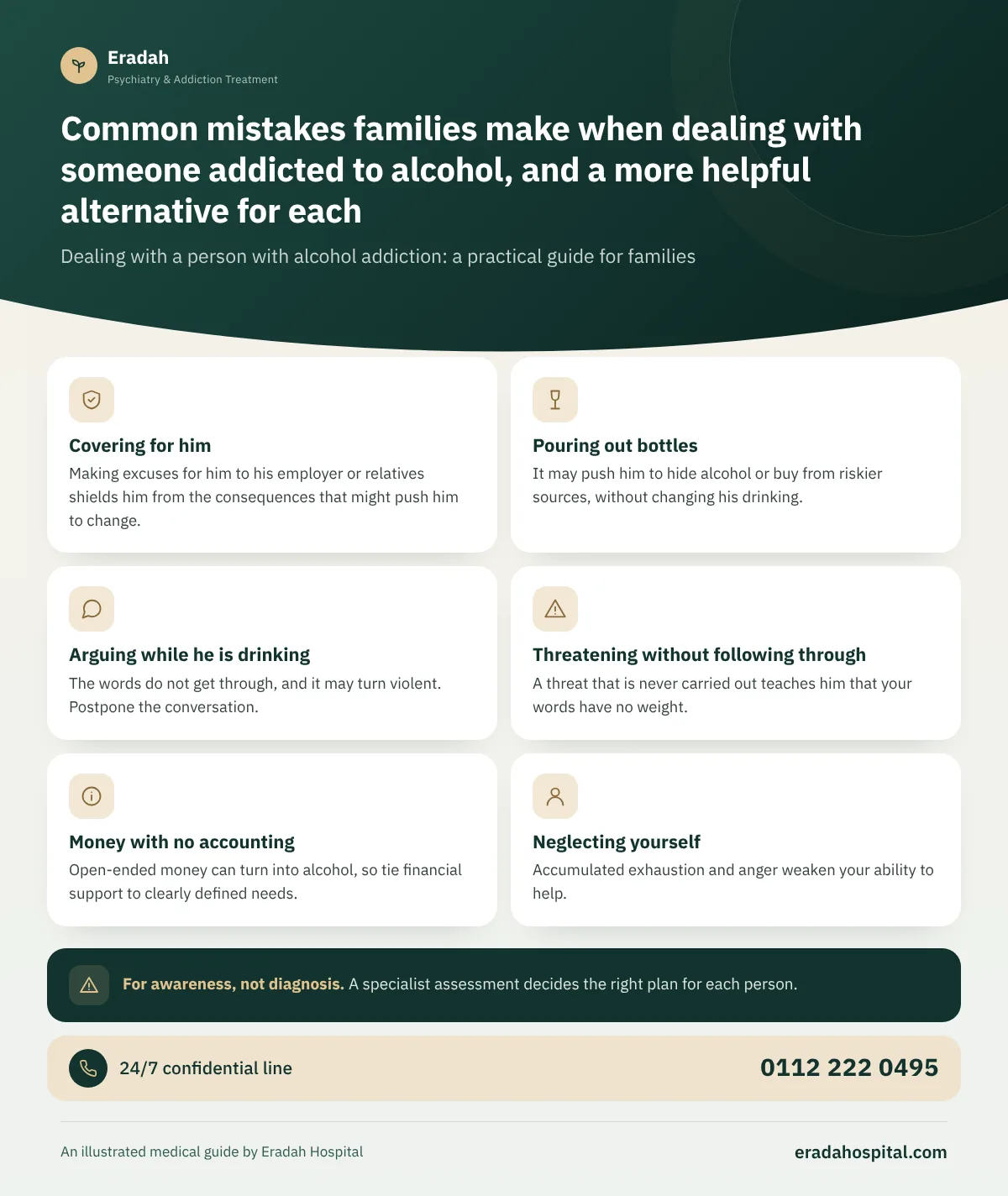
Common mistakes when dealing with someone addicted to alcohol
Making excuses for him to his employer or relatives shields him from the consequences that might push him to change.
It may push him to hide alcohol or buy from riskier sources, without changing his drinking.
The words do not get through, and it may turn violent. Postpone the conversation.
A threat that is never carried out teaches him that your words have no weight.
Open-ended money can turn into alcohol, so tie financial support to clearly defined needs.
Accumulated exhaustion and anger weaken your ability to help.
Do not let him stop suddenly at home
This is the most important warning on the page. Alcohol is one of the few substances whose withdrawal can be life-threatening. The US National Library of Medicine (MedlinePlus) notes that alcohol withdrawal symptoms usually begin within 8 hours of the last drink and peak within 24 to 72 hours, and that “delirium tremens” can occur, with severe confusion, fever, hallucinations, and seizures, and that death is possible, especially with this condition.
So if your relative has been drinking heavily every day for some time, do not encourage him to stop suddenly on his own, and do not lock him in the house to make him stop. The right step is a medical assessment, which may lead to medically supervised detox. The page on alcohol withdrawal symptoms explains the stages of withdrawal in detail.
If he comes home severely intoxicated
The US National Institute on Alcohol Abuse and Alcoholism (NIAAA) explains that an alcohol overdose can slow breathing and heart rate and lower body temperature, and that vomiting while unconscious can cause choking. What helps that night:
- Do not leave him alone, and do not let him sleep on his back if he is very drowsy; place him on his side.
- Do not give him coffee or a cold shower to “sober him up.” These do not lower the alcohol in the blood.
- Do not let him drive, no matter how much he says he is fine.
- If he cannot be woken, vomits while unconscious, or breathes slowly: call an ambulance (123) immediately.
Violence and child protection
If the drinking comes with shouting, smashing things, or hitting, your safety and your children’s safety come before any conversation. Agree in advance with a relative you trust on a place you can go, keep important papers and your phone within reach, and call the police emergency line (122) at any threat. Children in a home affected by addiction need someone to explain that what is happening is not their fault, and the page on my husband is addicted offers practical steps for this.
Take care of yourself too
Living with someone who drinks drains your nerves, sleep, and money. Support groups for families of people with addiction, such as Al-Anon groups, offer a space to share experiences, and the earlier US trial found that family members’ emotional well-being improved with all three approaches. Taking care of yourself does not mean you have abandoned him; it means you are preserving your ability to support him.
From conversation to treatment
When he agrees to the first step, the starting point is a medical assessment that determines whether he needs supervised detox, followed by a treatment plan combining psychological therapy and supportive medication when needed, as the page on alcohol addiction treatment explains. Families should also beware of alcohol of unknown origin, because it may be adulterated with methanol, as the page on methanol poisoning explains. At Eradah, the first consultation is free and confidential. Do not start or stop any medication without a doctor.
Signs of alcohol poisoning: call an ambulance (123) immediately
- Cannot be woken, or does not respond.
- Repeated vomiting while drowsy or unconscious.
- Slow or irregular breathing.
- Cold, pale, or bluish skin, or low body temperature.
- Seizures, or hallucinations and confusion after stopping drinking.
Call ambulance (123) immediately. If the person is unconscious but breathing, place them on their side so they do not choke on vomit. Stay with them and do not leave them alone. Do not give them food or drink, and tell the paramedics everything they took or used, and the amount and time if you know them.
Call the ambulance 123