Anger is a natural and sometimes necessary feeling, but when it comes quickly, goes out of control and leaves hurt relationships behind, anger and outbursts have become a problem that deserves attention. Answer honestly to see where you stand.
Start the irritability test
How is the irritability test result calculated?
Each answer has a score: “Never” = 0, “Sometimes” = 1, “Often” = 2, and “Almost always” = 3. The scores for the ten questions are added up to give a number from 0 to 30. The questions cover four areas: how quickly anger comes and how often, how intense it is, the ability to control it, and its consequences for your life. The last two questions cover two areas that need special attention: the link between anger and substance use, and thoughts of self-harm. The score should not be read as a verdict on your personality, but as a sign of how much you need someone to help you understand your anger.
| Level | Reading | Suggested step |
|---|---|---|
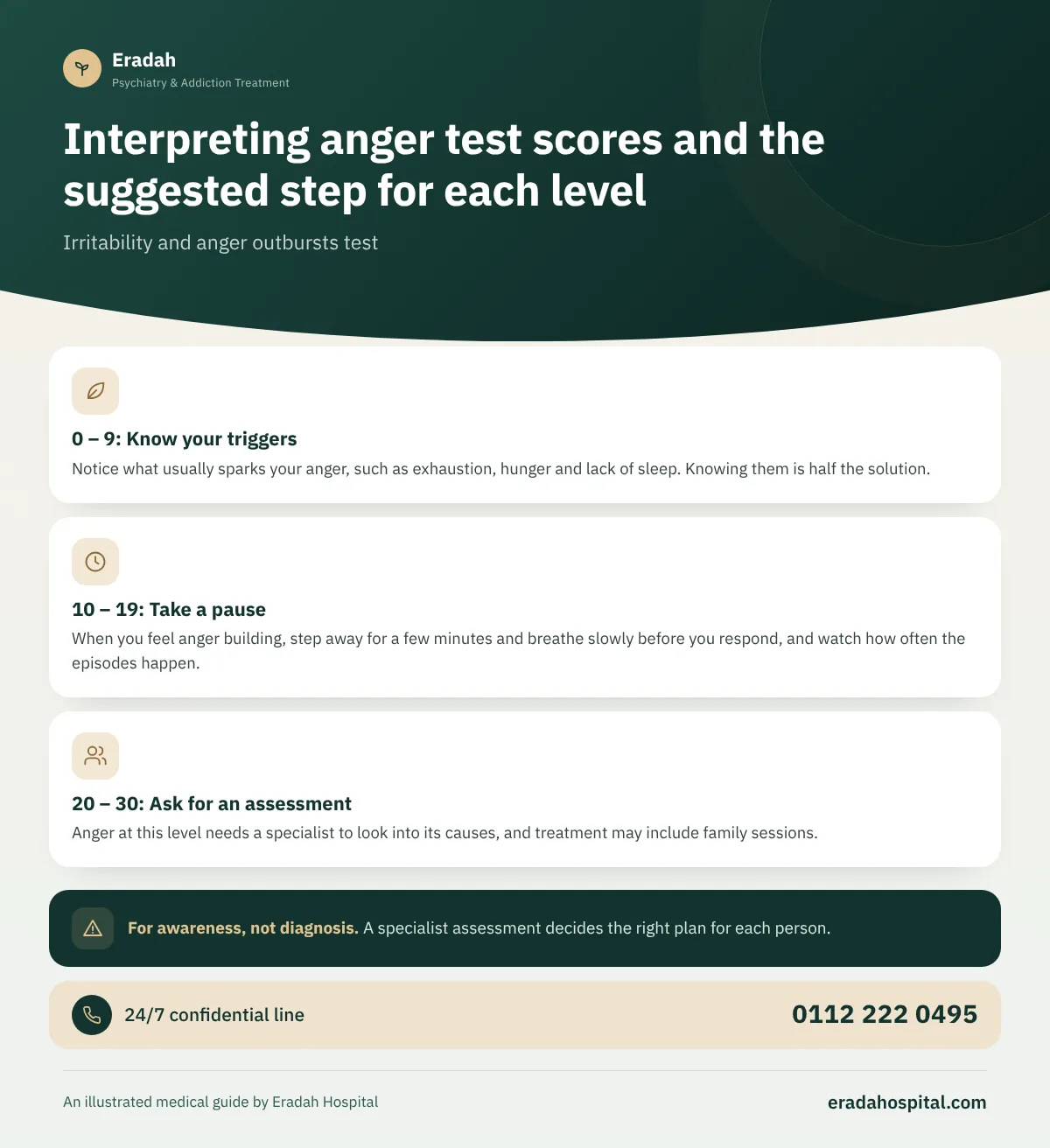
| 0 – 9 | Low likelihood that you need an assessment | Pay attention to triggering situations and retake the questionnaire if things change |
| 10 – 19 | Moderate likelihood | Calming techniques and follow-up, and an assessment if the episodes continue |
| 20 – 30 | High likelihood | Assessment by a specialist and a plan for anger treatment |
Because this is an awareness questionnaire and not a validated scale, its score cutoffs are approximate and were set cautiously. Also look at your individual answers: an answer of “Often” to the question about breaking things or aggression, or any answer other than “Never” to the self-harm question, deserves attention whatever your total.
What to do after your result
Notice what usually sparks your anger, such as exhaustion, hunger and lack of sleep. Knowing them is half the solution.
When you feel anger building, step away for a few minutes and breathe slowly before you respond, and watch how often the episodes happen.
Anger at this level needs a specialist to look into its causes, and treatment may include family sessions.
Healthy anger and pathological anger
Healthy anger fits the situation, is expressed in clear words, then settles and leaves room for a solution. Pathological anger comes out bigger than its cause, recurs quickly, and emerges as insults, breaking things or aggression, often followed by regret and losses in relationships or work. Recurrent anger may also be a symptom of another disorder, such as depression, bipolar disorder or borderline personality disorder, which is what an assessment uncovers.
| Aspect | Healthy anger | Pathological anger |
|---|---|---|
| Severity | Fits the situation | Far bigger than its cause |
| Frequency | Occasional, with a clear cause | Recurrent, over minor triggers |
| Expression | Clear words without insults | Shouting, swearing, breaking things or aggression |
| Control | Can be stopped or postponed | Hard to restrain once it starts |
| Afterward | Settles and opens a door to a solution | Regret and losses in relationships or work |
The DSM-5 diagnostic manual defines a disorder called “intermittent explosive disorder,” in which episodes of verbal or physical aggression recur that are out of proportion to the trigger, are not planned, and cause distress or clear problems. This questionnaire draws on those features, but it is not enough to diagnose it; that requires an interview that rules out other causes.
Limits of this questionnaire
- An awareness questionnaire that is not scientifically validated, and it is no substitute for an interview with a specialist.
- It does not diagnose intermittent explosive disorder or any other disorder.
- It is affected by the circumstances of the last month, such as work pressure or a passing family problem.
- Chronic pain, lack of sleep and some medications can increase irritability.
- A low score does not mean ignoring a single episode that ended in harm.
Anger and addiction
Substance use is one of the things most likely to ignite anger episodes. Alcohol weakens a person's ability to restrain their reactions, stimulants such as crystal meth (shabu) and Captagon can cause irritability, suspicion and aggression, and withdrawal symptoms from hashish, sedatives and opioids often show up as tension and an explosion over the smallest thing. In turn, some people turn to the same substance to calm down, so they go around in a closed loop. The risk rises when anger and substance use come together, as the likelihood of domestic violence, accidents and legal problems goes up.
If your anger gets worse with substance use or after stopping, the solution is not to control the anger alone but to treat both together in a dual diagnosis program.
Free confidential consultation
Admitting that anger has become a problem is a brave step. Contact the Eradah team on 01122220495 for a free, confidential consultation in which you can understand the causes of your irritability and ways to deal with it.