Where does treatment for excessive irritability begin?
Treatment begins with a question: why has anger become faster and stronger? If the cause is lack of sleep, substance use or depression, control exercises alone will be working against the current. That is why good treatment combines an assessment of the cause, in-the-moment skills that prevent an outburst, and deeper work on the thoughts and habits that feed anger.
The goal is not never to get angry, which is neither possible nor healthy, but to be angry in proportion to the situation, to express your anger in words rather than harm, and to calm down afterward within a reasonable time.
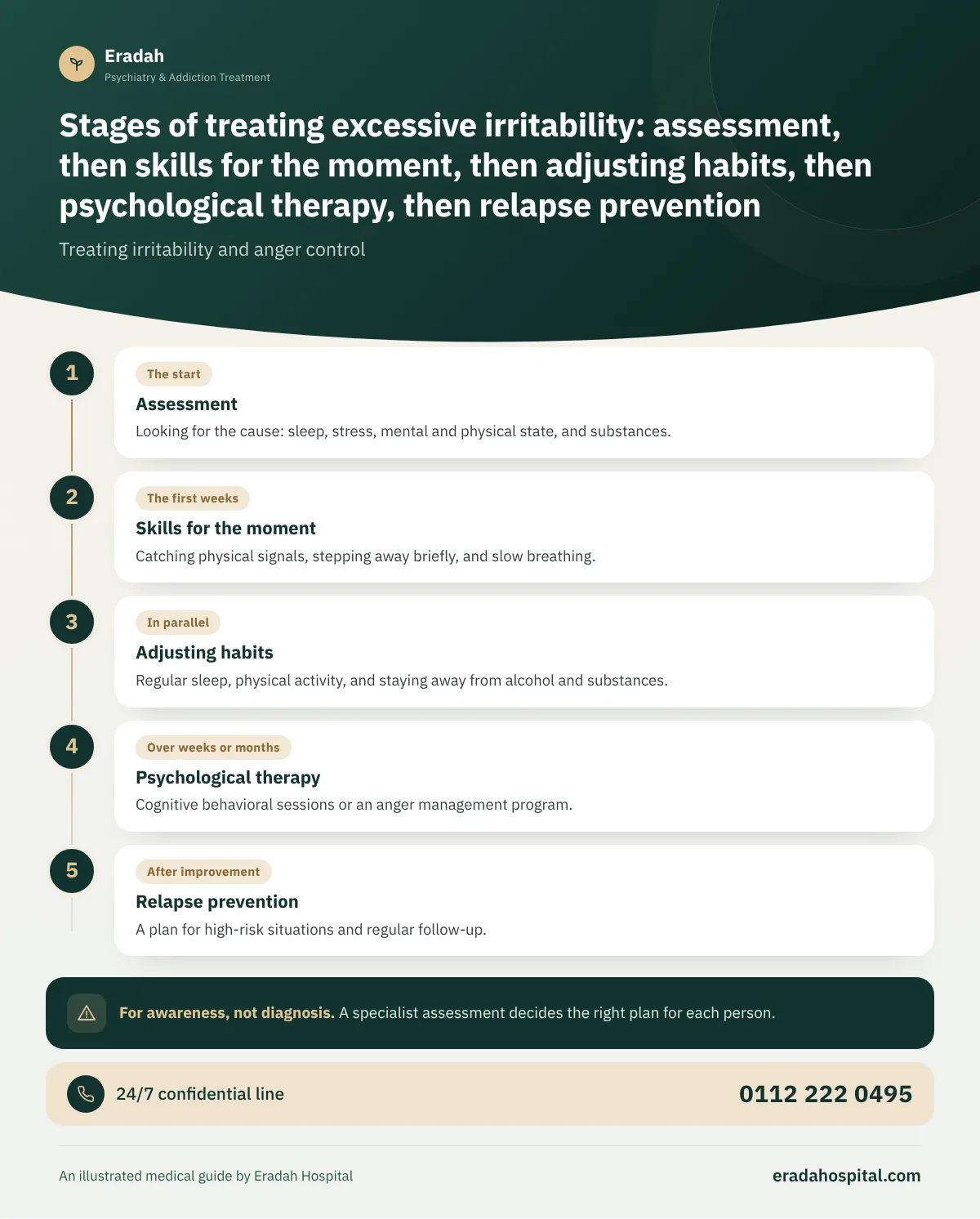
What are the stages of treating excessive irritability?
- The startAssessment
Looking for the cause: sleep, stress, mental and physical state, and substances.
- The first weeksSkills for the moment
Catching physical signals, stepping away briefly, and slow breathing.
- In parallelAdjusting habits
Regular sleep, physical activity, and staying away from alcohol and substances.
- Over weeks or monthsPsychological therapy
Cognitive behavioral sessions or an anger management program.
- After improvementRelapse prevention
A plan for high-risk situations and regular follow-up.
How do you control your anger in the moment?
- Catch the physical signal early: a hot face, a clenched jaw or a tight fist means the wave has started. The UK's National Health Service recommends mindfulness exercises so you notice anger starting early and calm down as soon as possible.
- Give yourself time before replying: count to ten and breathe calmly, as the NHS suggests.
- Step out of the situation briefly: “I need five minutes and I'll be back to continue,” and then really walk away.
- Move your body: a brisk walk or climbing stairs releases the charge safely.
- Postpone decisions and messages: do not send or decide anything while you are angry.
- Review your interpretation: is there another possible explanation for what happened besides it being deliberate?
- Come back using “I” language: “I felt upset when…” instead of “You always…”.
Which daily habits reduce irritability?
| Habit | Why it helps |
|---|---|
| Enough sleep | Lack of sleep increases the intensity of anger, as a randomized experiment on 142 people showed |
| Regular exercise | The NHS notes that running, walking, swimming and yoga help you relax and reduce stress |
| Talking to a neutral person | The NHS advises talking about what angers you with someone not involved in the situation, such as a friend or a doctor |
| Small goals | Not trying to do everything at once, and focusing on what can be changed, reduces frustration |
| Staying away from substances | The NHS warns against using alcohol, cigarettes, gambling or drugs to vent anger |
What is the psychological treatment for excessive irritability?
Cognitive behavioral therapy is the core treatment for anger, and the NHS notes that most anger management programs include it, and that a program may be a one-day course, a weekend, or may run over a few months. In the sessions, the person learns to:
- Recognize their own triggers and early physical signals.
- Change the thoughts that fuel anger, such as “He's targeting me” and “He needs to be taught a lesson.”
- Calming and relaxation skills.
- Assertive communication without aggression, and problem solving.
- A plan for relapse prevention and for high-risk situations.
The evidence supports this approach: in a statistical analysis by Michael Saini covering 96 studies, psychological treatments for anger were generally effective, with variation in the size of the benefit linked to the number of sessions and the use of a structured treatment manual. In another analysis by Del Vecchio and O'Leary covering 23 studies of adults with anger problems, the different treatments achieved a medium to large effect, and the results supported cognitive therapy for anger as a lasting trait, and relaxation for momentary outbursts of anger.
These skills can be delivered individually or in group therapy sessions, and dialectical behavior therapy also helps when anger is linked to marked emotional instability.
Is there medication for excessive irritability?
There is no “irritability medication” that suits everyone. The doctor decides on medication according to the cause: treating depression or anxiety if they are behind the irritability, treating ADHD, or mood stabilizers in bipolar disorder. For intermittent explosive disorder specifically, a double-blind randomized trial by Emil Coccaro and colleagues on 100 people found that fluoxetine, a selective serotonin reuptake inhibitor, reduced impulsive aggression and irritability compared with a placebo, and full or partial improvement in episodes of impulsive aggression occurred in 46% of those who received it. Only the doctor decides whether any medication is suitable, and its dose and monitoring, so do not start or stop any medication without a doctor.
How is drug-related irritability treated?
If the irritability results from substance use or withdrawal, the real treatment is treating the addiction itself. Withdrawal from some substances needs medical supervision in a detox program, followed by a rehabilitation program that teaches skills for dealing with stress and anger without substances. At Eradah, anger and substance use are assessed together within the dual diagnosis program.
How can the family help in treating excessive irritability?
- Choose a calm time to talk about the problem, not the moment of an outburst.
- Agree together on the plan for stepping away briefly and the signal word.
- Praise successful attempts to control anger, even small ones.
- Do not put up with violence in the name of patience; safety comes first.
- If there is a threat or violence in the home, ask for help right away, and call the police (122) or an ambulance (123) in case of imminent danger.
When do you need specialist treatment?
If your own attempts do not work, or you are behaving abusively or violently, or the anger comes with stress, anxiety or depression, these are signs the NHS lists for seeking medical help. Notably, the Kessler survey and colleagues found that fewer than a third of people with intermittent explosive disorder had ever received treatment for their anger, even though effective treatments are available. Start with a confidential consultation in Eradah's outpatient clinics.
Anger that has reached violence or thoughts of harm? Act now
- Threatening or attacking a family member or children, or smashing things in a way that puts someone in danger
- Talk of harming oneself or others, or of death
- Severe agitation with suspicion, hallucinations or confusion, especially after substance use
- An anger outburst with chest pain, a sudden severe headache or weakness on one side of the body
- Severe irritability with trembling, sweating and sleeplessness after suddenly stopping alcohol or sedatives
First move away from the danger and get children out, and do not attempt a physical confrontation. If there is imminent danger to anyone, call the police (122) or an ambulance (123). If the peak has passed and thoughts of death or self-harm appear, do not leave the person alone, calmly ask them what they are thinking, and call the mental health support line 16328 (24 hours) or take them to the nearest emergency room.
Ambulance 123 Mental health support line 16328