What is irritability?
“I'm not like this… but I've started getting irritated by every word, and afterwards I stay upset with myself.” Many people say this sentence, and doctors hear it every day. Irritability is not a fixed “temperament” that never changes, as some think. It is usually the result of something happening in the body, in life or in the brain, and knowing what it is is half the way to calm.
The UK's National Health Service says most people get angry sometimes, and that anger can affect how you feel physically and mentally and how you behave: some people become aggressive toward others when angry, while others hide their anger and turn it on themselves. Irritability, by contrast, is when the “fuse” of anger becomes very short: the person explodes quickly, with a louder voice and harsher words than the situation deserves, and then finds it hard to calm down.
When is anger normal, and when does it become a problem?
Anger is a healthy response to injustice, threat or frustration, and it sometimes drives you to defend your rights. But the difference between healthy anger and a problem lies in proportion, frequency, the way it is expressed, and the outcome:
| Point of comparison | Normal anger | Excess irritability |
|---|---|---|
| Severity | Proportionate to the size of the situation | Far greater than the situation, over small things |
| Frequency | Occasionally | Weekly or daily |
| Expression | Through words and dialogue | Intense shouting, insults, smashing things or hitting |
| Calming afterward | Calms within a short time | Lasts for hours or turns into a grudge |
| Result | Does not damage relationships | Losses at home or work, or legal problems |
What happens in the body and brain during anger?
Anger is a physical wave too, not just a thought. When the brain senses an insult or threat, the body releases adrenaline, so the heart speeds up, blood pressure rises, the jaw and fists tighten, and the face grows hot. At the peak of the wave, the front parts of the brain responsible for calm thinking and weighing consequences temporarily step back, which is why a person says or does in a moment of anger what they would not say when calm.
The important news is that this wave rises and then falls. Someone who learns to notice its physical start can gain a few minutes, enough for the peak to pass without an explosion.
How does an anger outburst build?
An anger outburst usually passes through five stages, each with a signal you can catch and step in at:
- 1The situation
A word, a delay, a crowd or criticism, and it often lands on top of an exhausting day or a sleepless night.
- 2Explanation
“He's provoking me on purpose” or “nobody respects me,” which fuels the anger more than the situation itself.
- 3The charge
A hot face, a clenched fist, a fast pulse and short breath.
- 4The explosion
A loud voice, hurtful words or smashing things, when logical thinking is hard.
- 5After the outburst
Calm and then regret and shame, or justification and blaming others, so feelings pile up for next time.
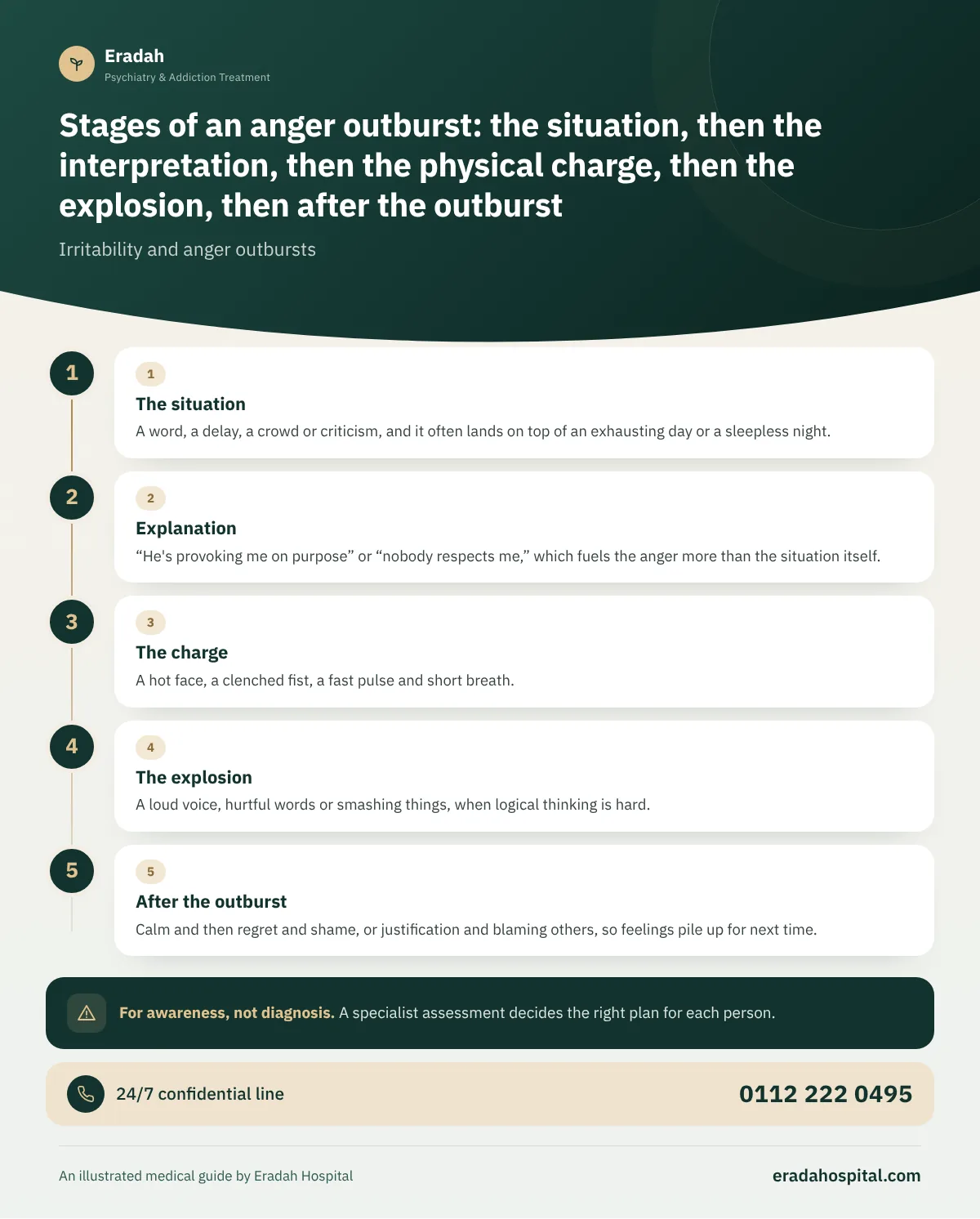
The second stage is the key to most treatment programs, because changing the interpretation changes the size of the anger, which we explain in detail in irritability treatment.
What is intermittent explosive disorder?
When sudden anger outbursts keep recurring with an intensity out of proportion to the situation, and no other mental disorder or substance explains them, the doctor may diagnose intermittent explosive disorder. The outburst comes quickly and is short, and may include shouting, smashing things or assault, and is often followed by regret or shame.
In a US national survey of 9,282 adults published by Ronald Kessler and colleagues in 2006, the lifetime prevalence of this disorder was estimated at about 7.3%, and over one year at about 3.9%, with an average age of onset of 14 years. Notably, only 28.8% of those with it had ever received treatment for their anger.
Causes of irritability in brief
Irritability rarely has a single cause. Among the best-known contributors are accumulated stress, lack of sleep, depression and anxiety, attention-deficit/hyperactivity disorder, post-traumatic stress disorder, drug use or withdrawal, and some physical causes. The details and what studies say are in causes of irritability.
Irritability and drugs
The UK's National Health Service notes that drugs and alcohol make some people more aggressive than usual. If a family notices that their calm son has suddenly become irritable and agitated, with changes in sleep, friends and money, these are signs worth attention, as we explain in signs of drug use. Stimulants such as crystal meth (shabu) can cause aggression and suspicion, and irritability is one of the best-known withdrawal symptoms, as in tramadol withdrawal. In these cases calming advice is not enough; the substance use itself needs treatment.
What are the harms of irritability?
The price of repeated anger is not limited to relationships. In a statistical analysis by Yoichi Chida and Andrew Steptoe published in 2009 in the Journal of the American College of Cardiology, covering 25 studies of people who were initially healthy, anger and hostility were linked to about a 19% increase in coronary heart disease events, and to a worse outlook in people with heart disease, with the researchers noting signs of publication bias in these studies. Beyond the heart, repeated anger leaves its mark on family, children and work, and may lead to legal problems when it reaches violence.
Irritability treatment in brief
Treatment starts with an assessment that looks for the cause, then in-the-moment control skills such as a temporary time-out and slow breathing, then cognitive behavioral therapy and anger management programs, and the doctor may prescribe medication when the anger is driven by a disorder that calls for it. The practical steps and what research says are in irritability treatment and anger control.
How do you deal with an irritable person?
- Do not argue with them at the peak of an outburst; logic does not get through at that moment.
- Lower your voice and keep a safe distance, and do not corner them in a small space.
- Postpone the discussion until a calm time, and talk about the behavior, not the person.
- Notice whether the irritability is new and comes with other changes that may point to substance use.
- Encourage them to get a mental health assessment, in the language of care, not accusation.
- Set clear limits: violence is unacceptable, and your safety and your children's safety come first.
When do you need a psychiatrist because of irritability?
The UK's National Health Service advises seeking medical help if you find it hard to handle your anger and your own attempts have not worked, if you are behaving abusively or violently, if you are under stress or have anxiety or depression, or if your mood has been low for more than two weeks. You can start with a confidential consultation at Eradah Psychiatric Hospital.
Irritability guide: everything you need to know
We have gathered everything about irritability into 2 pages, each answering one question in detail. Choose what you are looking for:
Causes of irritability
What causes irritability and quick temper? Stress, lack of sleep, depression, ADHD and trauma, drugs and their withdrawal, physical causes such as the thyroid and pain, and what we learn as children.
Treating irritability and anger control
How do you treat irritability and control your anger? Practical steps in the moment of an outburst, daily habits, anger management programs and cognitive behavioral therapy, when the doctor prescribes medication, and the role of the family.
Anger that has reached violence or thoughts of harm? Act now
- Threatening or attacking a family member or children, or smashing things in a way that puts someone in danger
- Talk of harming oneself or others, or of death
- Severe agitation with suspicion, hallucinations or confusion, especially after substance use
- An anger outburst with chest pain, a sudden severe headache or weakness on one side of the body
- Severe irritability with trembling, sweating and sleeplessness after suddenly stopping alcohol or sedatives
First move away from the danger and get children out, and do not attempt a physical confrontation. If there is imminent danger to anyone, call the police (122) or an ambulance (123). If the peak has passed and thoughts of death or self-harm appear, do not leave the person alone, calmly ask them what they are thinking, and call the mental health support line 16328 (24 hours) or take them to the nearest emergency room.
Ambulance 123 Mental health support line 16328