Why do some people get angry faster than others?
The UK's National Health Service says the causes of anger are many and differ from person to person, and that what angers you may not bother someone else at all. It lists common situations: being treated unfairly and feeling powerless to do anything about it, feeling threatened or attacked, others not respecting your feelings or belongings, or someone interrupting you while you are trying to reach a goal.
But a more useful question than “What made me angry?” is “Why has my fuse become so short?” The situation is the same, but your ability to tolerate it changes with your sleep, your stress, your mental and physical state, and what you are using or have stopped using.
What are the best-known causes of excessive irritability?
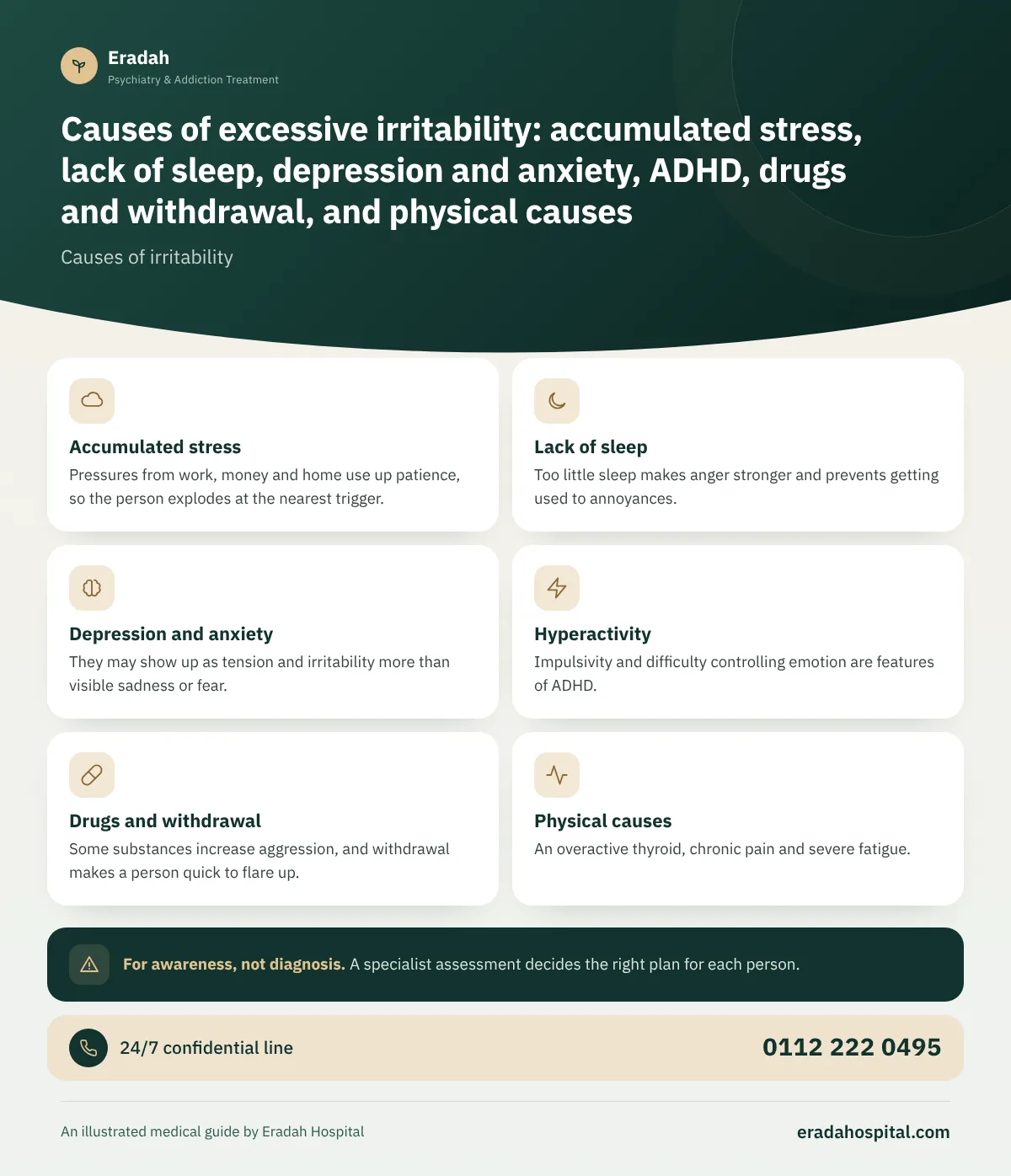
Pressures from work, money and home use up patience, so the person explodes at the nearest trigger.
Too little sleep makes anger stronger and prevents getting used to annoyances.
They may show up as tension and irritability more than visible sadness or fear.
Impulsivity and difficulty controlling emotion are features of ADHD.
Some substances increase aggression, and withdrawal makes a person quick to flare up.
An overactive thyroid, chronic pain and severe fatigue.
How do lack of sleep and stress make you more irritable?
In a randomized experiment published by Zlatan Krizan and Garrett Hisler in 2019, 142 people from the community were divided into a group that kept their usual sleep and another that cut their sleep for two days, and the researchers then rated their anger during a simple task accompanied by annoying noise. The result was that sleep restriction increased anger, and even disrupted the habituation to the annoyance that normally eased with repetition, and feeling sleepy explained most of this effect.
As for stress, the NHS says that people dealing with many problems or pressures may find it harder to control their anger. That is why the first things a doctor asks are: how are you sleeping, and what are you carrying these days? Read about stress and how it shortens the fuse.
Which mental health conditions cause excessive irritability?
Irritability is a shared symptom in many mental health conditions, and in these cases treating the underlying disorder is the key to calm. The Kessler survey and colleagues found that intermittent explosive disorder itself is clearly associated with most mood and anxiety disorders and with substance use.
| The situation | How irritability shows up in them |
|---|---|
| Depression | Distress, tension and impatience, and in some people irritability may outweigh visible sadness |
| Bipolar disorder | Severe irritability during manic or hypomanic episodes, with little sleep and excess energy |
| Post-traumatic stress disorder | Constant tension and alertness, which the NHS says can lead to angry outbursts |
| Borderline personality disorder | Intense, sudden anger with rapid swings in emotions and relationships |
| Attention-deficit/hyperactivity disorder | Impulsivity and difficulty controlling emotion and waiting |
| Anxiety disorders | Ongoing tension that makes any extra annoyance unbearable |
How do drugs and withdrawal cause excessive irritability?
Substances are among the causes the NHS names explicitly, saying that drugs and alcohol make some people more aggressive than usual, and advising against using alcohol, cigarettes or drugs to vent anger. This happens in different ways:
- During use: stimulants can cause tension, suspicion and aggression, and synthetic cannabinoids such as Strox can cause sudden agitation.
- Alcohol: weakens inhibitions, making the aggressive response quicker in some people.
- During withdrawal: irritability and tension are among the best-known symptoms of withdrawal from tramadol, hashish and sedatives, and may last days or weeks.
- The lifestyle that goes with it: staying up late, debts, lying and conflicts add to the whole load of stress.
So if irritability appears suddenly in someone who used to be calm, along with changes in sleep, money and friends, it is wise to consider substance use. In that case the treatment lies in dual diagnosis, not in calming advice alone.
Are there physical causes of excessive irritability?
Yes, which is why the doctor may order tests before attributing the irritability to a psychological cause:
- Overactive thyroid: the MedlinePlus medical encyclopedia lists irritability, restlessness, sleep problems and sweating among its symptoms.
- Chronic pain: constant pain drains the ability to cope and disrupts sleep.
- Severe fatigue: accumulated tiredness reduces patience in the simplest situations.
- Hormonal changes: such as the premenstrual period in some women.
- Some medications: may cause irritability or restlessness as a side effect, so check with your doctor before stopping any medication and do not stop it on your own.
Is excessive irritability inherited or acquired?
Usually a mix of both. The NHS says your family history affects how you handle anger, and you may have learned unhelpful ways of dealing with it from the adults around you in childhood. A child who grew up in a home where disputes were settled by shouting or hitting may see that as normal. The temperament a person is born with may also play a role, but it is not destiny; anger-management skills can be learned at any age through training and therapy.
The NHS adds that people who have been through traumatic or frightening events may develop post-traumatic stress disorder, which can lead to angry outbursts, and that what angers you may not bother others at all and it may be hard to explain why, but talking to someone can help find a solution.
When does sudden irritability point to a problem that needs checking?
- New irritability in someone who used to be calm, with no clear reason.
- Irritability with severe lack of sleep, excess energy and racing thoughts.
- Irritability with changes in friends, money and behavior.
- Irritability with persistent sadness or talk about death.
- Irritability with physical symptoms such as weight loss, palpitations, tremor and sweating.
- Irritability that escalates to threats or violence.
In these cases, start with a psychiatric medical assessment that looks for the cause, then move on to the irritability treatment plan that suits it.
Anger that has reached violence or thoughts of harm? Act now
- Threatening or attacking a family member or children, or smashing things in a way that puts someone in danger
- Talk of harming oneself or others, or of death
- Severe agitation with suspicion, hallucinations or confusion, especially after substance use
- An anger outburst with chest pain, a sudden severe headache or weakness on one side of the body
- Severe irritability with trembling, sweating and sleeplessness after suddenly stopping alcohol or sedatives
First move away from the danger and get children out, and do not attempt a physical confrontation. If there is imminent danger to anyone, call the police (122) or an ambulance (123). If the peak has passed and thoughts of death or self-harm appear, do not leave the person alone, calmly ask them what they are thinking, and call the mental health support line 16328 (24 hours) or take them to the nearest emergency room.
Ambulance 123 Mental health support line 16328