The question “Am I addicted?” is not settled by the amount you use alone, but by what the use does to your life and your ability to control it. These questions go through the same signs a doctor assesses, so you understand what addiction means in practical terms.
Start the drug addiction test
How is the score calculated?
Each “yes” answer represents one of the eleven signs, so your score is the number of signs that applied to you over the past year. The diagnostic manual sets severity by the number of signs, provided they cause clear distress or affect your life:
| Number of signs | What it corresponds to | Suggested step |
|---|---|---|
| 0 – 1 | Does not reach the minimum threshold | Self-monitoring and early stopping |
| 2 – 3 | Mild | Assessment by a specialist and early intervention |
| 4 – 5 | Moderate | Specialist assessment and a structured treatment plan |
| 6 – 11 | Severe | Urgent assessment, and often medically supervised detox followed by rehabilitation |
What to do after your result
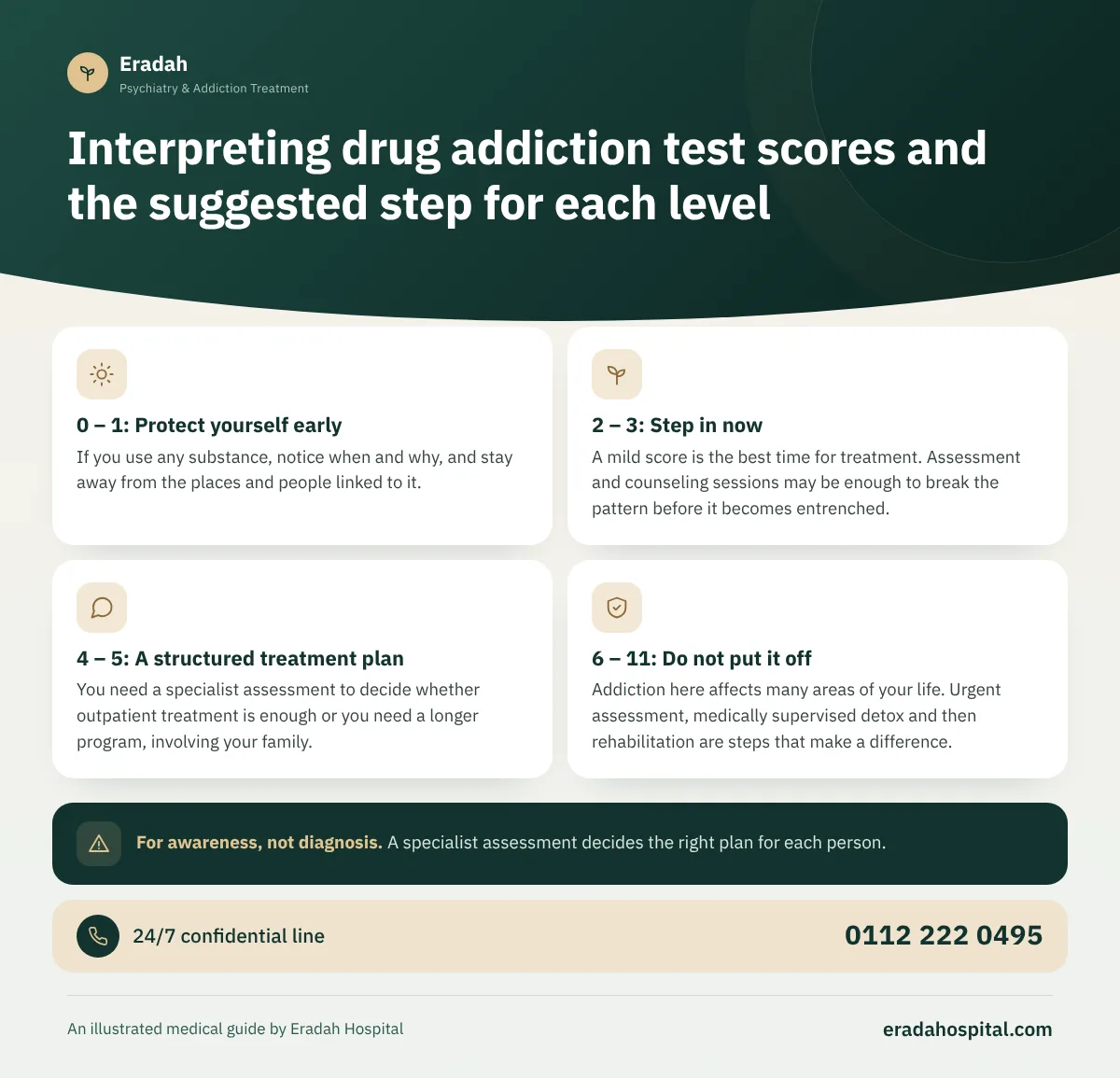
If you use any substance, notice when and why, and stay away from the places and people linked to it.
A mild score is the best time for treatment. Assessment and counseling sessions may be enough to break the pattern before it becomes entrenched.
You need a specialist assessment to decide whether outpatient treatment is enough or you need a longer program, involving your family.
Addiction here affects many areas of your life. Urgent assessment, medically supervised detox and then rehabilitation are steps that make a difference.
What happens in an assessment session?
Many people put off the first step for fear of being judged or of having a treatment imposed on them that they do not want. The truth is that the assessment session is a confidential conversation whose aim is for the doctor to understand the full picture before any decision, and it usually includes:
- Questions about the substances you use, since when, and how your use has changed over time.
- A review of your physical and mental health, and the medications you take.
- Estimating the risk of withdrawal, to decide whether stopping needs medical supervision.
- Talking about your family, your work, and the support around you.
- Agreeing with you on a clear plan that suits your situation, whether outpatient treatment or a longer program.
Going for an assessment does not commit you to anything afterward; it is a step to find out where you stand, and the decision remains yours. And if you fear relapse after earlier attempts, know that relapse is common on the road to recovery and does not mean treatment has failed, but that the plan needs adjusting and longer follow-up.
If you are a family member, remember that pressure and threats rarely persuade a person to accept treatment, while calm talk about specific situations opens a door to thinking. You can start by asking for a consultation yourself to learn how to act, even before they agree.
What are these questions based on?
The fifth edition of the Diagnostic and Statistical Manual of Mental Disorders, DSM-5, issued by the American Psychiatric Association in 2013, merged the concepts of “abuse” and “dependence” into a single diagnosis called substance use disorder, measured on a spectrum from mild to severe. Its eleven criteria fall into four groups: impaired control, social harm, risky use, and pharmacological signs, which are tolerance and withdrawal.
The questions here are a simplified wording of these criteria, not a scale published with its own validation studies; they help you review yourself the way a doctor thinks, while actual diagnosis relies on a detailed interview.
Limits of the test
- It does not diagnose addiction; the doctor assesses how long symptoms have lasted and their impact, and rules out other causes.
- Tolerance and withdrawal are not counted if you are taking a prescribed medication under medical supervision and as directed.
- It depends on the honesty of your answers, and denial is a common part of addiction itself.
- It does not measure the risk of overdose or of mixing substances, which are present at any score.
- A low score does not mean use is safe, especially in adolescents.
Addiction and mental health
Many people with addiction also have depression, anxiety or another mental disorder, and sometimes the use begins as an attempt to cope with these symptoms. The most successful treatment deals with both conditions together in a dual diagnosis program. Residential care at Eradah is available for men, while women and adolescents receive assessment and follow-up services.
If you want to talk about your result, or you are worried about a son, husband or brother, contact us on 01122220495 for a free and completely confidential consultation.