After an accident, an assault, or a sudden loss, most people need time for the impact to settle. But when nightmares, constant alertness, and avoidance continue for weeks, it may be post-traumatic stress disorder. These short questions help you check.
Start the PTSD test
How is the score calculated?
The first question, about exposure to a traumatic event, is not part of the score; it determines whether the scale applies to you. If your answer is “yes,” each “yes” in the five following questions equals one point, so the result is from 0 to 5. The scale's developers set a score of 3 as the cutoff:
| Level | Result | Suggested step |
|---|---|---|
| 0 – 2 | Negative screen | Monitor your symptoms and ask for help if they continue |
| 3 – 5 | Positive screen | Assessment with a psychiatrist to confirm the diagnosis |
What to do after your result
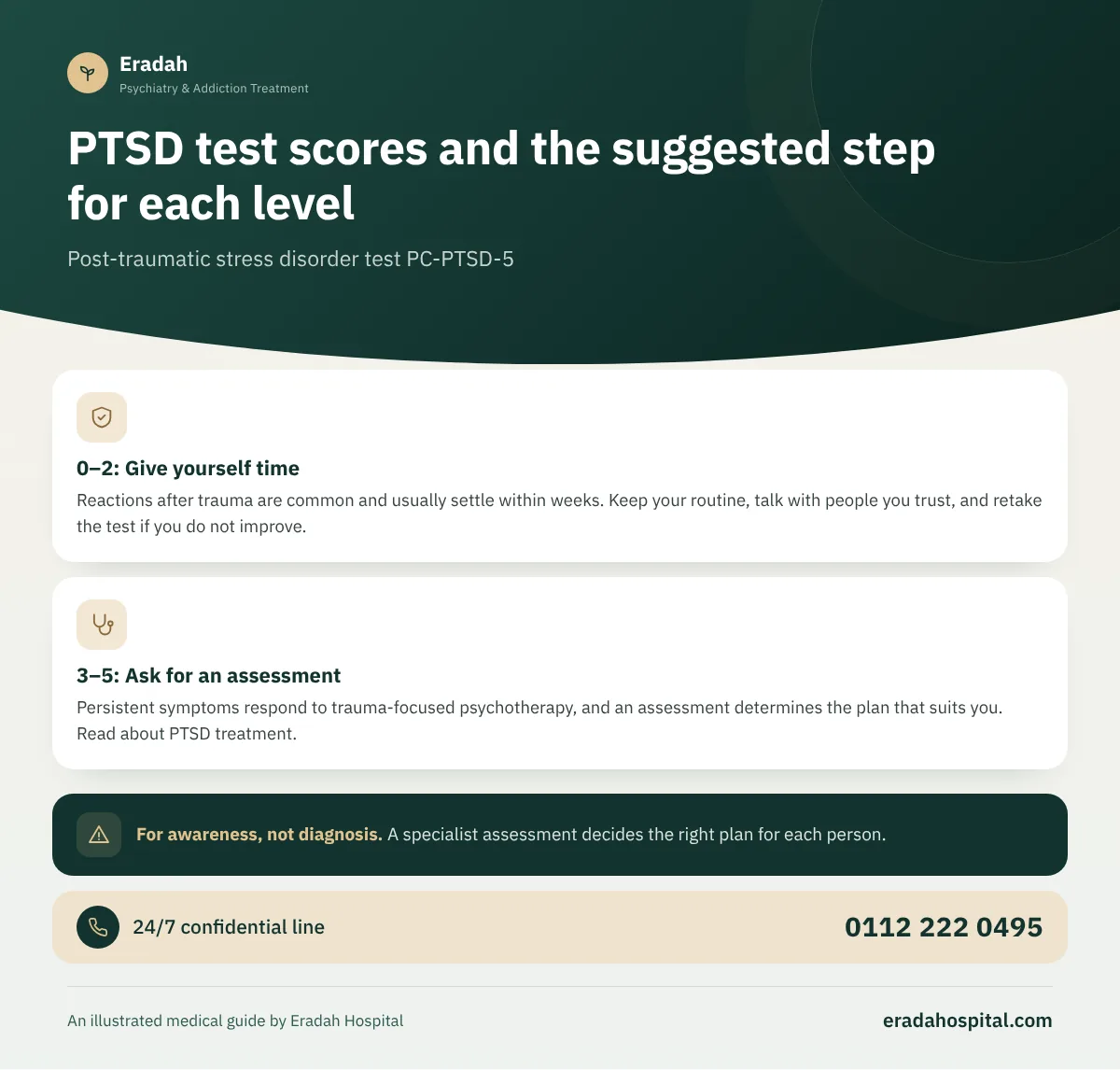
Reactions after trauma are common and usually settle within weeks. Keep your routine, talk with people you trust, and retake the test if you do not improve.
Persistent symptoms respond to trauma-focused psychotherapy, and an assessment determines the plan that suits you. Read about PTSD treatment.
What is the PC-PTSD-5?
The researcher Annabel Prins and her colleagues at the National Center for PTSD, part of the US Department of Veterans Affairs, developed this scale, and it was published in 2016 to match the fifth edition of the Diagnostic and Statistical Manual of Mental Disorders. Its five questions correspond to the core symptom clusters: re-experiencing, avoidance, hyperarousal, emotional numbing, and blaming oneself or others.
In the original validation study, a score of 3 or higher picked up the great majority of PTSD cases confirmed by a clinical interview, and a later study in 2021 confirmed its accuracy and ease of use in primary care clinics. The scale is available for public use without prior permission.
Symptoms worth noticing after trauma
- Reliving the event in intrusive memories or nightmares, or feeling as if it is happening all over again.
- Avoiding places, people, or conversations that remind you of it.
- Constant tension, trouble sleeping and concentrating, and being startled by the slightest sounds.
- Persistent negative feelings such as guilt, fear, and anger, and a dulling of interest in what used to bring you joy.
If these symptoms last more than a month and affect your life, they deserve an assessment. You will find a fuller explanation in the article on PTSD symptoms.
How do you support someone who has been through trauma?
If the test is for a relative of yours, how you treat them may ease a great deal for them:
- Listen without pressing them to tell the details, and let them choose when to speak and how much.
- Avoid phrases like “forget what happened” or “it could have been worse.”
- Help them keep their routine of sleeping, eating, and going out as much as possible.
- Watch for signs of severe withdrawal, increased substance use, or talk of death, and encourage them to get assessed.
Remember that family support does not replace treatment when symptoms persist, but it makes the road to treatment easier.
Limits of the test
- It does not diagnose PTSD; a diagnosis requires an interview with a psychiatrist.
- It was designed for adults in primary care and is not suitable for assessing children.
- It does not measure symptom severity; it screens for who needs a deeper assessment.
- If the trauma is very recent, the symptoms may be an acute reaction that settles with time.
- Depression, anxiety, and substance use can overlap with the result, and a low score does not cancel out real suffering.
Trauma and addiction
Psychological trauma is among the strongest drivers of substance use; alcohol, sedatives, and opioid painkillers may dull memories and bring temporary sleep, but they disrupt the natural recovery from trauma and add a dependence that is hard to leave. If you find yourself turning to a substance to forget, treating both together works better, as the article on PTSD and addiction explains.
Free confidential consultation
Talking about trauma is not easy, and you will not be asked to say more than you want to. If you want to understand your result or ask about the next step, contact the Eradah team for a free, confidential consultation on 01122220495.