Is the traumatic event the only cause?
The traumatic event is an essential condition for the diagnosis, but it is not the whole cause. The World Health Organization estimates that about 70% of people experience a potentially traumatic event in their lifetime, yet only about 5.6% of those exposed develop the disorder. So the real question is: what makes the memory "stick" in some people?
Science answers that the disorder results from the interaction of three layers: what happened (the nature of the trauma), who it happened to (biological and psychological predisposition and prior history), and what came after (safety, support and later stresses). No single factor decides the outcome on its own.
Does the risk differ by type of trauma?
Yes. Studies indicate that traumas deliberately caused by another person, such as physical or sexual assault, torture and domestic violence, are linked to a higher likelihood of developing PTSD than accidents or natural disasters, because they shake trust in people and a sense of safety at the same time. The risk is also higher in war zones; the World Health Organization estimates the rate among people exposed to armed conflict at about 15.3%.
| Feature | Why does it raise the risk? |
|---|---|
| Trauma deliberately inflicted by a person | Destroys the sense of trust and safety in relationships |
| Repeated or prolonged trauma | Leaves no chance to recover between events, and is linked to complex trauma |
| Physical injury during the event | Adds pain and long treatment that keeps reminding the person of the event |
| Witnessing a death or serious injury | Leaves intense sensory images that are hard to process |
| Feeling totally helpless | Being unable to escape or resist deepens the sense of threat |
| Violent loss of a loved one | Combines grief and trauma at the same time |
What is the role of the brain and stress hormones?
In a moment of danger, the body releases adrenaline and cortisol as part of the "fight or flight" response. The brain quickly learns to link everything that accompanied the danger, such as sounds, smells and places, with the feeling of threat. This fast learning is useful for survival, but in PTSD it does not switch off when the danger is gone.
Imaging research in some people with PTSD shows overactivity in the amygdala, the brain's alarm center, and relative weakness in areas of the prefrontal cortex that calm it and distinguish past from present, along with differences in the regulation of the stress hormone axis. These are group-level findings and cannot be used to diagnose an individual.
Is PTSD hereditary?
The disorder itself is not inherited, but genes influence how sensitive a person is to stress and how their nervous system and hormones respond. This is why the risk is slightly higher for people with a family history of mental health conditions such as depression, anxiety and addiction. Even so, experience and support still have a major influence; genetic predisposition is not an inescapable fate.
How do difficult childhood experiences affect risk?
One of the strongest risk factors is exposure to trauma, neglect or cruelty in childhood. A brain that grew up in an unsafe environment learns that the world is dangerous and becomes more sensitive to threat in adulthood. That is why someone may develop the disorder after an event in their thirties while its deeper roots lie in their childhood.
Prolonged childhood abuse is also one of the main causes of complex trauma, because it takes place at a stage when a child's image of themselves, their ability to trust others and their ability to regulate emotions are being formed.
Why does what happens after the trauma matter?
Many studies find that conditions after the event affect the likelihood of developing PTSD as much as the event itself, or more. Lack of support, blame or disbelief, or new stresses such as losing a job or home or a long recovery from injury all raise the likelihood. In contrast, a sense of safety and having someone who listens and believes you are protective.
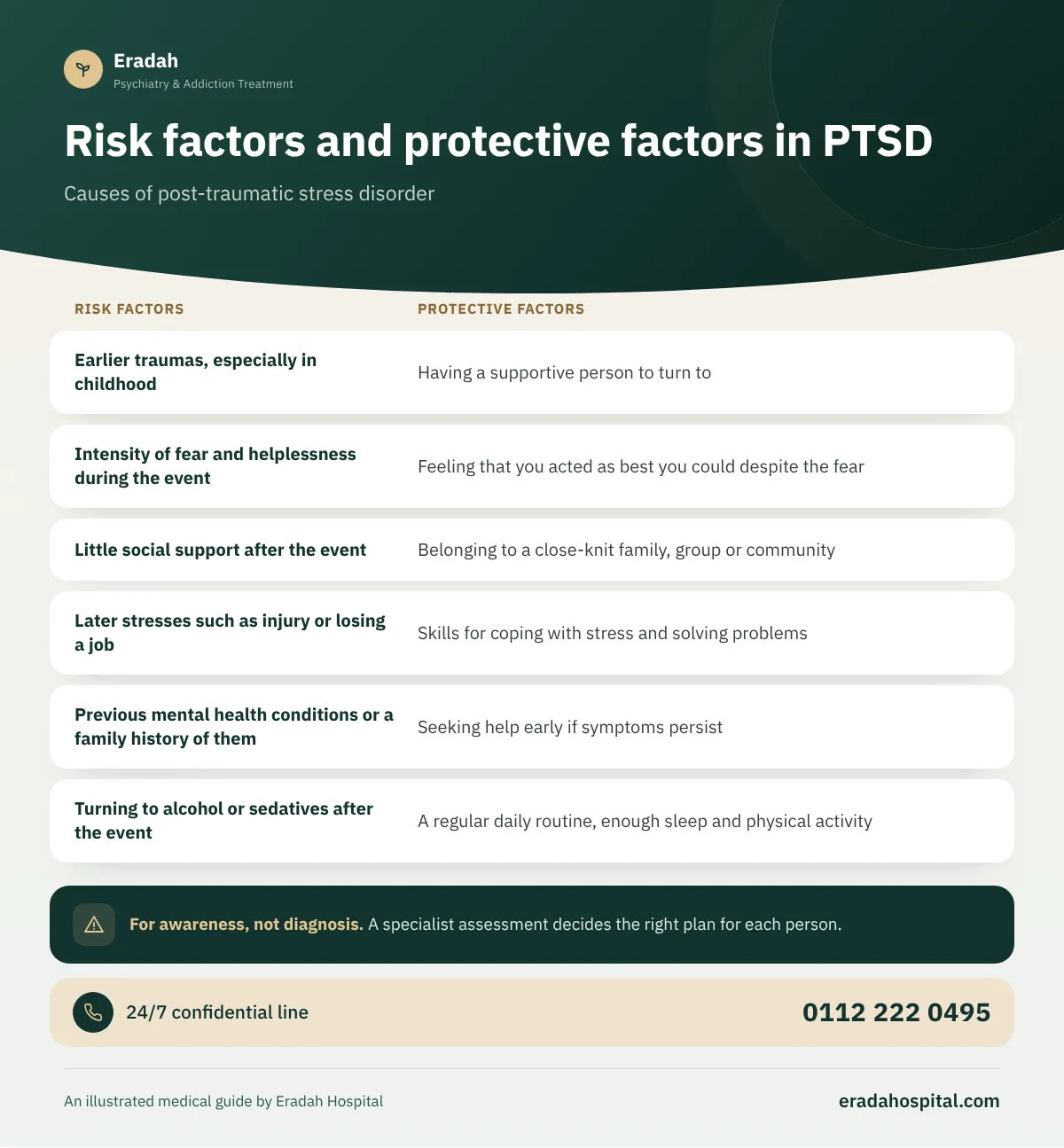
Risk factors and protective factors
| Risk factors | Protective factors |
|---|---|
| Earlier traumas, especially in childhood | Having a supportive person to turn to |
| Intensity of fear and helplessness during the event | Feeling that you acted as best you could despite the fear |
| Little social support after the event | Belonging to a close-knit family, group or community |
| Later stresses such as injury or losing a job | Skills for coping with stress and solving problems |
| Previous mental health conditions or a family history of them | Seeking help early if symptoms persist |
| Turning to alcohol or sedatives after the event | A regular daily routine, enough sleep and physical activity |
Who is most at risk?
- Survivors of violence, assault, war and displacement.
- People in jobs with repeated exposure to trauma: ambulance and emergency staff, firefighters, police, and journalists in conflict zones.
- Women, partly because of the kinds of trauma they are more often exposed to.
- Children who go through trauma without a supportive and safe adult.
- People who already have depression, anxiety or addiction.
- Patients who have had harsh medical experiences, such as a long stay in intensive care.
Can trauma be passed on to those close to the person?
Doctors, therapists and family members who constantly listen to distressing details or care for a traumatized person over a long time may be affected, in what is known as secondary trauma. The DSM-5 also recognizes that repeated, direct exposure to traumatic details through work can be enough for the disorder to develop. This is why we always stress that families should look after themselves too.
Myths about the causes of trauma
| The myth | The truth |
|---|---|
| "It only affects people who lack strength to cope." | Even the strongest people can develop it if the event is severe and support is absent. |
| "If the event was small, there is no trauma." | What matters is the person's sense of threat at the time, not other people's assessment of the event. |
| "Old trauma doesn't affect you now." | Childhood trauma is among the strongest risk factors, even decades later. |
| "Drinking or sedatives help you forget." | They disrupt the natural processing of the memory and raise the risk that the disorder will persist. |