Why does pregabalin withdrawal happen?
Pregabalin calms excitatory nerve signals. With regular use, the nervous system adapts to its presence and resets its balance around this constant dampening. When the drug is stopped suddenly, that brake disappears at once, the nervous system becomes overactive, and symptoms appear that are often the opposite of the drug's effect: instead of calm and drowsiness, you get anxiety, insomnia, and tension.
Because pregabalin leaves the body relatively quickly, with a half-life of about six hours in people with healthy kidneys, symptoms can begin within a fairly short time after the last dose.
Pregabalin withdrawal timeline
There is no fixed timetable that applies to everyone. The course depends on how long the drug was used, the amount, and whether the person was mixing it with other substances. But the approximate course described in medical reports is as follows:
- Within 1–2 daysThe start
Anxiety and tension, insomnia, irritability, sweating, nausea, headache, and an urge to go back to the drug.
- Days 2 – 5The peak
Insomnia and anxiety intensify, with diarrhea, palpitations, tremor, and body aches. Panic attacks or confusion may appear. The risk of seizures is higher during this period.
- Week 1–2Easing
Physical symptoms ease gradually, while fatigue, disturbed sleep, and mood swings continue.
- After two weeksA prolonged phase in some people
Anxiety, insomnia, mood swings, and cravings for the drug may continue for several more weeks, especially in people who used it for a long time at high doses.
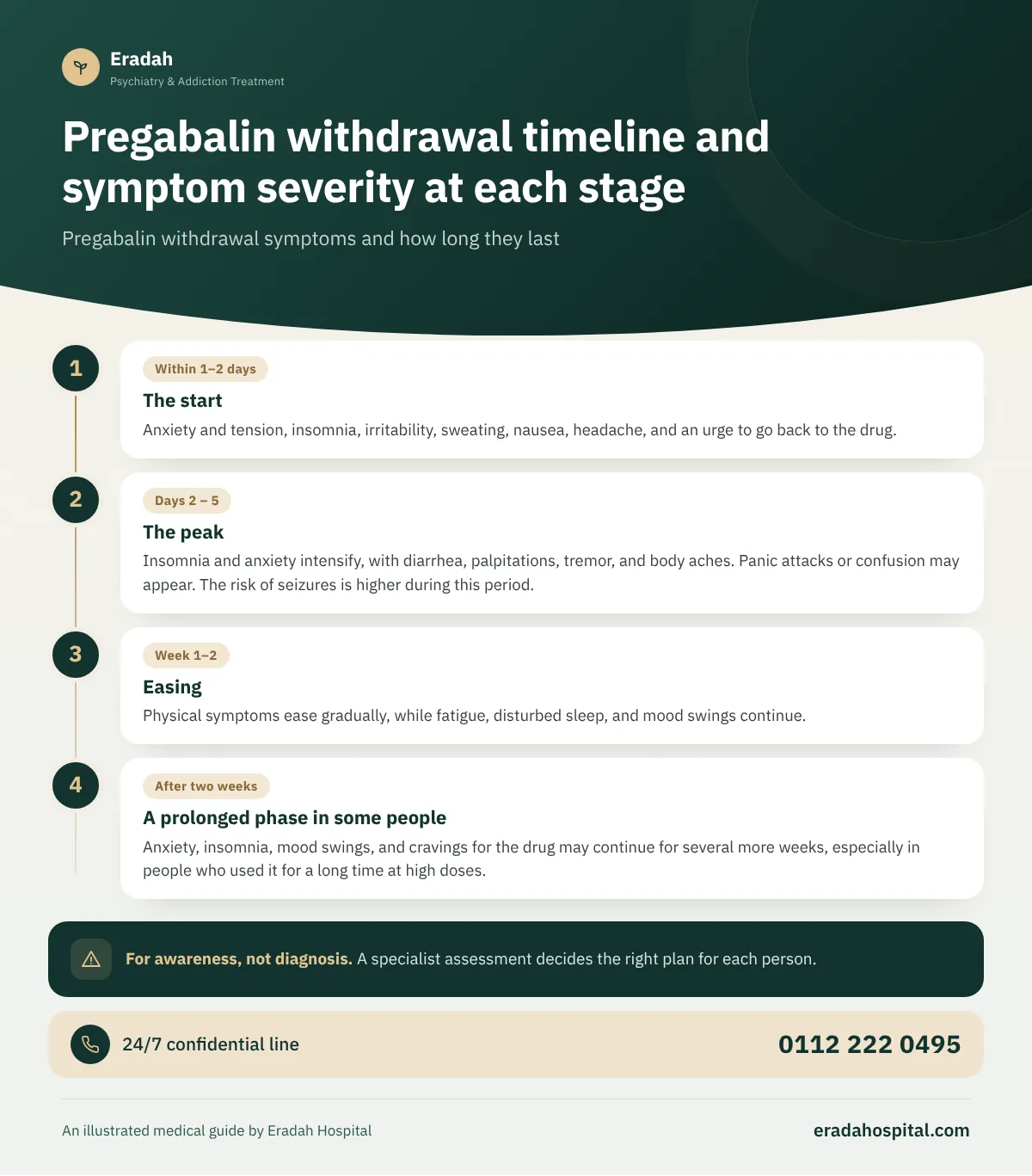
These time frames are approximate, based on case reports and medical references, and vary widely between people.
Physical and psychological symptoms of pregabalin withdrawal
| Type | Symptoms |
|---|---|
| Common physical symptoms | Insomnia, excessive sweating, nausea, headache, diarrhea, and muscle and body aches. |
| Heart and nervous system | Palpitations and a racing heart, tremor, dizziness, and heightened sensitivity to light and sound. |
| Psychological | Severe anxiety, panic attacks, irritability, restlessness, depression, and strong cravings for the drug. |
| Serious | Seizures, severe confusion, and sometimes hallucinations. These need immediate medical attention. |
The official drug leaflet lists insomnia, nausea, headache, anxiety, sweating, and diarrhea among the most common symptoms of sudden discontinuation, while the UK's National Health Service (NHS) adds agitation, panic attacks, palpitations, tremor, and restlessness.
Is pregabalin withdrawal dangerous?
Pregabalin withdrawal may seem like "temporary discomfort," but in some cases it carries real risks:
- Seizures: Stopping suddenly can increase the frequency of seizures in people with epilepsy, and seizures have also been reported in people with no history of epilepsy after abruptly stopping large amounts.
- Return of the original pain or anxiety, sometimes stronger: Someone who was taking it for nerve pain or anxiety may face a temporary, more intense return of symptoms.
- Dual withdrawal: If the person is also using tramadol or other sedatives, the withdrawal symptoms of more than one substance can overlap and complicate the picture.
- Relapse: The severity of the insomnia and anxiety pushes many people back to the drug, sometimes at higher amounts or together with other substances.
Who is most at risk of severe withdrawal?
- People who have used pregabalin for a long time or in amounts much higher than prescribed.
- People with epilepsy, because of the risk of seizures returning.
- People who mix it with tramadol, opioids, benzodiazepines, or alcohol.
- People with a previous anxiety disorder or depression.
- People who have previously had severe withdrawal or seizures when stopping any substance.
Why is it not advisable to stop pregabalin at home?
Stopping suddenly at home means facing insomnia, anxiety, and the risk of seizures without monitoring, without treatment for the underlying pain or anxiety, and without protection against relapse. In a medical setting, it is possible to:
- Set up a safe tapering plan that fits the length of use, the amount, and the person's health.
- Monitor vital signs and catch any seizures or confusion early.
- Manage tramadol withdrawal or withdrawal from other accompanying substances within the same plan.
- Treat insomnia and anxiety in safe ways that do not create a new dependence.
- Move straight into psychological therapy and a relapse prevention program.
Medical supervision also includes ongoing assessment of the person's mental state: severe anxiety and insomnia during withdrawal can bring on negative thoughts in some patients, and spotting this early is an essential part of safety.
What is prolonged withdrawal after pregabalin?
In some people, symptoms such as insomnia, anxiety, mood swings, poor concentration, and cravings for the drug continue for weeks after the acute phase ends. These symptoms come in waves and ease gradually with time, psychological therapy, and regular sleep. What matters is that the person does not read them as "proof" that they permanently need the drug. They are a temporary phase that can be overcome with the right support.
Pregabalin withdrawal in special groups
Stopping suddenly can bring back seizures in a more severe form, which is why the medication is adjusted only on the decision of a neurologist.
Stopping suddenly without a doctor is not acceptable. Withdrawal or a return of seizures can harm both mother and baby, and the doctor will set up a plan that is safe for both.
Confusion and sleep disturbance may be more severe in older adults, who need monitoring of fluids, blood pressure, and the risk of falls.
Pain may return strongly for a time, and they need an alternative pain management plan alongside the taper.
What if the person is using pregabalin together with tramadol?
This combination is common in Egypt and makes withdrawal more complicated. Tramadol withdrawal has its own symptoms, such as muscle pain, a runny nose, diarrhea, and cravings, and tramadol itself can cause seizures. When this is combined with pregabalin withdrawal, the symptoms overlap and the risk of seizures and relapse rises.
For this reason, it is never advisable to stop both substances suddenly at home. The doctor decides which substance to start with and how to manage each one, and may use approved medications to treat opioid withdrawal. To learn more, see tramadol withdrawal symptoms.
Pregabalin withdrawal compared with other sedatives
| Substance | Approximate onset of symptoms | Main risks |
|---|---|---|
| Pregabalin | Within one to two days | Insomnia and severe anxiety, with seizures in some patients |
| Short-acting benzodiazepines such as Xanax | About one day | Seizures and delirium that can be life-threatening |
| Long-acting benzodiazepines such as Rivotril | After several days | Prolonged withdrawal and seizures |
| Tramadol | Within hours to a day | Pain, diarrhea, and cravings, with a risk of seizures |
This is an approximate comparison for awareness. Onset and severity vary by person, length of use, and amount.
The shared lesson from this comparison is that any sedative medication used regularly should be stopped gradually under medical supervision, not through a sudden decision made alone.
How can the family support someone going through pregabalin withdrawal?
- Understand that irritability and insomnia are part of withdrawal and are not aimed at you personally.
- Help them stick to the medical plan and follow-up appointments.
- Provide a calm environment, and encourage regular sleep, light activity, and good nutrition.
- Do not give them sedatives or sleeping pills from the home medicine cabinet to ease the symptoms.
- Watch for any warning sign such as seizures, severe confusion, or suicidal thoughts, and call an ambulance (123) immediately if they appear.
For the full treatment plan after the stopping phase, from psychological therapy to relapse prevention, see the page on pregabalin addiction treatment.
Signs of pregabalin poisoning or overdose: call an ambulance on 123 immediately
- Extreme drowsiness, or difficulty waking the person, with no response to calling
- Slow, shallow, or irregular breathing, especially if the medicine was mixed with tramadol, opioids, or alcohol
- Blue or pale lips and fingernails
- Severe confusion, agitation, hallucinations, or unintelligible speech
- Seizures, or sudden swelling of the face, lips, and throat with difficulty swallowing or breathing
Call an ambulance on 123 immediately, place the person on their side so they do not choke, do not give them anything by mouth, stay with them until help arrives, and keep the medicine packs they took to show the doctor. If opioids or tramadol were part of the mixture, the emergency team may use the drug naloxone to reverse their effect.
Call the ambulance 123