Stages of benzodiazepine addiction treatment
Treating benzodiazepine addiction does not end with a “detox” completed in a few days. It begins with a calm assessment and ends with a person who knows how to face anxiety and sleep without a pill.
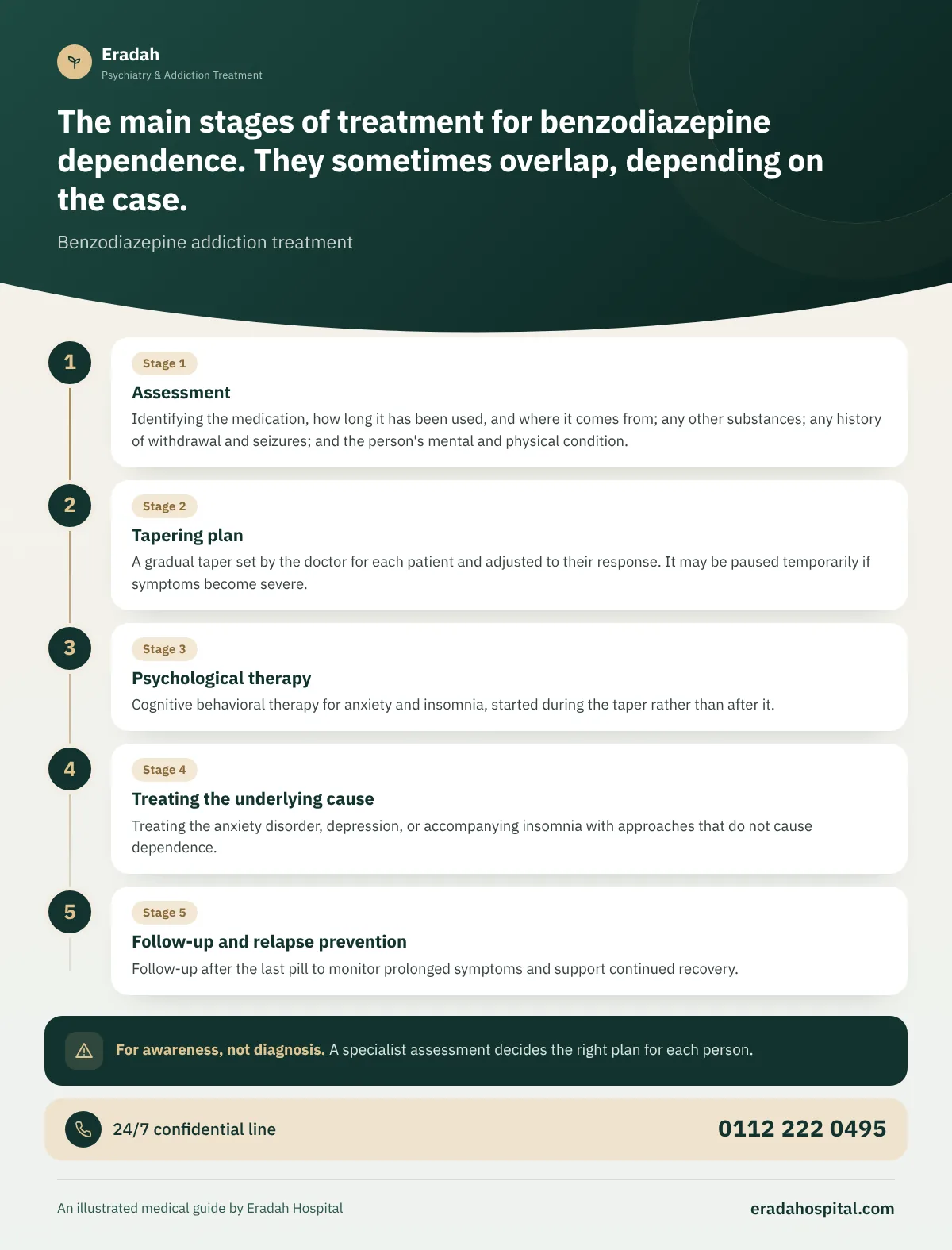
- Stage 1Assessment
Identifying the medication, how long it has been used, and where it comes from; any other substances; any history of withdrawal and seizures; and the person's mental and physical condition.
- Stage 2Tapering plan
A gradual taper set by the doctor for each patient and adjusted to their response. It may be paused temporarily if symptoms become severe.
- Stage 3Psychological therapy
Cognitive behavioral therapy for anxiety and insomnia, started during the taper rather than after it.
- Stage 4Treating the underlying cause
Treating the anxiety disorder, depression, or accompanying insomnia with approaches that do not cause dependence.
- Stage 5Follow-up and relapse prevention
Follow-up after the last pill to monitor prolonged symptoms and support continued recovery.
Stage 1: A comprehensive assessment before any tapering
Before changing any dose, the doctor needs the full picture, because the safe plan for a patient who has taken a prescribed pill for a year is very different from the plan for someone who mixes pills of unknown origin with tramadol. The assessment covers:
- Which benzodiazepine is used, how many days a week, for how long, and where it is obtained.
- Other substances: alcohol, opioids, pregabalin, and stimulants.
- Previous withdrawal experiences, and any seizures or delirium.
- Co-occurring mental health conditions and the risk of self-harm.
- Age, liver function, pregnancy, and other medications.
The 2025 guidelines recommend that people who use benzodiazepines without a prescription are often switched to a long-acting medication unless there is a reason not to, because the strength of the pills they take is unknown.
Stage 2: Safe, gradual tapering
The rule the guidelines agree on: no abrupt discontinuation for anyone likely to be dependent. The American Society of Addiction Medicine recommends that the doctor design the taper for each patient and slow it or pause it if symptoms become severe, bearing in mind that the final stages are usually the hardest. If reaching zero is not possible, staying on a lower dose with regular review may be a safer temporary option than continuing at a high dose.
As for switching to a longer-acting benzodiazepine such as diazepam or clonazepam, the guidelines say that the literature differs on it and that the decision should be individualized, taking liver function and other medications into account.
Are there medications that treat benzodiazepine addiction?
There is no medication that “flushes out” benzodiazepines or replaces tapering. A 2018 Cochrane review looked at about 38 trials involving 2,543 participants. No drug approach was tested in more than four trials, and the evidence for any benefit was low or very low certainty. An analysis published in the journal Addiction in 2009 found that adding a substitute drug did not improve the results of gradual tapering, and that abruptly swapping to another drug was less effective than tapering alone.
The 2025 guidelines warn against using flumazenil or general anesthetic drugs to speed up withdrawal, and limit very long-acting drugs such as phenobarbital to hospitals. Medications for anxiety or depression that a doctor may prescribe treat the underlying cause; they are not a substitute for tapering.
Psychotherapy: why does it improve the chances of success?
In a 2015 Cochrane review, combining cognitive behavioral therapy with tapering was more successful at achieving discontinuation than tapering alone after four weeks of treatment (risk ratio 1.40) and after three months (1.51), with moderate certainty, while longer-term results were less clear. The 2009 analysis found that psychotherapy plus tapering outperformed tapering alone.
Cognitive behavioral therapy focuses on understanding the physical symptoms of anxiety without panic, gradually facing what the patient avoids, and learning calming skills. People with insomnia benefit from cognitive behavioral therapy for insomnia, which the guidelines explicitly recommend; you can find the details in insomnia treatment.
Treating accompanying anxiety, insomnia, and depression
Many people started benzodiazepines to treat real anxiety, panic, or insomnia, and if the drug is withdrawn without treating that root problem, they quickly return to it. That is why both are treated together within a dual diagnosis program. Ashton notes that antidepressants are a better long-term treatment than benzodiazepines for anxiety, panic, and phobias, and that they may help during withdrawal in some cases; the decision here belongs to the doctor.
If benzodiazepines are combined with tramadol or alcohol
Mixing changes the shape of treatment. The 2025 guidelines recommend treating the other substance use disorder in parallel with the benzodiazepine taper, not stopping opioid addiction medications because of the sedative, and, for a person using opioids, usually stabilizing them on their treatment before starting the taper. You can find what applies to each substance in the tramadol guide, the alcohol guide, and addiction treatment medications.
How long does benzodiazepine addiction treatment take?
There is no fixed duration. Someone who used the drug for a few weeks may need only a short plan, while someone who used it for years may need months, and NICE notes that withdrawal can take several months or longer. What is encouraging is Ashton's observation that many studies found the final success rate is not affected by the length of use, the dose, the type of drug, or previous attempts; you can start from any point.
Outpatient or residential?
The 2025 guidelines say most patients can complete tapering as outpatients, with medical inpatient care considered when the risk is too great to be managed on an outpatient basis:
| The situation | Most suitable setting |
|---|---|
| Prescribed medication, no other substances, and no history of seizures | Outpatient treatment with regular follow-up |
| Pills from multiple sources or unknown doses | Careful assessment; the plan may begin with a short inpatient stay |
| A history of seizures or delirium in a previous withdrawal | Medically supervised detox in the hospital |
| Mixing with alcohol or opioids, or a severe mental health condition | A comprehensive residential program |
Relapse prevention after stopping benzodiazepines
- Safely dispose of any pills left at home.
- Tell every doctor you see about your history with sedatives before they prescribe you any medication.
- Keep a written plan for episodes of anxiety and insomnia.
- Continue psychotherapy after the last pill.
- Keep up with an aftercare program, and ask for help as soon as signs of relapse appear.
Benzodiazepine addiction treatment at Eradah
At Eradah, we begin with a free, confidential first consultation in which we ask about the sedative, how it is used, and any other substances alongside it, and we assess the anxiety or insomnia behind it. The doctor then agrees with the patient on a tapering plan that suits them, with psychotherapy sessions running alongside it from day one. Stable patients are followed in the outpatient clinics, while those who mix the sedative with other substances or have had seizures before begin treatment in the men's psychiatric hospital under round-the-clock medical supervision.