What are digital drugs?
“My son sits with headphones for hours, and I read that there are drugs you can listen to.” This kind of worry has spread among parents in the Arab region for more than a decade. The important question: can a sound do what a drug does? The scientific answer is much calmer than the headlines, but it does not mean we should ignore the matter entirely.
Digital drugs are audio files sold or shared online under names that suggest drugs, in which the listener is asked to wear headphones, close their eyes and lie down in a dark place for a set time. They usually rely on an auditory phenomenon called binaural beats, and music or nature sounds may be added. The marketing idea is that the “frequency” of each file creates a state similar to a particular drug, a claim no research has proven.
How do binaural beats work?
When the right ear hears a tone at a certain frequency and the left ear a tone at a slightly different frequency, the brain perceives a third tone that “pulses” at the difference between them. According to a systematic review published in 2023 in PLOS ONE, this audible difference falls at roughly 1 to 30 hertz, which is the range of the brain’s electrical waves, hence the hypothesis that the sound “drags” brain waves toward its frequency. But the same review, which analyzed 14 studies, found the results inconsistent: 5 studies supported the hypothesis, 8 produced opposite results, and one was mixed.
Do digital drugs give the effect of drugs?
No published study proves that an audio file mimics the effect of cannabis, stimulants or anything else. What exists is research on the effect of binaural beats on ordinary functions: a pooled analysis of 22 studies published in 2019 in the journal Psychological Research found a moderate effect on memory, attention, reduced anxiety and the sensation of pain. These are effects similar to what calm music or relaxation exercises might do, not what intoxicating substances do.
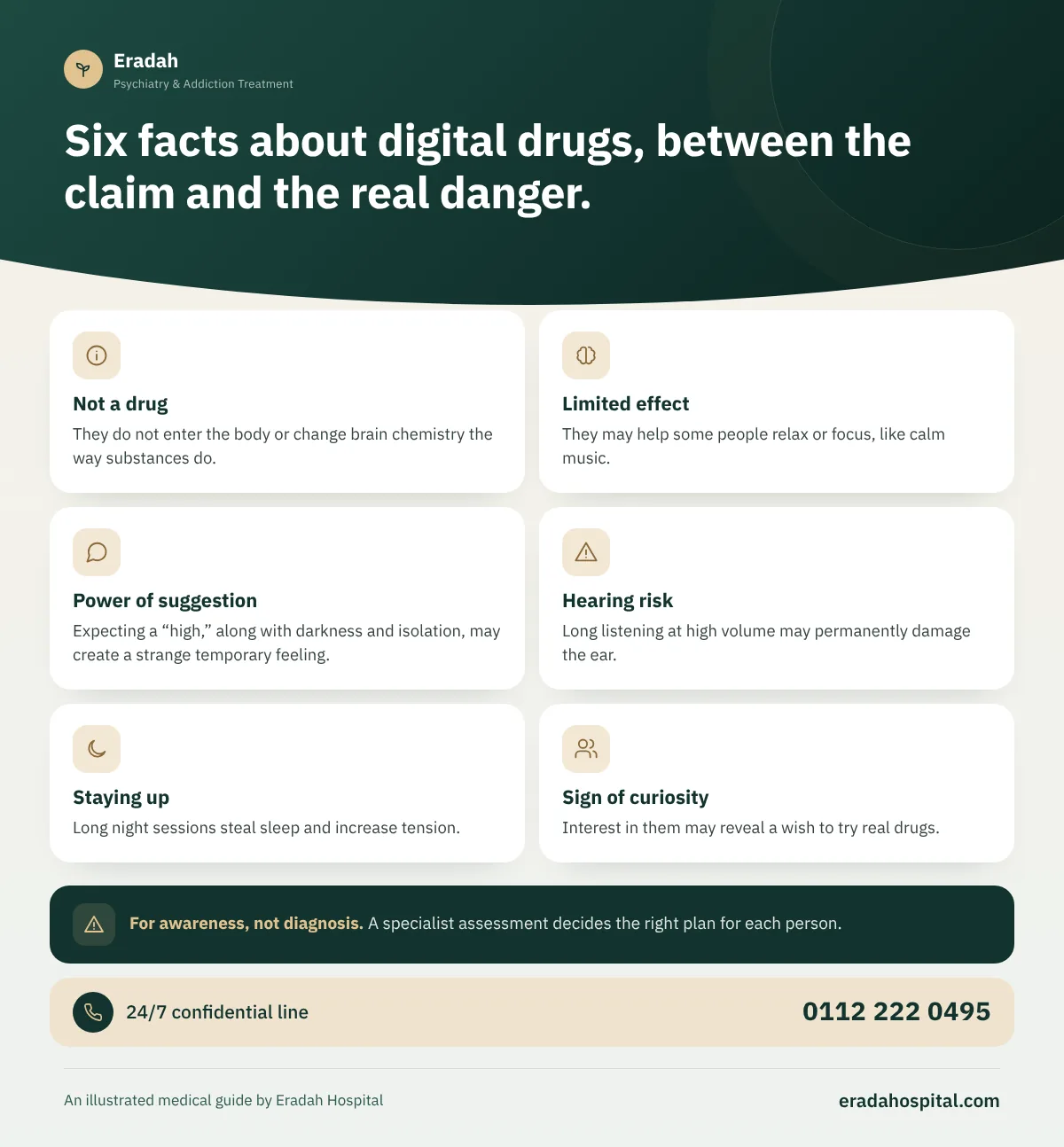
They do not enter the body or change brain chemistry the way substances do.
They may help some people relax or focus, like calm music.
Expecting a “high,” along with darkness and isolation, may create a strange temporary feeling.
Long listening at high volume may permanently damage the ear.
Long night sessions steal sleep and increase tension.
Interest in them may reveal a wish to try real drugs.
Who uses digital drugs and why?
In the 2021 Global Drug Survey, which gathered 30,896 participants from 22 countries and whose results were published in 2022 in the journal Drug and Alcohol Review, 5.3% reported listening to binaural beats to try a different mental state. The most common reason was relaxation or sleep (72.2%), then changing mood (34.7%), while only 11.7% said they wanted a drug-like effect. The researchers noted that use was linked to recent use of cannabis, hallucinogens or new substances, meaning digital drugs may be part of a culture of experimentation rather than a substitute for it.
Do digital drugs cause addiction?
There is no evidence that they cause chemical addiction or withdrawal symptoms. But any screen or headphone activity can turn into a compulsive behavior if it becomes the only way to escape anxiety, boredom or loneliness, and is practiced for hours at the expense of sleep, studies and relationships. Here the problem lies in the pattern, not the audio file, and it resembles what happens in smartphone addiction or social media addiction.
The real risks of digital drugs
The clearest danger is to hearing: the World Health Organization estimates that more than a billion young people are at risk of permanent, avoidable hearing loss from unsafe listening practices. Long sessions with headphones at maximum volume to strengthen the “effect” increase this risk. Added to this are sleep disruption, and the fact that some sites promoting these files also promote a culture of substance use and normalize it.
How should parents handle digital drugs?
- Start by asking, not accusing: what attracted you? How did you feel?
- Explain the scientific truth calmly: no proven drug effect, and a real risk to hearing.
- Pay attention to what lies behind the interest: anxiety, insomnia, loneliness, or curiosity about drugs.
- Set general screen and sleep rules for the whole family, not just for the son.
- If signs of real substance use appear, go back to the signs of drug use.
When do you need a specialist?
If your son isolates himself for long hours, his sleep and studies decline, he shows persistent sadness or anxiety, or he talks about trying real substances, a psychological assessment is best. Compulsive screen use is often a cover for depression or social anxiety. Outpatient treatment offers a confidential assessment and an age-appropriate plan, and the family can benefit from the family program.
Signs of real substance use or thoughts of self-harm? Get help now
- Severe drowsiness, difficulty waking, or slow breathing after taking a real substance
- Agitation, hallucinations, seizures or chest pain
- Talk about death, self-harm or life being meaningless
- Complete isolation for days with refusal to eat or sleep
- Sudden hearing loss or severe persistent ringing in the ears after listening at high volume
Stay calm and close to the person, and do not leave them alone. If there are signs of poisoning or loss of consciousness, call the ambulance on 123 immediately; if the person is unconscious but breathing, place them on their side and tell the paramedics what they took. If thoughts of self-harm appear, ask calmly and listen without blame, and call the mental health support line 16328, available around the clock. Sudden hearing loss needs an ear, nose and throat doctor the same day.
Ambulance 123 Mental health support line 16328