What are the nine criteria for gambling disorder?
The American Psychiatric Association's DSM-5 relies on nine signs, and the disorder is diagnosed when four or more are present within twelve months, provided the behavior is not explained by a manic episode. We set them out here in plain language for awareness:
| The sign | What it looks like in real life |
|---|---|
| Needing increasing amounts | The small bet no longer "does it" for the thrill |
| Irritability when cutting down | Anxiety, tension and irritability when trying to stop or cut back |
| Failed attempts to stop | Repeated "last time" promises, then going back |
| Constant preoccupation | Continually thinking about past and future bets and how to get the money |
| Betting to escape | Betting when feeling distress, guilt, anxiety or depression |
| Chasing losses | Returning the same day or the next to win back what was lost |
| Lying | Hiding the scale of betting from family, a therapist or friends |
| Losing what matters | Putting a relationship, job or studies at risk, or losing them |
| Relying on others financially | Asking family or friends for money to cover a crisis caused by betting |
The doctor sets severity by the number of signs: four to five is mild, six to seven is moderate, and eight to nine is severe. In ICD-11 the World Health Organization uses three core features: impaired control, giving betting priority over other things, and continuing despite consequences.
What are the financial signs of gambling addiction?
Money is the clearest mirror of this addiction, and the financial signs are often the first thing discovered:
- Sums disappearing from the home or accounts with no convincing explanation.
- Loans, installments or debts the family knows nothing about.
- Repeatedly asking family and friends for money with a different story each time.
- Selling or pawning valuables, or gold or devices vanishing from the home.
- Rent or bills paid late despite a regular income.
- Many e-wallets and payment cards, and strong irritation if anyone looks at his phone.
- Periods of sudden "prosperity" after a win, followed by serious financial shortfall.
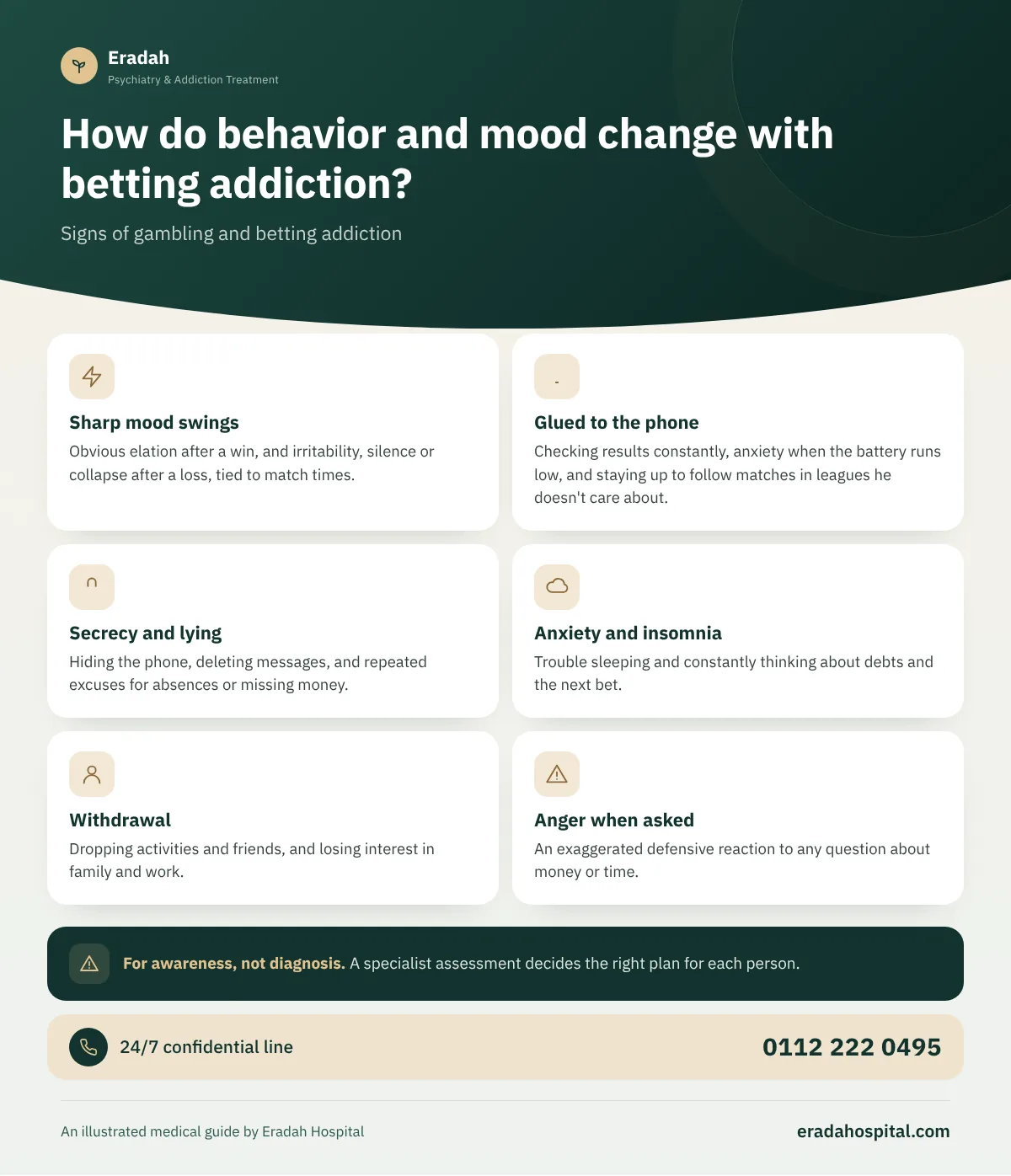
How do behavior and mood change with betting addiction?
Obvious elation after a win, and irritability, silence or collapse after a loss, tied to match times.
Checking results constantly, anxiety when the battery runs low, and staying up to follow matches in leagues he doesn't care about.
Hiding the phone, deleting messages, and repeated excuses for absences or missing money.
Trouble sleeping and constantly thinking about debts and the next bet.
Dropping activities and friends, and losing interest in family and work.
An exaggerated defensive reaction to any question about money or time.
What are the signs of online betting in particular?
Betting by phone needs no venue and no partner, so its outward signs disappear. But there are signals you can notice:
- Frequent notifications from apps or closed messaging groups talking about "predictions" or "tickets".
- Sudden interest in matches in unfamiliar leagues or late at night.
- Following a match result with intense tension out of proportion to an ordinary fan.
- Small, repeated transfers from the account or e-wallet.
- Accounts in other people's names, or asking to use a family member's card.
How do you know a teenager has started betting?
Teenagers may begin by betting with friends on matches, or through video games with gambling-like elements, and then move on to betting apps. Signs worth noticing:
- Constant talk of "predictions" and friends' winnings from betting.
- Pocket money that disappears quickly, or extra cash whose source the parents do not know.
- Borrowing from classmates or selling his own belongings.
- Falling grades and long nights tied to match times.
- Unexplained irritability or sadness after particular matches.
Questions to help you assess your relationship with betting
- Have you bet more than you could afford to lose?
- Have you needed larger amounts to get the same thrill?
- Have you gone back to bet again to try to win back what you lost?
- Have you borrowed money or sold something in order to bet?
- Have you felt you might have a problem with betting?
- Has anyone criticized your betting or told you that you have a problem?
- Have you felt guilty about the way you bet or about what happens when you bet?
- Has betting caused you or your family emotional strain, anxiety, or health or money problems?
If you answered yes to more than one question, that is a sign betting has begun to harm your life. The next step is to talk to a specialist, and you will find the options on the overcoming betting addiction page.
How do you start the conversation with someone you suspect is betting?
- Choose a calm time, not after a big loss or at a moment of shocking discovery.
- Start with facts, not accusations: "I noticed some money is missing, and I'm worried."
- Listen without interrupting, and expect denial or minimizing at first.
- Do not offer to pay off the debts as a first solution; offer help getting to treatment.
- Watch for any talk of hopelessness, or of the family being "better off without him", and ask for help immediately if you hear it.
- Get support for yourself too; facing this addiction is exhausting for a family.
Despair over debts or thoughts of self-harm? Get help now
- Talk about death being the “only solution” to the debts, or that the family would be better off without him
- Severe despair after a big loss or the exposure of the debts to the family
- Saying goodbye to loved ones, writing a will, or suddenly putting affairs in order
- Complete withdrawal, or a sudden unexplained calm after a period of intense distress
- Outbursts of anger or threats of violence at home, or a major increase in use of alcohol or drugs
Do not leave the person alone, ask them calmly and openly about their thoughts, and listen without blame or talk of money at this moment; debts have solutions, and life matters more. Call the ambulance on 123 or take them to the nearest emergency room, or call the mental health support line 16328 (24 hours), and keep medications and anything they could harm themselves with out of their reach. If there is a risk of violence, move away with the children to a safe place.
Ambulance 123 Mental health support line 16328