My husband gambles: where do I start?
"I found out he has betting debts far bigger than his salary, and every time he says he'll make it up on the next match." The first shock leaves many wives swinging between anger and covering up. The first step in dealing with a gambling addiction is to stop putting out the financial fires and begin protecting what is left.
Gambling addiction, or gambling disorder, is a medically recognized illness, not a moral weakness, and we explain its nature in the gambling and betting addiction guide. The World Health Organization stresses that the harms of gambling reach other people, including broken relationships, domestic violence, financial hardship and neglect of children. So this guide is about you and your home as much as it is about him.
Dealing with a gambler starts with protecting the money
An account of your own for household and children's expenses that he cannot reach, and cancel powers of attorney and joint cards if you can.
Gold, savings and property deeds in a safe place out of his reach.
Rent, school fees and bills are paid on payday before anything else.
Encourage him to block betting sites and apps on his devices and to ask the bank to block betting transfers.
A clear list of debts and creditors instead of guesswork, in preparation for a repayment plan that he takes on.
Temporary management of the money by someone both of you trust during treatment.
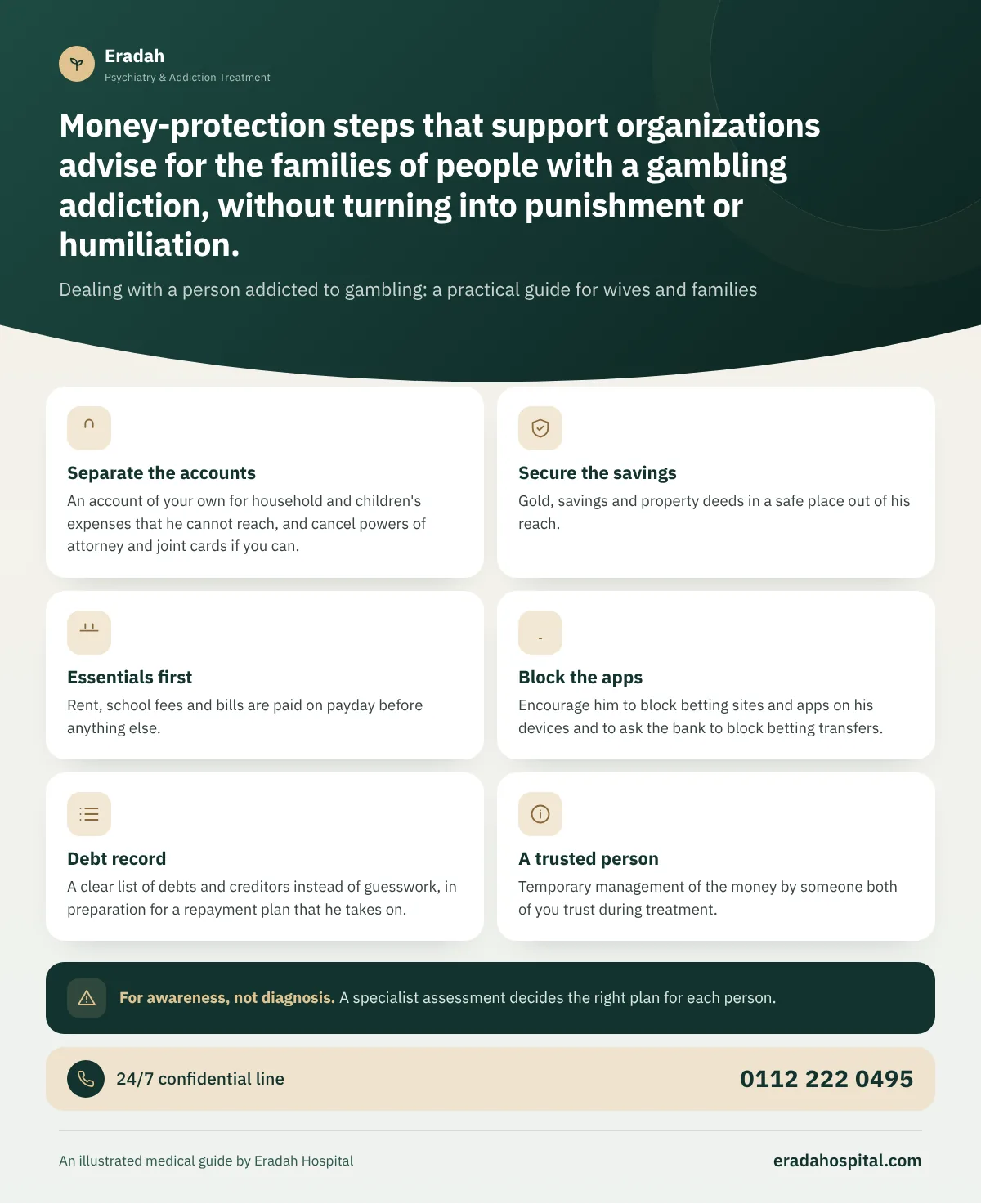
These steps are close to what the UK's National Health Service (NHS) advises for people who have a gambling problem themselves: paying important bills on payday, blocking betting sites, asking the bank to stop transfers to them, and dealing with debts instead of ignoring them. The difference is that, wherever possible, they are applied by agreement, not by force.
Should I pay my husband's gambling debts?
This is the hardest decision a family faces. Paying rescues you from today's embarrassment, but it sends the message that someone will pay for the losses, and it is often followed by a new bet "to make up" for what was lost. The safest rule is: do not pay betting debts in secret or in one lump sum, and if you must step in to protect the home from eviction or imprisonment, do it within a written plan that he takes part in and that is tied to starting treatment. Do not sign for new loans or guarantees in your name.
How do I talk to a person with a gambling addiction without a clash?
- Choose a calm time, away from a match day or a big loss.
- Talk about specific events and figures: "The rent hasn't been paid for the last two months."
- Express your feelings and worry instead of insults and judgments.
- Do not get drawn into arguing about his "system" or his "luck" in betting; that is an illusion that feeds the problem.
- End with one clear request: an appointment for an assessment, blocking the apps, or temporarily handing over management of the money.
Expect denial or promises the first few times. We explain the signs of the shift from entertainment to addiction on the signs of gambling addiction page, which helps you speak from facts, not impressions.
Common mistakes that prolong the crisis
- Covering up in front of family and creditors: it shields him from the consequences and so delays the decision to get treatment.
- Giving him money "one last time": it usually goes to a new bet.
- Constant monitoring and searching: it wears you out and pushes him to hide more.
- Threatening divorce without meaning it: your words carry less weight next time.
- Blaming yourself: you are not the cause of his addiction, and you cannot cure it alone.
Can the family change the situation if he refuses treatment?
Yes, to a degree. A randomized study published in the Journal of Gambling Studies in 2007 tested a self-help program for 186 relatives of gamblers, 82% of them women and 56% spouses or partners, based on the CRAFT approach to training families. Participants' lives and relationships improved, and their loved ones gambled on fewer days in the program groups, although the number who entered treatment did not increase. The researchers concluded that families need guidance and follow-up more than a booklet alone, and this is what the family program provides.
How do I protect the children from the effects of their father's gambling?
Keep the children away from money arguments, and protect their routine and school expenses first. Explain in simple words that their father has a problem and is being treated, and that it is not their fault. Do not make any of them a go-between or a keeper of money secrets. You will find the impact of gambling on the family and children in detail on the harms of gambling addiction page.
When does dealing with a gambler become an emergency?
A study of Swedish national registers published in the Journal of Behavioral Addictions in 2018 found that people with gambling disorder were about 15 times more likely to die by suicide than the general population, and that depression was the strongest predictor. So take any talk of death or despair after a big loss completely seriously.
How does treatment begin?
Cognitive behavioral therapy has the strongest evidence in gambling addiction, together with treatment of any co-occurring depression or substance use, and we explain the full plan in the gambling addiction treatment guide. At Eradah you can book a free, confidential first consultation for yourself or for him, and we offer outpatient treatment, and inpatient treatment for men when gambling comes with substance use, severe depression or a risk to life.
Despair over debts or a threat of self-harm? Get help now
- Talk of death, or of the family being "better off without him", after a big loss
- Sudden huge debts with panic, breakdown or disappearing for long hours
- Threats or violence toward the wife or children when asked about money
- Saying goodbye to family, writing letters or giving away belongings
- Heavy use of alcohol or drugs after losses
Stay close to him and do not blame him for the loss at this moment, and ask him directly and calmly whether he is thinking of harming himself; asking does not plant the idea. Quietly remove medications and dangerous objects. Call ambulance (123) or go to the nearest emergency department if the danger is imminent, and contact the mental health support line 16328, which is open around the clock. If there is violence, you and the children should move to a safe place and call the police (122).
Ambulance 123 Mental health support line 16328