What are the first steps to overcoming betting addiction?
Recovery starts with a decision to admit the problem, then quick, practical steps that cut the path between the urge and the bet. The urge can come at any moment, and the aim is to make betting hard enough to reach that the urge passes.
- Talk to someone you trust: a partner, a parent or a friend; secrecy is the soil this addiction grows in.
- Work out the full picture: write down all debts and obligations honestly, even if the numbers are shocking.
- Delete betting apps and accounts, and leave the groups that post "predictions".
- Turn on blocking: software that blocks betting sites on phone and computer, and self-exclusion where available.
- Reduce the money within reach: carry only what you need for the day.
- Book a specialist assessment: a psychiatrist or addiction treatment center to assess the case and any co-occurring disorders.
How do you protect money during treatment?
Financial protection is a temporary "seat belt" that everyone who has recovered from this addiction knows; it does not diminish dignity and is not meant as punishment. The UK's National Health Service (NHS) advises similar steps:
- Temporarily handing management of salary and accounts to a trusted person the patient agrees to.
- Asking the bank or payment provider to block betting transactions, where that service is available.
- Removing saved card details from the phone and browser and canceling extra cards.
- Paying rent, bills and obligations as soon as income arrives, before any other spending.
- Taking no new loans, and telling the family not to lend.
- A realistic debt repayment plan with the help of a financial adviser or lawyer, not through betting.
How does cognitive behavioral therapy help treat gambling?
The World Health Organization notes that long-term cognitive behavioral therapy and motivational interviewing are among the most effective approaches, and the UK's NICE guideline (NG248, 2025) recommends group or individual cognitive behavioral therapy. This therapy works on several fronts:
| Domain | What happens in sessions |
|---|---|
| Correcting thinking errors | Challenging the illusion of control, the gambler's fallacy and "I'm close to winning" with evidence |
| Analyzing triggers | Mapping the situations and feelings that come before a bet |
| Skills for handling urges | Delaying the urge, distracting yourself, and asking for support at the hard moment |
| Problem-solving | Dealing with debts and pressures in realistic ways instead of "the big hit" |
| Building an alternative life | Activities, relationships and sources of enjoyment and meaning that fill the gap betting left |
| Relapse prevention | A written plan for high-risk situations and early warning signs of going back |
What is the role of motivational interviewing for someone who hasn't made up their mind?
Many people come to treatment under family pressure, not fully convinced they have a problem. Motivational interviewing is a conversational approach that respects this hesitation and helps the person weigh what gambling gives them against what it takes from them, and discover their own reasons for change, without lectures or threats. It is often a good starting point before a longer treatment program.
How is the family involved in treatment?
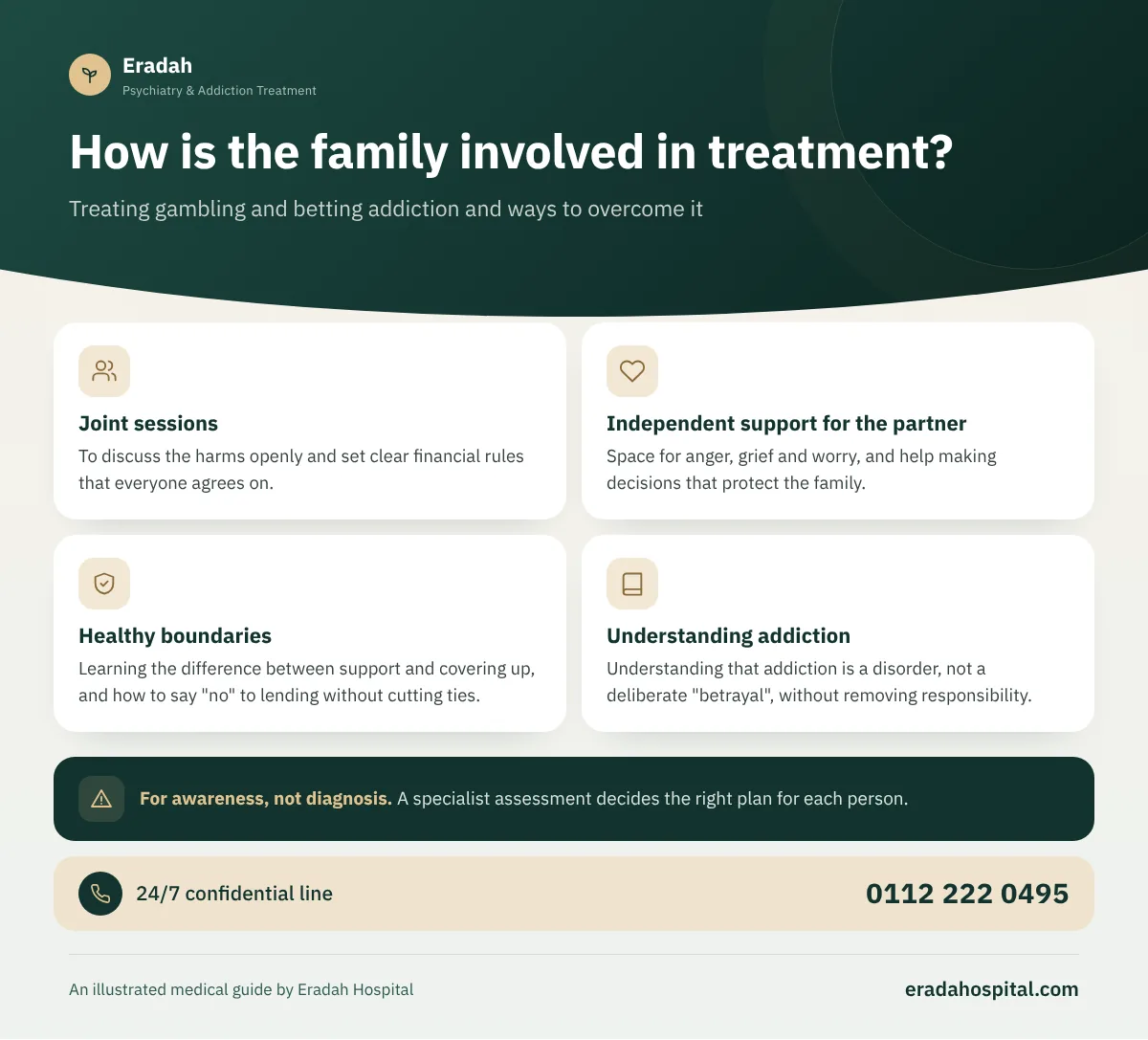
Family counseling is an essential part of treating gambling addiction, because the family needs to rebuild trust, organize money and learn how to handle a relapse. It includes:
To discuss the harms openly and set clear financial rules that everyone agrees on.
Space for anger, grief and worry, and help making decisions that protect the family.
Learning the difference between support and covering up, and how to say "no" to lending without cutting ties.
Understanding that addiction is a disorder, not a deliberate "betrayal", without removing responsibility.
Even if the gambler refuses treatment, the family can start counseling on its own; this protects them and sometimes raises the chance he accepts treatment later. NICE guidance confirms the right of people affected by someone else's gambling to support.
Do support groups such as Gamblers Anonymous help?
Self-help support groups such as Gamblers Anonymous are based on the twelve-step program and sharing experiences, and there are parallel groups for gamblers' families. Their meetings are available in many countries, some of them online. The American Psychiatric Association lists them among sources of support, and they help most when they complement specialist treatment rather than replace it, especially when there is depression or suicidal thoughts.
Are there medications for treating gambling addiction?
There is as yet no medication approved by the US Food and Drug Administration specifically for gambling disorder, according to the American Psychiatric Association. But medication may help in two situations:
- Treating co-occurring disorders such as depression, anxiety, ADHD and alcohol addiction, which improves the chances of recovering from the gambling itself.
- Reducing urges in selected cases: NICE guidance notes that a medication such as naltrexone may be considered if psychological treatment alone is not enough, and the psychiatrist decides this after assessment.
No psychiatric medication is used without a prescription and medical follow-up, and a prescribed medication should not be stopped without consulting the doctor. Note too that some medications for other conditions, such as certain drugs for Parkinson's disease, have occasionally been linked to impulsive gambling behavior, so tell your doctor if you notice this.
When does a person with a gambling addiction need inpatient treatment or urgent care?
- Suicidal thoughts, or a previous attempt to harm themselves.
- Gambling together with alcohol or drug addiction that requires detox.
- Severe depression or a manic episode.
- Repeated failure of outpatient treatment, or a surrounding environment that does not allow recovery.
- An acute family or financial crisis that makes staying in the same surroundings risky.
How do you prevent relapse after you stop betting?
A slip, meaning a bet after a period of abstinence, is common on the road to recovery and does not mean everything is lost. What matters is that the slip does not turn into a full relapse:
- Admit the slip quickly to a supportive person or your therapist instead of hiding it.
- Do not try to win back what you lost in it; that is the start of chasing losses all over again.
- Identify the situation that came before it: a big match? a salary? an argument? loneliness?
- Turn blocking and financial protection back on if they had been relaxed.
- Celebrate the days of abstinence, and remember that every day strengthens the brain in the healthy direction.
Choosing a hospital for gambling and betting addiction treatment
Betting addiction does not need detox or medical equipment, so it is a mistake to judge a place by its number of beds or how grand the building is. What makes the difference here is a specialist psychological program that takes apart the illusions of "making up the loss" and "the next big hit", and a team who know that the greatest danger may be hidden depression or thoughts of self-harm under the pressure of debt. Before you commit to any facility, put these questions to them:
- Do you have a therapist trained in cognitive behavioral therapy for gambling disorder specifically, not only for substance addiction?
- In the first session, is the patient asked frankly, and without blame, about suicidal thoughts and the size of the debts?
- Do you help the family set temporary financial controls the patient accepts, instead of harsh monitoring or paying everything off at once?
- Do you screen for alcohol, drugs or video games that accompany the betting?
- Is there regular follow-up after the program ends, since tournament seasons and paydays are recurring moments of risk?
At Eradah the medical side is led by Dr. Mahmoud El-Sawy, Consultant Psychiatrist and Addiction Specialist, and the psychologists work in individual and group sessions, while the family support program involves the wife or parents in the plan to protect money. If betting comes together with depression or substance use, the dual diagnosis pathway treats both together. To understand what drives betting in the first place, see the causes of gambling addiction.
How does Eradah treat gambling and betting addiction?
At Eradah we begin with a comprehensive assessment of the severity of the disorder, the person's mental state, the risk of self-harm and any accompanying addictions. We then set a plan combining individual or group cognitive behavioral therapy, motivational interviewing, and treatment of any co-occurring depression or addiction, with family counseling sessions and a practical plan to protect money and prevent relapse. We provide outpatient or inpatient treatment as needed, in complete confidentiality and without judgment.