Why do some people become addicted to gambling and others do not?
Many people bet once or twice and then stop, while others get stuck in a loop that never ends. The real reason is a combination of factors that come together in one person, with nothing to do with intelligence or morals: biological and psychological vulnerability, stressful life circumstances, and a product carefully designed to make stopping hard.
Health bodies today view gambling as a public health issue, not only a matter of individual choice. The World Health Organization and the Lancet Commission point out that the rapid spread of online betting and intensive marketing raise harm across society as a whole, not only among "vulnerable" individuals.
How does the design of betting make it hard to stop?
We explain these mechanisms for awareness only, so that a person and their family can understand why they feel "pulled in" despite losing, not to offer any way to gamble:
Wins come at times that cannot be predicted. This kind of reward is the strongest at fixing a behavior in place, because every attempt might be "the one".
A result that "almost" won activates the brain as if it were nearly a win, pushing you to the next attempt instead of leaving you discouraged.
Successive bets during a match and fast-paced games shorten the gap between bet and result, so the cycle of excitement repeats dozens of times.
Getting part of the stake back, with celebratory sounds and colors, makes the player feel they won while they have actually lost.
Balances and points on a screen separate the person from the feeling of real money's value.
Free bets, bonuses and personal messages that pull back someone who tried to stop.
The Lancet Commission warns that online casino products and sports betting are linked to higher rates of problem gambling among their users, and that rates among adolescent users are higher than among adults.
What is the role of dopamine and the reward circuits?
Betting activates the brain's reward circuit, and dopamine rises specifically in moments of anticipation and uncertainty. With repetition the circuits adapt, so ordinary activities such as work, family and hobbies give less pleasure, and betting becomes more appealing.
Research also points to relatively weaker function in the frontal lobe areas responsible for impulse control and planning in some people with the disorder, which explains how hard it is to stop "in the middle of a session" even with sincere intentions. These changes resemble what happens in substance addiction, and they improve gradually with treatment and abstinence.
What thinking errors feed gambling addiction?
| The thinking error | How it appears | The truth |
|---|---|---|
| The gambler's fallacy | "I've lost five times, so a win is coming" | Every outcome is independent, and past losses do not bring a win closer |
| The illusion of control | "I understand the odds and I work it out carefully" | Knowledge does not cancel luck or the margin calculated against players |
| Remembering wins and forgetting losses | Talks about "the big hit" and forgets dozens of losses | The full tally is usually a clear loss |
| Personal superstitions | A lucky number, shirt or time of day | They have no connection to the result at all |
| "I was so close" | Interpreting a near miss as getting close to winning | A near miss is, in practice, a complete loss |
These errors do not mean low intelligence; they are biases everyone falls into to different degrees, but they become dangerous when they drive repeated financial decisions. Cognitive behavioral therapy targets them directly.
What is the role of depression, anxiety and ADHD?
Many people with gambling disorder also have another mental health condition, and the relationship runs in both directions:
- Depression: betting gives temporary excitement that breaks the emptiness, then the losses deepen the depression.
- Anxiety: betting is a way to escape worried thoughts, but it generates even more anxiety from debts and secrets.
- ADHD: impulsivity, sensation seeking and weak financial planning are known risk factors.
- Bipolar disorder: excessive betting may be part of a manic episode, which needs a different assessment.
- Substance addiction: alcohol and stimulants weaken restraint and increase risk-taking, and the two addictions often occur together.
How do financial circumstances, environment and football culture affect it?
Financial pressure, unemployment and the dream of "getting out of the crisis in one stroke" are among the strongest reasons for starting, especially among young people. Then losses deepen the crisis, so the motive turns into a consequence and the loop goes round.
The risk rises when those around you are betting too: friends swapping "predictions", messaging groups posting pictures of winnings, and ads and influencers linking betting to love of football, manliness and success. The World Health Organization warns that intensive marketing contributes to normalizing gambling among children and young people.
What triggers bring a person back to betting?
- The times of big matches and tournaments.
- Receiving a salary or any unexpected sum of money.
- Feeling bored, lonely or low, especially at night.
- A family argument or pressure at work.
- A promotional message or "free bet" on the phone.
- Drinking alcohol or using other substances.
- A big loss that pushes you to a "last try" to win it back.
How does betting develop from entertainment into a disorder?
- The winning phaseThe start
Small bets and sometimes an early win create overconfidence and a sense of skill.
- The losing phaseChasing losses
Raising amounts and bets to recover losses, and the start of lying and borrowing.
- The desperation phaseLoss of control
Large debts, isolation and family crises, and constant thoughts of "the big hit" that will solve everything.
- The crisis phaseThe turning point
The debts come to light or a job is lost; this is a moment of danger that calls for urgent support, and it can also be the start of seeking treatment.
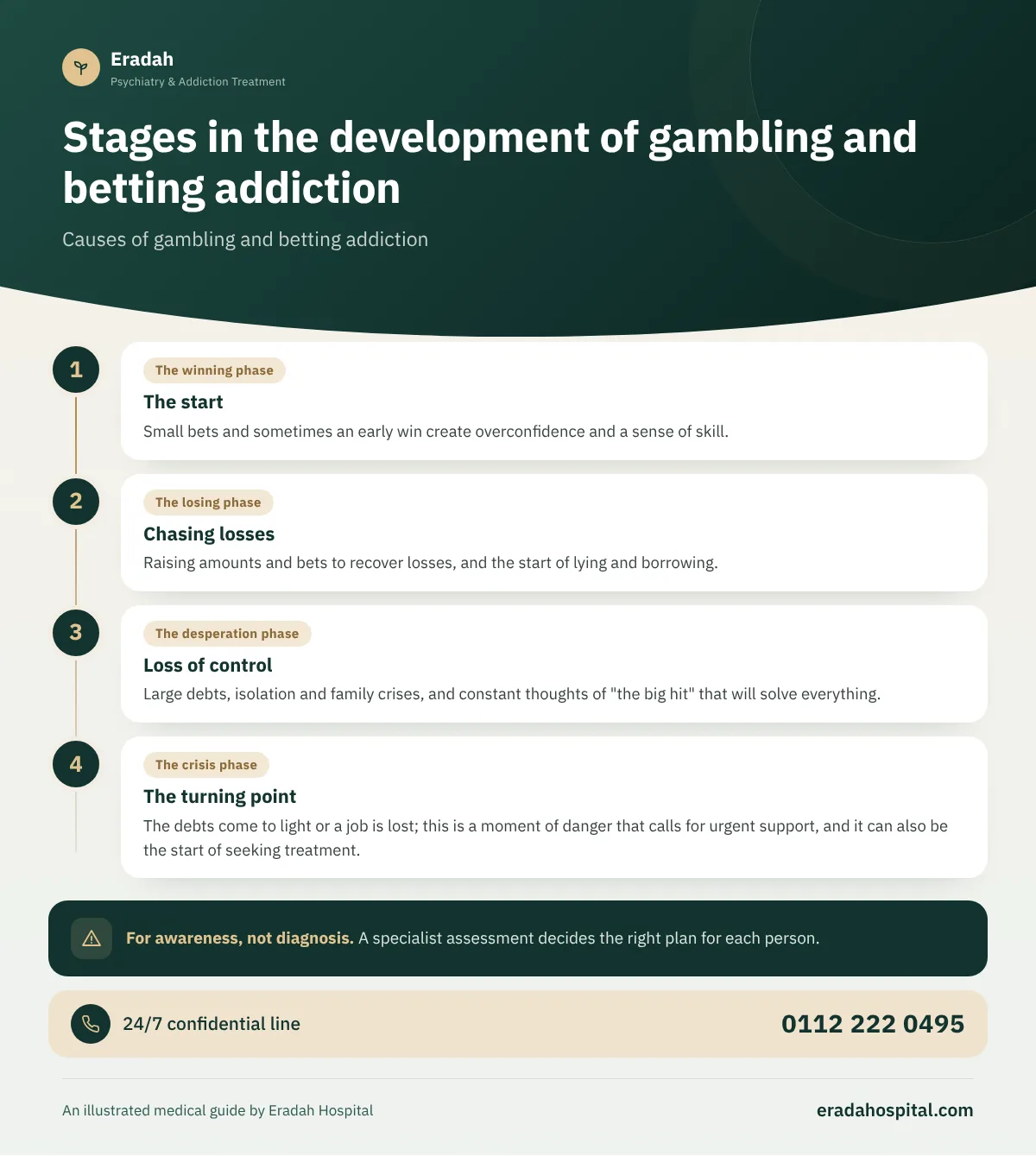
Not everyone goes through these stages in the same order, but many people in recovery recognize themselves in them. Knowing them helps the family step in before the crisis stage is reached.
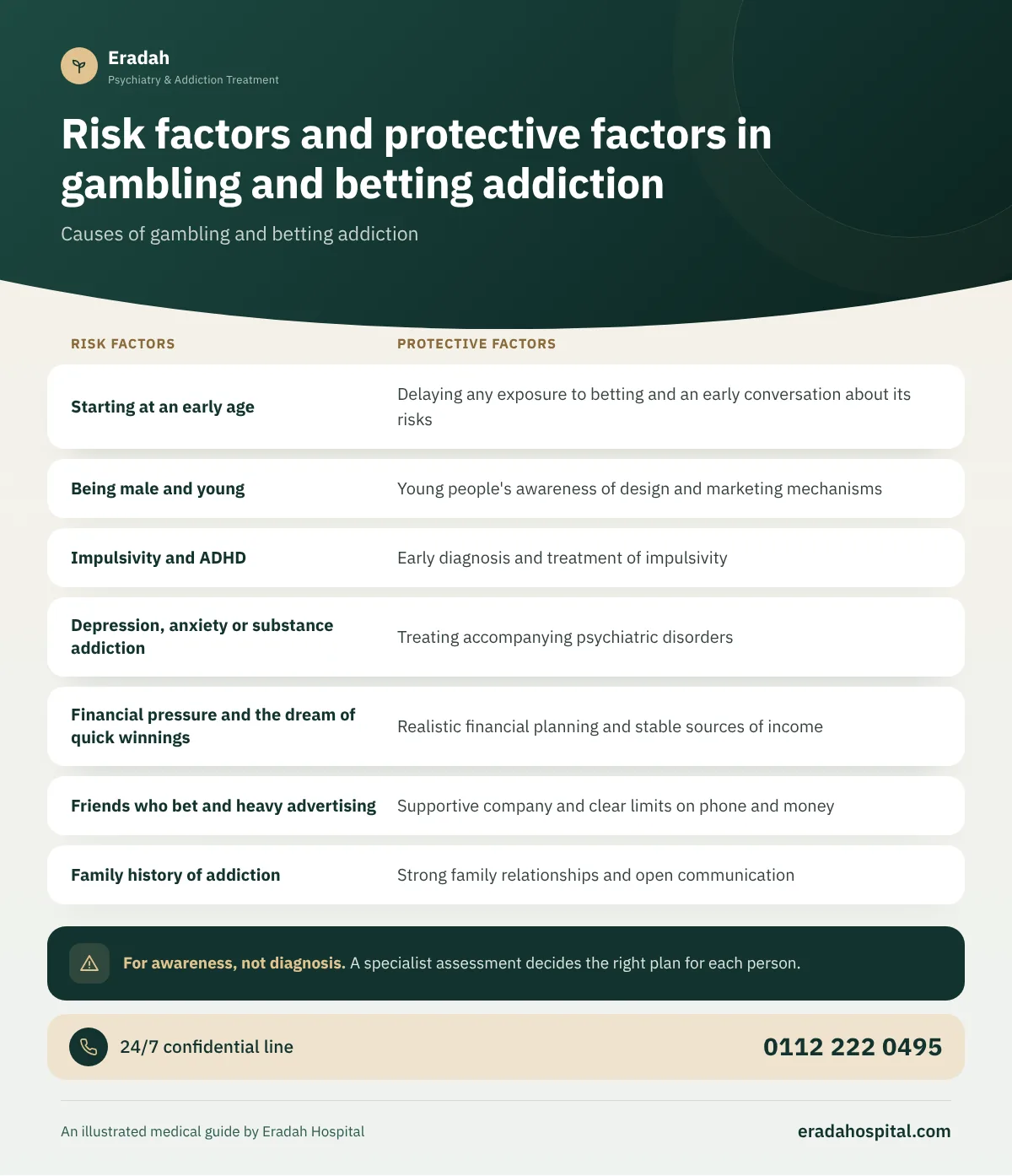
What are the risk and protective factors in gambling?
| Risk factors | Protective factors |
|---|---|
| Starting at an early age | Delaying any exposure to betting and an early conversation about its risks |
| Being male and young | Young people's awareness of design and marketing mechanisms |
| Impulsivity and ADHD | Early diagnosis and treatment of impulsivity |
| Depression, anxiety or substance addiction | Treating accompanying psychiatric disorders |
| Financial pressure and the dream of quick winnings | Realistic financial planning and stable sources of income |
| Friends who bet and heavy advertising | Supportive company and clear limits on phone and money |
| Family history of addiction | Strong family relationships and open communication |