What does a person pay for being attached to the phone?
The harms of the phone do not arrive as a sudden catastrophe, but as quiet erosion: half an hour of sleep each night, minutes of focus lost with every notification, and moments with family not fully lived. As the months accumulate, this erosion becomes noticeable in health, mood, work and relationships.
Sources: Sohn and colleagues in BMC Psychiatry (2019), and the World Health Organization road traffic injuries fact sheet.
How does the phone ruin sleep?
The phone harms sleep in three ways: it delays bedtime because "one more video" becomes ten, it keeps the brain alert with stimulating content and messages, and it interrupts sleep itself with notifications or waking up to check it at night. The bright light of the screen is an additional factor, not the main one.
A meta-analysis in JAMA Pediatrics covering more than 125,000 children and adolescents found that using portable devices at bedtime is linked to less sleep, poorer sleep quality and more daytime sleepiness, and notably, the mere presence of the device in the room was linked to the same outcomes even without using it. Lack of sleep in turn weakens mood, memory and immunity, and opens the door to chronic insomnia.
Does the phone weaken concentration and attention?
Every notification interrupts what you are doing, and getting back to full concentration after an interruption takes time. With dozens of interruptions a day, deep work such as studying, writing a report or reading a book becomes harder and harder. Many people complain that they can no longer read continuous pages or watch a whole film without reaching for the phone.
Some studies also suggest that having the phone near a person may draw off part of his attention even when it is face down on the table, although the results of this research are not settled. The practical advice is clear in any case: keep the phone away from where you study and do focused work.
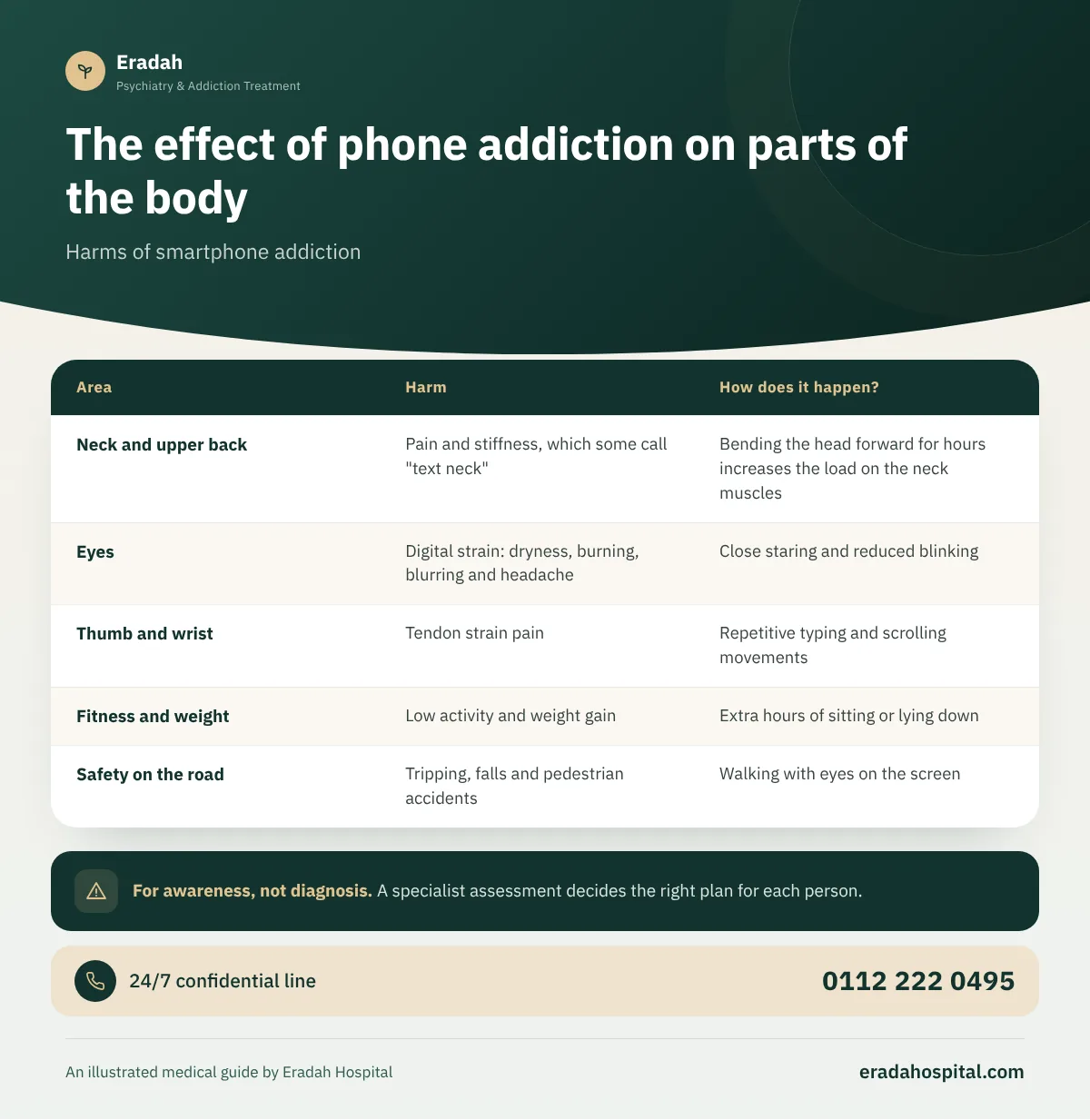
What are the physical harms of excessive phone use?
| Area | Harm | How does it happen? |
|---|---|---|
| Neck and upper back | Pain and stiffness, which some call "text neck" | Bending the head forward for hours increases the load on the neck muscles |
| Eyes | Digital strain: dryness, burning, blurring and headache | Close staring and reduced blinking |
| Thumb and wrist | Tendon strain pain | Repetitive typing and scrolling movements |
| Fitness and weight | Low activity and weight gain | Extra hours of sitting or lying down |
| Safety on the road | Tripping, falls and pedestrian accidents | Walking with eyes on the screen |
Why is phone use while driving the most dangerous harm?
This is the harm that can cost a life. The World Health Organization estimates that a driver who uses a phone is about four times more likely to crash, because the phone slows reaction time, especially in braking, and weakens lane keeping and safe following distance. Texting while driving raises the risk further, and headsets do not provide as much safety as many people think.
How is phone addiction related to anxiety and depression?
A systematic review of studies in children and young people found that problematic phone use is linked to about three times the odds of depression and anxiety, and to increased perceived stress and poorer sleep. But these studies show a correlation, not causation; anxiety may drive checking, and checking, lack of sleep and comparison may increase anxiety, and most likely each feeds the other.
Through the phone a person may also be exposed to cyberbullying, abuse or blackmail, painful experiences that can bring a person to severe despair. Any talk of death or self-harm calls for immediate help through ambulance (123) or the mental health support line 16328, treating the person with compassion, not blame.
How does phone preoccupation affect relationships?
Being absorbed in the phone while with others, or "phubbing," sends a silent message: "The screen matters more than you." Pooled studies link a partner's preoccupation with their phone to lower relationship satisfaction, more conflict and a feeling of being neglected. In the family, parents' phone preoccupation affects how they connect with their children, so there is less conversation, eye contact and shared play, which are what build the relationship.
- Repeated marital arguments about the phone in bed and at the table.
- Children who raise their voices or misbehave to get the attention of a distracted parent.
- Family gatherings where everyone sits together, each in his own screen.
- Friendships that turn into short messages without depth or real meetings.
What is the effect of screens on young children's development?
The early years of life are the most important period for learning language, communication and movement, all of which need real interaction with parents, hands-on play and movement. That is why the World Health Organization recommends no screen exposure for infants under one year, and that sedentary screen time not exceed one hour a day for children aged two to four, with less preferred.
When the phone replaces talking, play and enough sleep, the development of speech, attention and emotion regulation may be affected in some children. Good educational content, especially when a child watches it with a parent and they talk about it, has a much better effect than watching alone.
How does it affect school and work?
The phone robs the student twice: once when he stays up on it and goes to school exhausted, and again when it interrupts his studying every few minutes so study hours get longer and less effective. At work, constant interruptions mean more mistakes and slower progress, while checking during vacations prevents real rest, so exhaustion builds up.
Can the harms of the phone be avoided?
Yes, and most improve quickly. Taking the phone out of the bedroom restores sleep within days, turning off notifications brings back some concentration, adjusting posture and taking breaks eases neck and eye pain, and setting phone-free times brings warmth back to relationships. Find a practical plan in phone addiction treatment.
Severe distress or thoughts of self-harm? Get help now
- Talk of death or that life is not worth living, or goodbye messages on the phone or platforms
- A breakdown or severe panic after online bullying, threats or blackmail over the phone
- Violent outbursts in which they hurt themselves or others when the phone is taken away
- Total isolation in the room for days with stopping eating, sleeping or studying
- Obvious despair and a sudden stop in talking to family and friends
Stay with the person, speak to them calmly and listen without blame or mockery, and do not make taking the phone a punishment in the moment of crisis. If there is a danger to their life, call an ambulance (123) or take them to the nearest emergency room, or call the mental health support line 16328 (24 hours). In cases of blackmail, keep the messages and do not delete them, and ask the relevant authorities for help.
Ambulance 123 Mental health support line 16328