Why is the phone harder to put down than any other device?
The TV stays where it is, and the game console has set times, but the phone goes with you every moment: in bed, in transit, at work and at the table. And it offers not one activity but dozens: messages, news, video, photos, shopping, banking and maps. This combination of constant presence and unlimited variety makes the phone the strongest "magnet" for attention humans have known.
And because it is genuinely necessary for work and communication, it cannot simply be put away the way a game console can. The difficulty comes down to one question: how do you use a tool you can't do without, without it using you? Understanding the causes is the first part of the answer.
How do apps create the checking habit?
Many apps rely on a simple principle: the more time you spend on them, the more they earn from ads. So their interfaces are designed to reduce "stopping points" and increase return visits. The most notable of these mechanisms are:
The red number on an app icon stirs a strong urge to "clear it," and a notification interrupts any activity and calls you back.
There is no last page, so there is no natural moment that says "enough."
The next video starts before you decide, so stopping becomes the decision that takes effort.
A motion like pulling a slot machine lever: something exciting may appear or may not.
A social reward at unpredictable times keeps you coming back to check again and again.
The app closest to your finger is the one you open automatically in a moment of boredom.
These mechanisms are not a "conspiracy," and they do not create addiction in everyone, but they make conscious use take extra effort. Many of them can be turned off in the phone's own settings.
What is the role of the fear of missing out?
"Fear of missing out" (FOMO) is a feeling that something important is happening right now somewhere else: a message in the friends' group, breaking news, or a discussion you are missing. This feeling drives constant checking so the person doesn't "fall behind" others.
This fear is amplified in teenagers whose friendships form inside chat groups, and in employees in workplaces that expect an immediate reply at any time. Over time, being away from the phone for even an hour becomes a real source of tension.
What psychological factors increase attachment to the phone?
| Factor | How does it feed phone attachment? |
|---|---|
| Anxiety | Checking gives temporary reassurance, then anxiety returns stronger and so does the checking |
| Depression | The phone is an easy way to pass time without effort or facing feelings |
| Loneliness | Digital connection partly makes up for the absence of close relationships |
| Attention problems | Difficulty tolerating boredom and a pull toward quickly switching between content |
| Low tolerance for boredom | Every moment of free time is filled at once, weakening the ability to wait and reflect |
Reviews indicate that problematic phone use is linked with anxiety and depression, but the direction of the relationship has not been settled: does anxiety drive use, does use increase anxiety, or both? Most likely it is a cycle that feeds itself.
How does the movement become an automatic habit?
A habit consists of three links: a cue (a vibration, boredom or anxiety), then a behavior (opening the phone), then a reward (something new or relief from the feeling). With hundreds of repetitions a day, the behavior moves from the conscious decision region to the automatic habit region of the brain, so it happens without thinking, as when you drive a road you know well.
How do family and environment contribute to phone addiction?
- The phone as a pacifier for the child: handing a young child the phone whenever he cries or at a restaurant teaches him that the screen is the way to handle any distress.
- Parents as role models: children learn from their parents' behavior with the phone more than from what they say.
- An "always available" culture: work messages and family groups at all hours make stepping away look like negligence.
- A lack of alternatives: few safe spaces and activities for children and teenagers outside the home.
- The phone in the bedroom: it is used as an alarm clock, so it stays beside the bed all night.
What everyday situations push you toward the phone?
- Waiting: in line, at the clinic or in transit.
- The moment of starting a hard or boring task such as studying or a work report.
- Waking up and just before sleep.
- Awkward social situations or silence in a gathering.
- Feeling lonely or sad in the evening.
- Hearing any sound or vibration, even if it is someone else's phone.
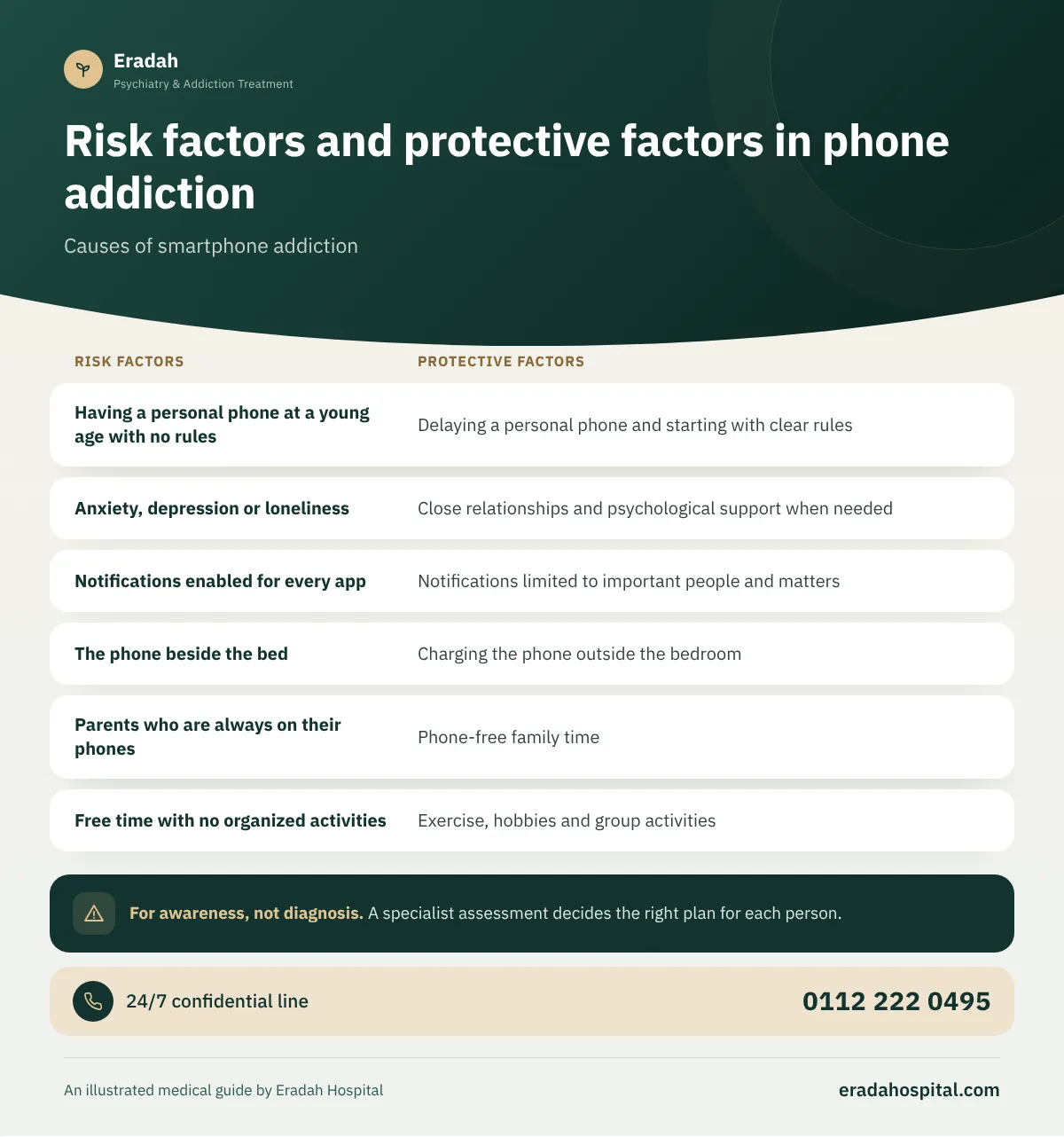
What are the risk and protective factors with the phone?
| Risk factors | Protective factors |
|---|---|
| Having a personal phone at a young age with no rules | Delaying a personal phone and starting with clear rules |
| Anxiety, depression or loneliness | Close relationships and psychological support when needed |
| Notifications enabled for every app | Notifications limited to important people and matters |
| The phone beside the bed | Charging the phone outside the bedroom |
| Parents who are always on their phones | Phone-free family time |
| Free time with no organized activities | Exercise, hobbies and group activities |
Is the cause "poor upbringing" or a "lost generation"?
It is easy to blame the teenager or call him lazy, but this explanation does not hold up: adults struggle with the same problem, and apps target everyone's attention without discrimination. Attachment to the phone is also the result of an interaction between powerful technical design, real psychological needs such as belonging and reassurance, and an environment that always makes the phone the easiest solution; it does not indicate weak faith or morals.
The right explanation changes the solution: instead of scolding and confiscation, we redesign the environment, meet the needs in other ways, and treat anxiety or loneliness if present. This is what we explain step by step in phone addiction treatment.