What is sex addiction?
"I know it's destroying me, and every time I swear it's the last, and I go back again." This sentence is repeated in psychiatric clinics in different forms, usually said by men who have put off seeking help for years out of shame. Sex addiction is a subject wrapped in silence in our society, but it is a medical condition with a definition and a treatment.
Doctors do not use the term "sex addiction" as an official diagnosis. They speak of compulsive sexual behavior disorder, which was added to the ICD-11 under code 6C72. A paper published in World Psychiatry in 2018 explains that the diagnosis rests on a persistent failure to control intense, repetitive sexual urges, appearing as behavior that becomes the center of a person's life at the expense of their health and responsibilities, with repeated unsuccessful efforts to cut down, and continuation despite consequences or little enjoyment, over an extended period, such as six months or more, with marked distress or clear impairment in life.
Is sex addiction a recognized disease?
Yes, in the International Classification of Diseases issued by the World Health Organization, where it is classed under impulse control disorders, not under addictions. The American DSM-5 did not include it, and a review published in World Psychiatry in 2022 notes that adding it to the ICD-11 was a decision that differed from the DSM-5, and that it was followed by a major expansion of research and services. A 2020 systematic review covering 415 studies reports that research has grown considerably, but much of it is simple in design, and high-quality treatment studies are still few.
The difference between sex addiction, high desire and guilt
| The situation | What sets it apart | Is it a disorder? |
|---|---|---|
| High sexual desire | Strong desire with the ability to control it and little or no harm | No |
| Guilt because the behavior conflicts with values | Moral or religious distress, with behavior that is not necessarily excessive | Not on its own, and it deserves different support |
| Unwanted, disturbing sexual thoughts | Thoughts the person hates, resists and does not enjoy | May be obsessive-compulsive disorder rather than addiction |
| Compulsive sexual behavior | Repeated loss of control, continuing despite harm, and failed attempts to stop over months | Yes: compulsive sexual behavior disorder |
The ICD-11 states clearly that distress that results entirely from moral judgments or from rejection of sexual urges is not enough on its own for a diagnosis. A meta-analysis published in Archives of Sexual Behavior in 2019 found that many people's sense of being "addicted" to pornography is closely linked to what researchers call moral incongruence between beliefs and behavior. If the problem is disturbing sexual thoughts that you hate, read about sexual obsessive-compulsive disorder.
Forms of compulsive sexual behavior
The disorder appears in many forms, and more than one often occurs in the same person: compulsive use of pornography, a compulsive pattern of masturbation, repeated sexual chats and encounters online and through apps, multiple extramarital relationships despite the consequences, and repeated spending on sexual services. The yardstick is not the type of behavior but loss of control over it and the harm it causes.
Signs of sex addiction
- Repeated attempts to stop or cut down that end in failure.
- Spending a long time thinking about the behavior, planning it or recovering from it.
- Neglecting work, study, family or health because of it.
- Continuing despite clear consequences such as marital, financial or legal problems, or infection.
- Using the behavior to escape stress, sadness or loneliness.
- Intense distress and shame afterward, then returning to it anyway.
Why promises are not enough: the compulsive behavior cycle
- 1Stress or emptiness
Pressure, loneliness, boredom or conflict raises inner tension.
- 2The urgent urge
The thought takes over and it is hard to focus on anything else.
- 3Behavior
The person carries out the behavior to relieve tension, often in isolation and secrecy.
- 4Brief relief
Tension eases for a short time, and the brain learns that this is the way out.
- 5Shame and regret
Guilt and fear return, so tension rises and the cycle begins again.
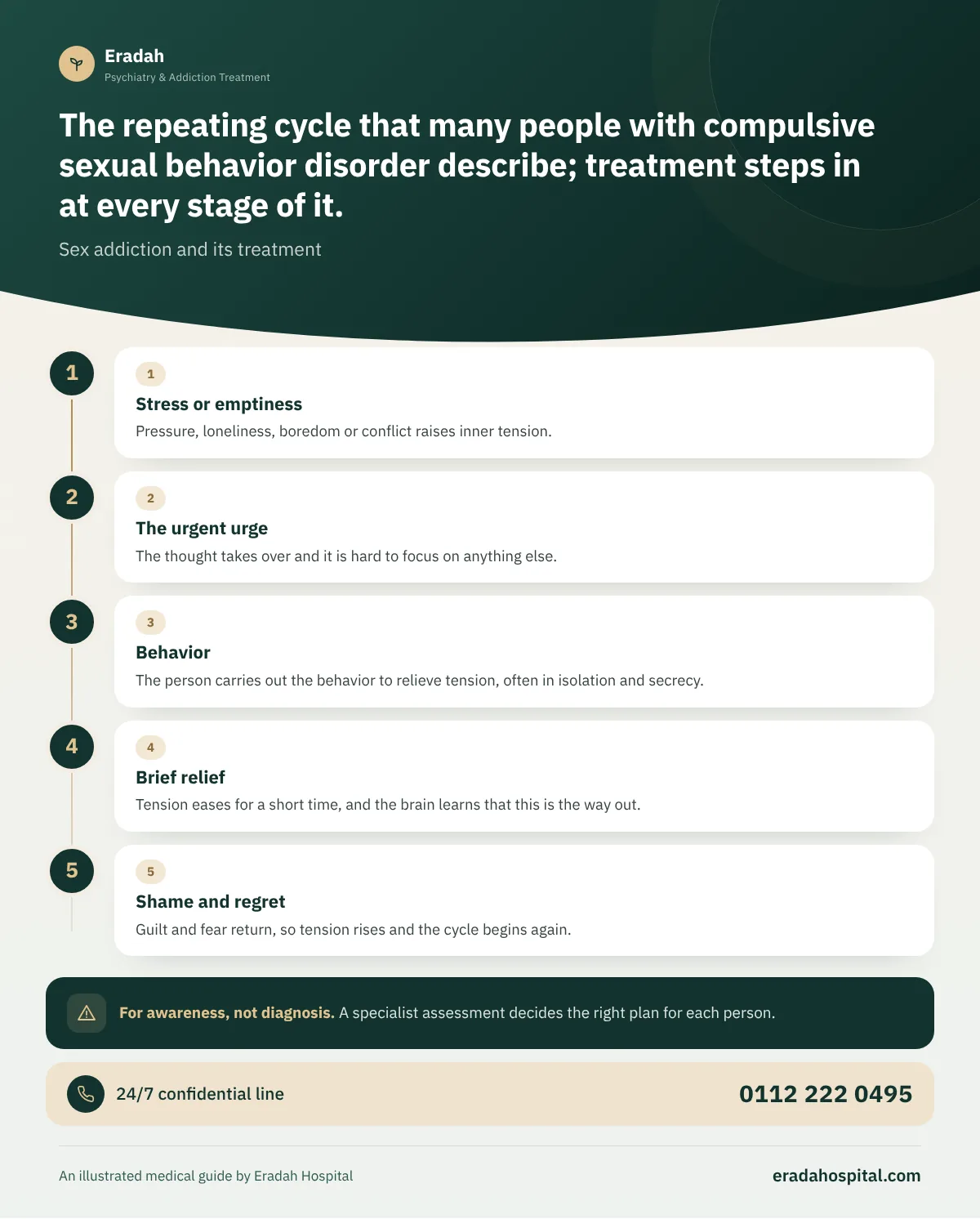
This cycle explains why prohibition alone fails, and why treatment focuses on managing emotions and triggers before the behavior itself.
How common is sex addiction?
These are figures from a US national survey published in JAMA Network Open in 2018, which used a scale for compulsive sexual behavior among adults aged 18 to 50. They measure distress linked to difficulty with control, not a full diagnosis, but they mean the problem is wider than assumed, and that the gap between men and women is smaller than was believed. There are no comparable published Egyptian data.
Its causes and harms in brief
There is no single cause. Factors overlap, such as using the behavior to regulate difficult emotions, anxiety and depression, easy access online, and painful earlier experiences in some people. The harms include depression, shame and isolation, collapse of marital trust, financial losses, the risk of sexually transmitted infections, and exposure to online blackmail. The US National Institute on Drug Abuse (NIDA) notes that use of methamphetamine, known as shabu, is linked to sexual behavior that transmits HIV and hepatitis, and we explain the effect of substances on sex in drugs and sex.
Treatment of sex addiction: what does the research say?
The strongest available evidence is for psychological treatment. In a randomized trial published in the Journal of Sexual Medicine in 2019 on 137 men, a 7-week group cognitive behavioral therapy program led to a greater reduction in symptoms and sexual compulsivity and an improvement in psychological state compared with a waiting list, and the effect lasted 3 and 6 months after treatment. Treatment usually includes:
- Cognitive behavioral therapy: to track triggers and justifying thoughts and to build alternative ways of coping with stress.
- Acceptance and commitment therapy and mindfulness: to tolerate the urge without acting on it.
- Couples therapy: to rebuild trust when the partner is affected.
- Group therapy and support groups: to break isolation and shame.
- Treating co-occurring problems: such as depression, anxiety and substance use, since they feed the behavior.
As for medication, there is no drug approved specifically for this disorder. A psychiatrist may sometimes use medication for co-occurring depression or anxiety, or other medications outside their approved uses on limited evidence, such as naltrexone, which looked possibly helpful in a small study of 20 men with no comparison group, with common side effects such as fatigue and nausea. Only the doctor decides this, and you should not start or stop any medication without a doctor.
Religion and treatment: do they conflict?
No. Many patients in Egypt come out of sincere religious motivation, and that motivation is a strong resource in treatment. The psychiatrist does not ask you to change your values, but helps you regain control over a behavior that you yourself want to change. What matters is that guilt does not turn into self-punishment that feeds the cycle, and that relapse is not seen as proof that the whole person is corrupt.
The role of the wife and family
Discovering the problem is a real shock for the partner, who may feel betrayed and humiliated; these feelings are understandable and deserve support too. It is better for the partner to get psychological support for themselves and not to become a permanent monitor. When the patient is a teenager, calm handling without scandal or harsh punishment protects them from isolation and blackmail, as we explain in the porn addiction guide.
When should you ask for help?
If your attempts to stop keep failing, or the behavior affects your marriage, work, finances or health, or comes with depression or substance use, this is a good time to consult a specialist. At Eradah the first consultation is free and completely confidential, and we provide treatment through outpatient treatment, with dual diagnosis care when the behavior occurs together with substance use, and residential treatment for men when needed.
Severe hopelessness, blackmail or thoughts of self-harm? Get help now
- Talk of death or of life not being worth living after the matter is exposed or after a relapse
- Online blackmail using photos or chats, with a threat of exposure
- Harming or punishing oneself because of guilt and shame
- Risky sexual behavior combined with drug or alcohol use, or exposure to infection
- Violence or threats within the marriage after the problem is discovered
Stay with the person and listen without preaching or belittling, since intense shame increases the risk. Calmly remove medications and dangerous objects. Call an ambulance on 123 or go to the nearest emergency room if the danger is imminent, and contact the mental health support line 16328, available around the clock. In blackmail, do not pay and do not send anything, keep the evidence, and report it to the competent authorities.
Ambulance 123 Mental health support line 16328