What is sexual OCD?
“Awful thoughts come into my head that I would never imagine doing, and I’ve become afraid of myself and can’t tell anyone.” Many people live with this secret for years, believing they are wicked or perverted, when what they are going through is a well-known form of OCD, and the terror they feel is exactly what marks it.
It is one form of obsessive-compulsive disorder, in which the obsessions center on sexual themes. The UK National Health Service (NHS) defines an obsession as an unwanted, unpleasant thought, image or urge that repeatedly enters the mind, causing anxiety or disgust, and a compulsion as a behavior or mental act that the person repeats to temporarily relieve this distress. “Sexual obsessions” describes the content of the obsessions; diagnostic manuals do not treat it as a separate disorder.
Why do these thoughts frighten you so much?
Doctors call these thoughts ego-dystonic, meaning they contradict the person’s values and true desires, which is why they cause shock and guilt. The paradox is that most people have passing strange or inappropriate thoughts and pay them no attention, while a person with OCD stops at them and asks: “Why did I think that? What does it say about me?” This terrifying interpretation, followed by trying to force the thought away, is what makes it return more often and more strongly.
Common forms of sexual OCD
A persistent fear that one’s orientation has changed, or that one is not who one knows oneself to be.
Terrifying intrusive thoughts about people the person protects and loves, with dread of being dangerous.
Unwanted images of relatives that cause intense disgust and guilt.
Sexual thoughts that invade the mind during worship or relate to sacred things.
Repeated fear of being attracted to someone other than one’s partner, or of not loving enough.
A study published in the journal Comprehensive Psychiatry in 2006 of 293 patients with OCD found that 24.9% had experienced sexual obsessions at some point in their lives and 13.3% currently have them, in similar proportions among men and women, often accompanied by aggressive or religious obsessions. Another study, published in 2011, found that about 12% of people with OCD had specifically experienced obsessive doubts about their orientation.
Hidden compulsions in sexual OCD
Many of the compulsions here happen in the mind, so no one sees them:
- Monitoring the body’s reactions to make sure there is no attraction.
- Reviewing memories again and again, looking for evidence.
- Seeking reassurance from friends or sheikhs, or searching online for hours.
- Avoiding people, places or situations for fear of the thought.
- Repeating phrases or prayers in a ritualized way to cancel the thought.
- Repeatedly confessing the thoughts to get rid of guilt.
- Testing oneself by deliberately calling the thought to mind to gauge one’s reaction.
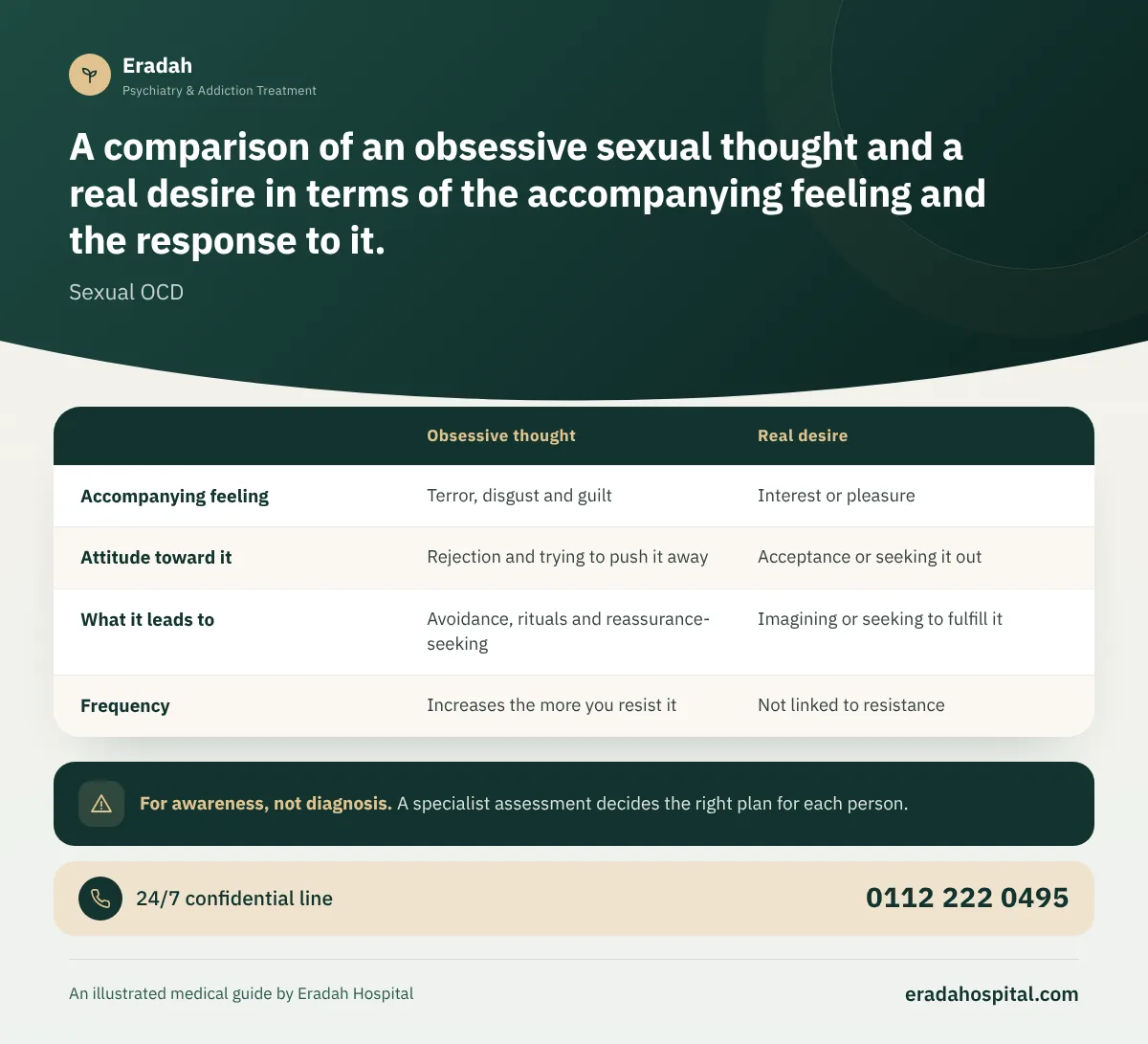
The difference between sexual OCD and a real desire
| Obsessive thought | Real desire | |
|---|---|---|
| Accompanying feeling | Terror, disgust and guilt | Interest or pleasure |
| Attitude toward it | Rejection and trying to push it away | Acceptance or seeking it out |
| What it leads to | Avoidance, rituals and reassurance-seeking | Imagining or seeking to fulfill it |
| Frequency | Increases the more you resist it | Not linked to resistance |
What makes sexual OCD worse?
Repeated reassurance, constant online searching, avoidance and trying to prove the opposite through tests all bring a few minutes of relief and then bring the doubt back stronger. OCD also worsens with stress, lack of sleep and depression. Some patients turn to hashish or alcohol to silence the thoughts, which increases anxiety in the long run.
Treating sexual OCD
- Exposure and response prevention: a type of cognitive behavioral therapy in which the patient is gradually exposed, under a therapist’s supervision, to the feared thought without performing rituals or seeking reassurance, until the brain learns that the thought is just a thought. The NHS notes that cognitive behavioral therapy usually starts to work quickly.
- Cognitive therapy: changes the terrifying interpretation of the thoughts and eases the exaggerated sense of responsibility for them.
- Medication: antidepressants from the selective serotonin reuptake inhibitor (SSRI) group, whose effect can take up to 12 weeks according to the NHS. The doctor decides the type and dose; never start or stop any medication without a doctor.
You will find more detail in the guide to treating OCD. At Eradah you can receive a confidential assessment with a psychiatrist and a therapist in the outpatient clinics, without embarrassment.
When should you ask for help?
If the thoughts take up a large part of your day, make you avoid people you love, spoil your worship or your relationship, or come with sadness and despair, it is time to seek help. If thoughts of harming yourself appear, call the mental health support line (16328).
Suicidal thoughts or danger to self? Get help now
- Talking about death or saying that life with OCD is “unbearable”
- Severe despair and a conviction that things will never get better
- Complete isolation, or giving up eating or sleeping because of rituals or fear
- Saying goodbye to family or writing farewell messages
- A sudden change to strange calm after a period of intense suffering
Stay with the person and listen calmly without blame, and don't dismiss what they say. Call an ambulance (123) or go to the nearest emergency room if the danger is imminent, contact the mental health support line 16328, and keep medications and dangerous objects out of their reach.
Ambulance 123 Mental health support line 16328