What is masturbation from a medical perspective?
Masturbation, which doctors also call "self-stimulation," is a common solitary behavior known to many people of both sexes, and it usually begins with puberty. Psychiatry approaches it in calm, scientific language, away from exaggeration or ridicule, because the fear and misinformation around it often cause more suffering than the behavior itself.
Medical sources such as Cleveland Clinic and Nemours KidsHealth note that it is a common part of development in puberty and afterward, and that it does not cause the illnesses that widespread myths attribute to it. At the same time, this does not mean it can never become a problem; like any behavior that brings quick relief, in some people it can turn into a repeated pattern that is hard to stop.
People differ in how they view it according to their values and beliefs, which is their right and is respected. Here we offer accurate medical information: what is real and what is exaggerated, when the situation needs specialist help, and how the behavior can be changed without self-punishment.
Is masturbation a mental illness?
The honest answer: no. Neither the international classification ICD-11 nor the American manual DSM-5 has a diagnosis called "masturbation illness." Repeating the behavior in itself, or practicing it at certain stages of life, is not a disorder.
However, the World Health Organization included in ICD-11 a diagnosis called "compulsive sexual behavior disorder" under code 6C72, within "impulse control disorders." It describes a persistent pattern of failure to control intense, repetitive impulses, in which the behavior becomes the center of life at the expense of health and responsibilities, with unsuccessful efforts to cut down and continuation despite consequences, over a long period (six months or more, as an example), with marked distress or impairment in life. Compulsive masturbation can fall under this diagnosis if all these conditions are met.
When does masturbation become compulsive behavior?
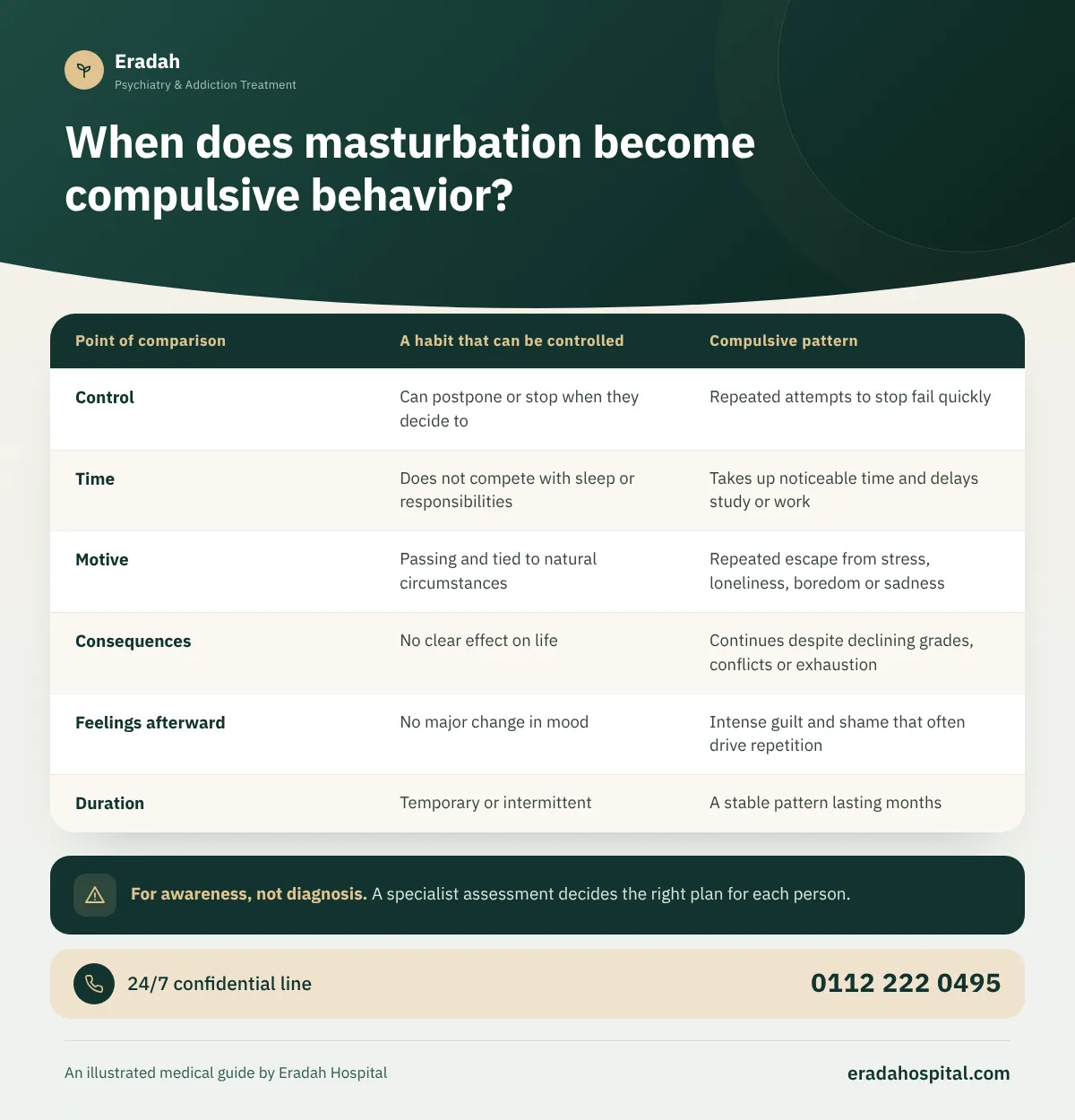
Doctors do not judge the problem by the number of times; there is no "normal" number and "pathological" number. The criterion is the person's relationship with the behavior: do they still choose, or has the behavior become the one leading them? The table shows the difference:
| Point of comparison | A habit that can be controlled | Compulsive pattern |
|---|---|---|
| Control | Can postpone or stop when they decide to | Repeated attempts to stop fail quickly |
| Time | Does not compete with sleep or responsibilities | Takes up noticeable time and delays study or work |
| Motive | Passing and tied to natural circumstances | Repeated escape from stress, loneliness, boredom or sadness |
| Consequences | No clear effect on life | Continues despite declining grades, conflicts or exhaustion |
| Feelings afterward | No major change in mood | Intense guilt and shame that often drive repetition |
| Duration | Temporary or intermittent | A stable pattern lasting months |
How common is it, and who is most prone to the compulsive pattern?
Masturbation itself is very common, and medical sources agree that it occurs in males and females, and in married and unmarried people. There are no reliable Egyptian or Arab figures, because the subject is surrounded by embarrassment and is hard to measure.
The compulsive pattern is far less common. A large American survey published in 2018 found that about 8% of adults reported marked distress linked to difficulty controlling sexual urges and behaviors in general, a result of an initial screening tool, not a diagnosis. Susceptibility is higher in teenagers and young adults, in people with anxiety, depression or loneliness, and in those with compulsive pornography use.
What happens in the brain? The reward system and emotion regulation
The brain works with a reward system based on dopamine, which drives us to repeat what gives us quick relief. Because this behavior is always available and gives temporary soothing, the brain may learn to link it to stress, boredom or trouble sleeping, and it becomes a "shortcut" for easing difficult feelings.
With repetition, the behavior moves from the area of conscious decision to the area of automatic habit, which explains why some people feel they "find themselves" doing it before they decide. And learned habits can be modified: the brain is flexible and regains its balance when the routine changes and new alternatives are learned.
The cycle of guilt and repetition: why promises are not enough
Many people describe a loop that repeats in an almost fixed way, in which shame feeds the behavior instead of preventing it:
- 1Pressure or emptiness
Stress, loneliness, boredom or insomnia, often late at night and when alone.
- 2Strong urge
A thought that escalates with justifications such as "just one last time."
- 3Brief relief
Temporary calm that does not last long.
- 4Harsh guilt
Severe self-blame, a sense of failure and firm promises to stop.
- 5Tension and isolation
Distress and withdrawal increase... and the cycle begins again.
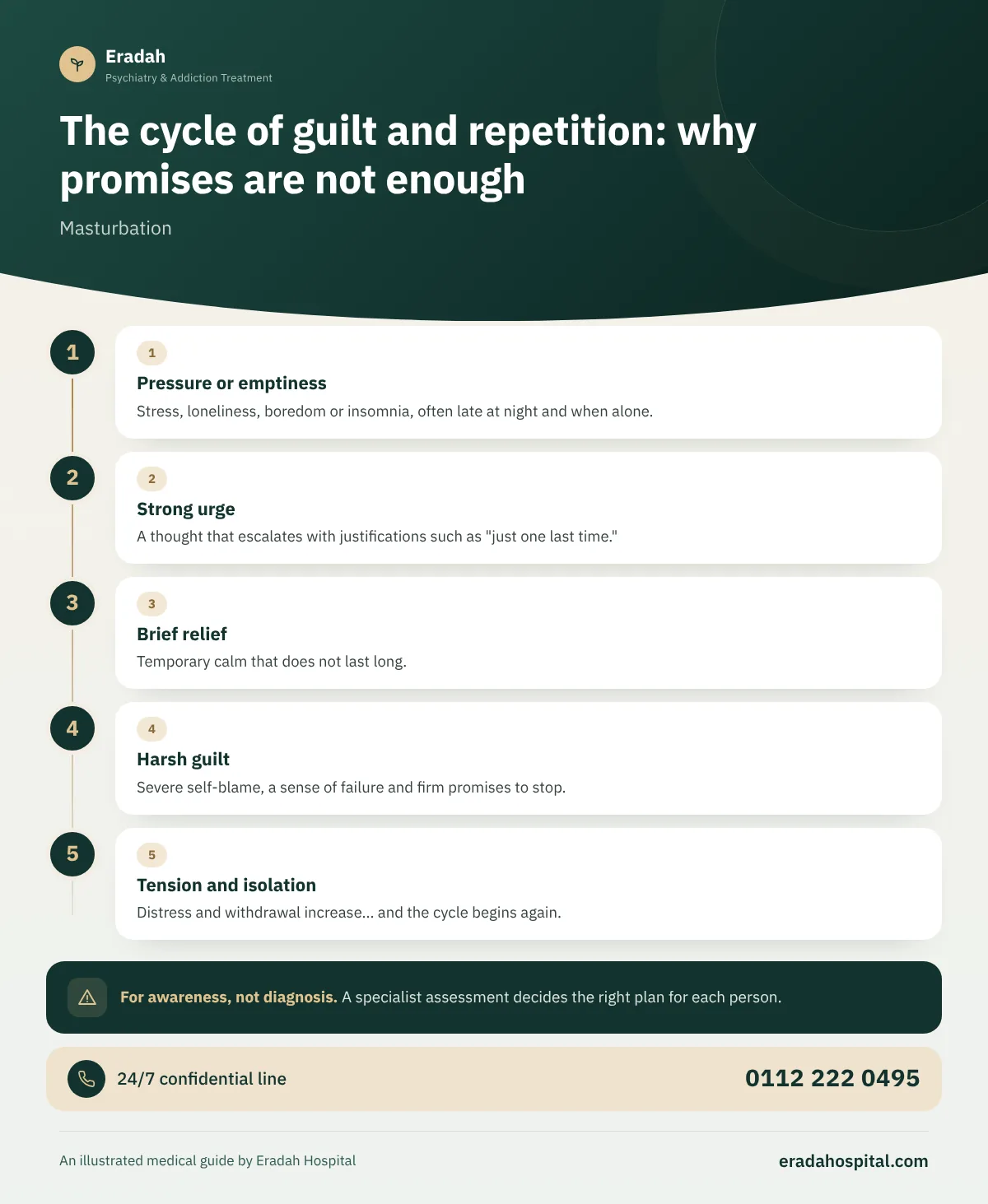
The irony is that self-punishment does not protect against repetition but paves the way for it, because guilt is a painful feeling that the brain looks for an escape from. Dealing with the behavior calmly, understanding its triggers and asking for support break the cycle from the middle.
Common myths and brief facts
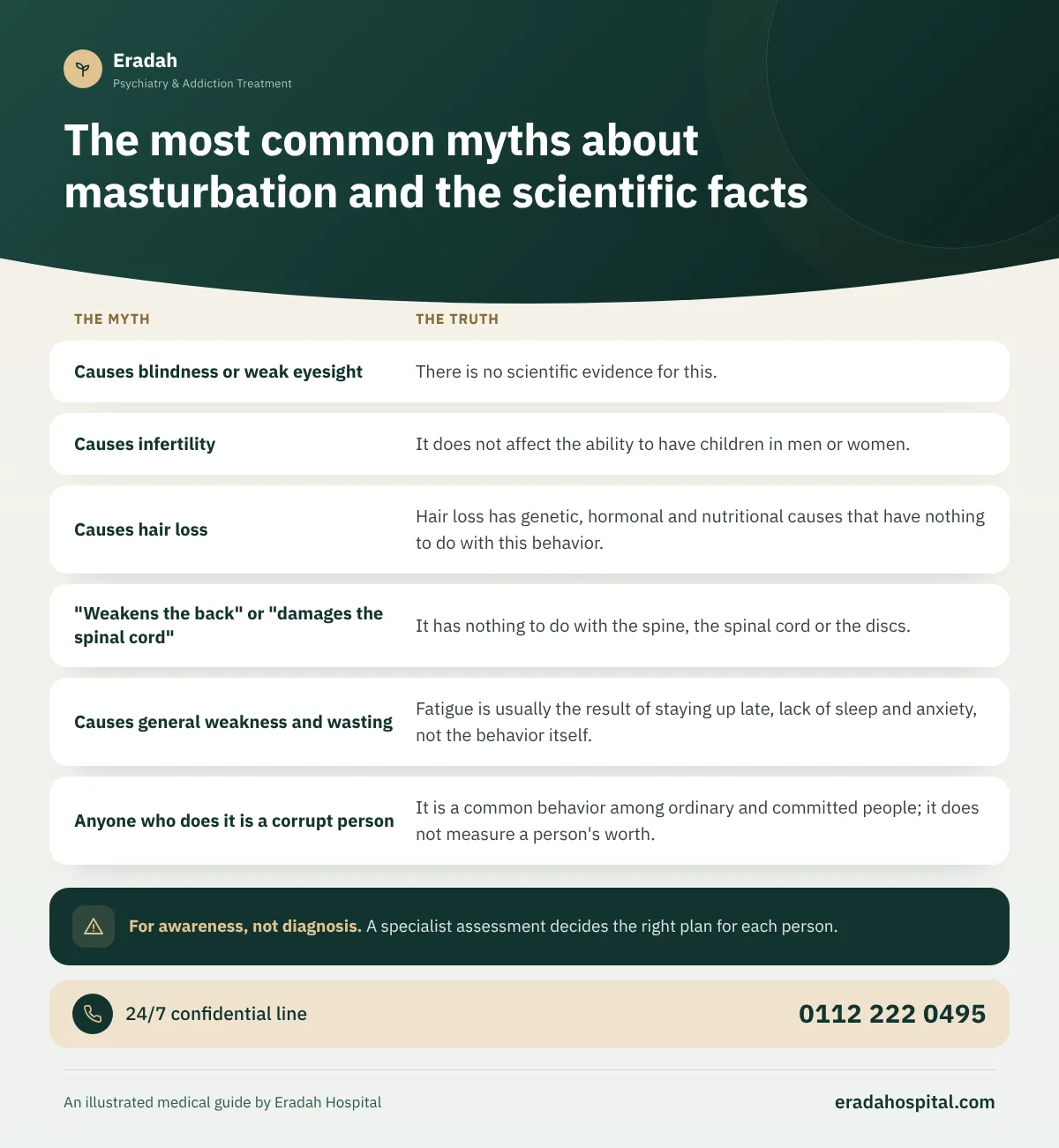
Many fears about this behavior are passed down through generations in our societies. These are the best known, in brief, and you will find them in detail on the harms page:
| The myth | The truth |
|---|---|
| Causes blindness or weak eyesight | There is no scientific evidence for this. |
| Causes infertility | It does not affect the ability to have children in men or women. |
| Causes hair loss | Hair loss has genetic, hormonal and nutritional causes that have nothing to do with this behavior. |
| "Weakens the back" or "damages the spinal cord" | It has nothing to do with the spine, the spinal cord or the discs. |
| Causes general weakness and wasting | Fatigue is usually the result of staying up late, lack of sleep and anxiety, not the behavior itself. |
| Anyone who does it is a corrupt person | It is a common behavior among ordinary and committed people; it does not measure a person's worth. |
The religious and medical perspectives: how do they complement each other?
For many Egyptian families this subject is tied to religious values, which is understandable and respected. Anyone who wants to know the religious ruling or seeks spiritual support may consult a trusted religious scholar alongside the doctor or psychotherapist, and faith can be a source of strength and a motive for change.
But it is important to distinguish between a healthy sense of responsibility that motivates repair and destructive shame that convinces a person they are hopeless. It is also important that medical myths are not used as a way to frighten; wrong information can cause anxiety and obsessions that last for years. The medical framework at Eradah respects each person's beliefs and builds the plan around what gives them meaning.
Teenagers: how can the family respond calmly?
This behavior usually begins with puberty, and many teenagers live with silent anxiety because of the myths they have heard, and feel too ashamed to ask. The family's role here is reassurance and accurate information, not intimidation or exposure:
Do not lose your temper, threaten or mock; anger teaches hiding and plants fear and guilt.
Talk about the changes of puberty, privacy and personal hygiene in simple language, and leave the door open for questions.
Correct common fears such as blindness or infertility; these myths cause real anxiety.
Set suitable controls on devices and keep them out of bedrooms at night, because pornographic content feeds the compulsive pattern.
If your son seems very anxious or withdrawn or his grades have dropped, consulting a pediatrician or psychiatrist helps.
The role of family and partner when worried about the problem
When parents or a partner notice that the behavior has started to affect life, it is more useful to talk about the impact, not the behavior itself: staying up late, withdrawal, tension and emotional distance. Separating the person from the behavior and agreeing on a practical step such as seeing a specialist is more helpful than accusation or humiliating monitoring.
In married life, both partners sometimes need a frank, calm conversation, and perhaps couples counseling, especially if the compulsive behavior combines with compulsive pornography use and affects closeness and trust.
When does masturbation need a mental health specialist?
- You have tried to cut down more than once and could not despite your sincere wish.
- The behavior steals your sleep or clearly affects your studies or work.
- You use it to escape ongoing sadness or anxiety, or it comes with compulsive pornography use.
- You are dominated by constant anxiety or obsessive thoughts about imagined harms.
- You are overwhelmed by crushing guilt or despair, or have thoughts of self-harm, in which case help is urgent.
A visit to a psychiatrist is confidential, and specialists handle this subject in professional language and without judgment. The aim is to understand the behavior and help you regain control, not to put you on trial.
Masturbation guide: everything you need to know
We have gathered everything about masturbation in 4 pages, each answering one question in detail. Choose what you are looking for:
Causes of compulsive masturbation
Why does a common behavior turn into a pattern that is hard to control? The role of stress, loneliness, boredom and insomnia, conditioning, digital content, and risk and protective factors.
Harms of masturbation: fact and myth
Debunking common myths such as blindness, infertility and hair loss, and explaining the real harms when the behavior becomes compulsive: guilt, anxiety, time and relationships.
Treatment of masturbation and ways to quit
Practical steps for changing the habit, dealing with strong urges, cognitive behavioral therapy, supporting teenagers, and when you need a psychiatrist.
Benefits of quitting masturbation: what really changes?
What are the real benefits of quitting? Psychological and everyday gains for those for whom it has become compulsive, the truth about the testosterone rise on day seven, whether stopping is harmful, and how to stop without self-punishment.
Crushing shame or thoughts of self-harm? Get help now
- Talk of wanting to die or that they "don't deserve to live" because of this behavior
- Severe shame and despair after a relapse, with a conviction of being "hopeless" or "corrupt"
- A teenager who is distraught or panicked after their family found out, or after threats or harsh punishment
- Sudden withdrawal from family and friends and stopping eating, sleeping or studying
- Increased use of alcohol, drugs or sedatives to bear the guilt
Stay with the person and listen calmly, and reassure them that what they are going through is common and treatable and that they are not a bad person; blame at this moment increases the risk. Call an ambulance on 123 or take them to the nearest emergency room, or call the mental health support line 16328 (24 hours), and do not leave them alone as long as thoughts of self-harm are present.
Ambulance 123 Mental health support line 16328