What is porn addiction?
People use the phrase "porn addiction" to describe a state in which viewing this content moves from an occasional act to a repeated behavior that is hard to stop. It consumes time and energy, is carried out in secret, and continues even though the person wants to stop and clearly sees the harm.
Many doctors and researchers prefer terms such as "compulsive use" or "problematic use" to the word "addiction", because the scientific debate over how to classify this condition has not been settled. But the name is not the most important thing. The suffering is real, and the person living with it needs understanding and help, not accusation or ridicule.
It is important to understand from the start that this problem is not a sign of corruption or weak morals. It is a behavioral pattern the brain has learned over time, fed by loneliness, stress and secrecy, and it is possible to learn to move out of it through structured steps and, when needed, specialist help.
When does use become compulsive?
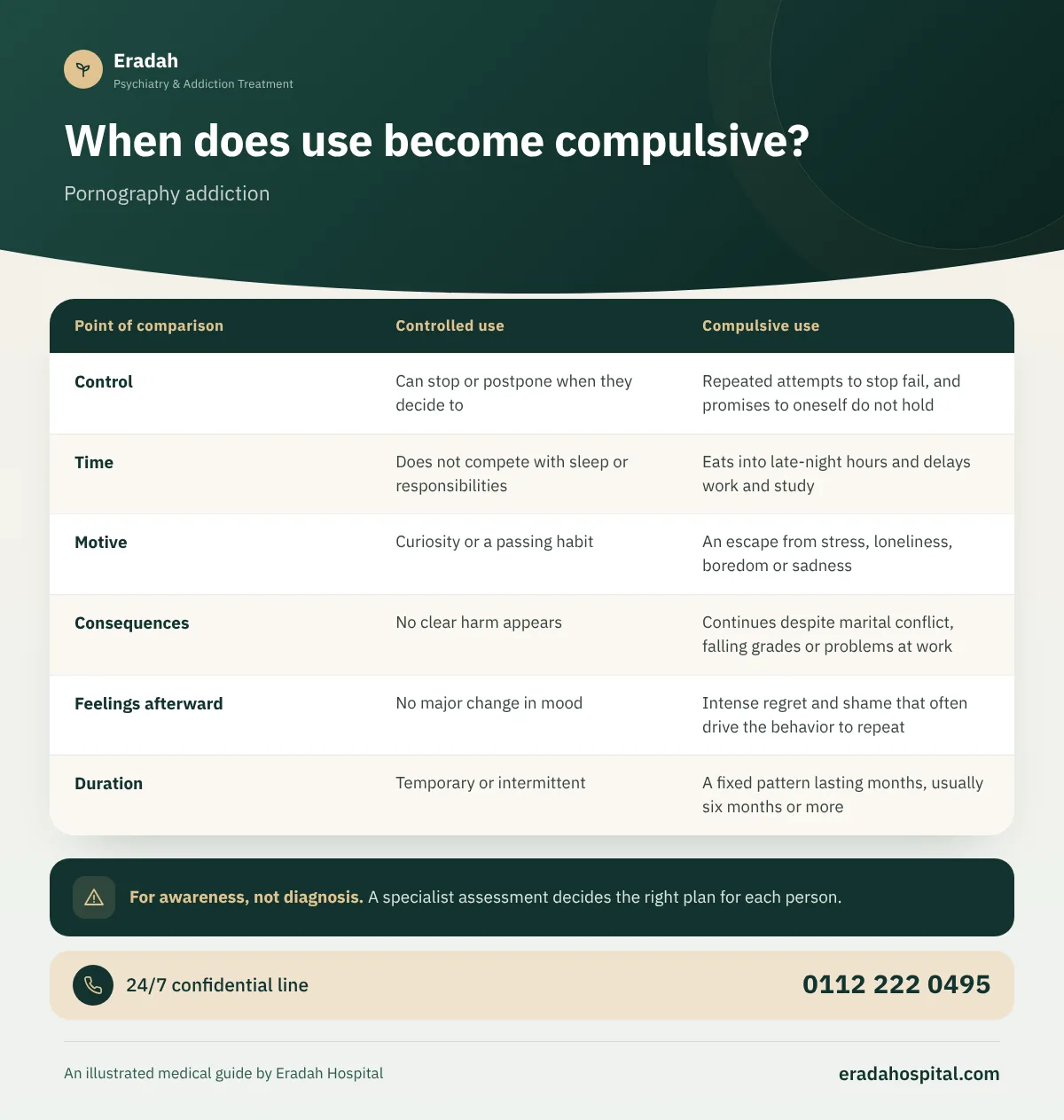
Doctors do not define the problem by how often or how many hours someone watches, but by the person's relationship with the behavior: do they still choose, or has the behavior become the one choosing for them? The table shows the difference between controlled use and compulsive use:
| Point of comparison | Controlled use | Compulsive use |
|---|---|---|
| Control | Can stop or postpone when they decide to | Repeated attempts to stop fail, and promises to oneself do not hold |
| Time | Does not compete with sleep or responsibilities | Eats into late-night hours and delays work and study |
| Motive | Curiosity or a passing habit | An escape from stress, loneliness, boredom or sadness |
| Consequences | No clear harm appears | Continues despite marital conflict, falling grades or problems at work |
| Feelings afterward | No major change in mood | Intense regret and shame that often drive the behavior to repeat |
| Duration | Temporary or intermittent | A fixed pattern lasting months, usually six months or more |
Is porn addiction a recognized medical diagnosis?
The honest answer: not under that name. The World Health Organization's International Classification of Diseases (ICD-11) includes a diagnosis called "compulsive sexual behavior disorder" under code 6C72. It sits within the group of "impulse control disorders", not the "behavioral addictions" group, which includes gaming disorder and gambling disorder. Severe compulsive use of pornography can fall under this diagnosis if its criteria are met.
The classification describes this disorder as a persistent pattern of failure to control intense, repetitive impulses, in which the behavior becomes a central focus of life at the expense of health and responsibilities, with unsuccessful efforts to cut down and continuation despite consequences, over an extended period (six months or more, as an example), causing marked distress or impairment in family, social, educational or occupational life.
The American manual, the DSM-5, does not list a separate diagnosis for this condition, and researchers remain divided. One camp sees it as similar to addiction in its mechanisms. Another sees it as closer to an impulse control disorder or an unhealthy way of coping with emotions. A third warns against turning a common behavior into a disease. For this reason the World Health Organization chose a cautious classification until the evidence becomes clearer.
How common is it, and who is most at risk?
There are no reliable Egyptian or Arab figures, because the subject is surrounded by embarrassment and is hard to measure. Globally, a large US survey published in 2018 found that about 8% of adults reported notable distress or impairment linked to difficulty controlling this kind of urge and behavior in general, not pornography alone. This is the result of a preliminary screening tool, not a diagnosis, but it suggests the problem is not rare.
Vulnerability is higher among teenagers and young adults because of easy access and limited experience, among people with anxiety, depression, loneliness or attention-deficit/hyperactivity disorder, and among those who were exposed to this content at an early age. Women are affected too, although they are less likely to seek help because of a double stigma.
What happens in the brain? The reward system in brief
The brain runs a reward system based on dopamine, which pushes us to repeat what makes us feel comfort or excitement. Endlessly refreshed digital content offers fast stimulation available at any moment, so the brain learns to link feelings of distress or boredom with this behavior as a shortcut to escape.
Some studies have observed brain response patterns similar to those seen in other addictions, such as stronger reactions to cues linked to the behavior. But this research is still limited and conflicting, and it is not accurate to say that pornography "destroys the brain", as some websites claim. It is more accurate to say it can become a strongly learned habit, and learned habits can be changed.
The shame and relapse cycle: why willpower alone is not enough
Many people who struggle with this problem describe a loop that repeats in an almost fixed way, in which shame fuels the behavior instead of preventing it:
- 1Pressure or emptiness
Stress, loneliness, boredom or an argument, often late at night and alone with a device.
- 2Strong urge
A thought that grows and is hard to ignore, with justifications such as "just one last time".
- 3Behavior
Brief, temporary relief, often followed by more time spent than intended.
- 4Regret and shame
Harsh self-blame and a sense of being "a bad person", along with firm promises to stop.
- 5Isolation and secrecy
They hide it and withdraw from people, so stress and loneliness increase... and the cycle starts again.
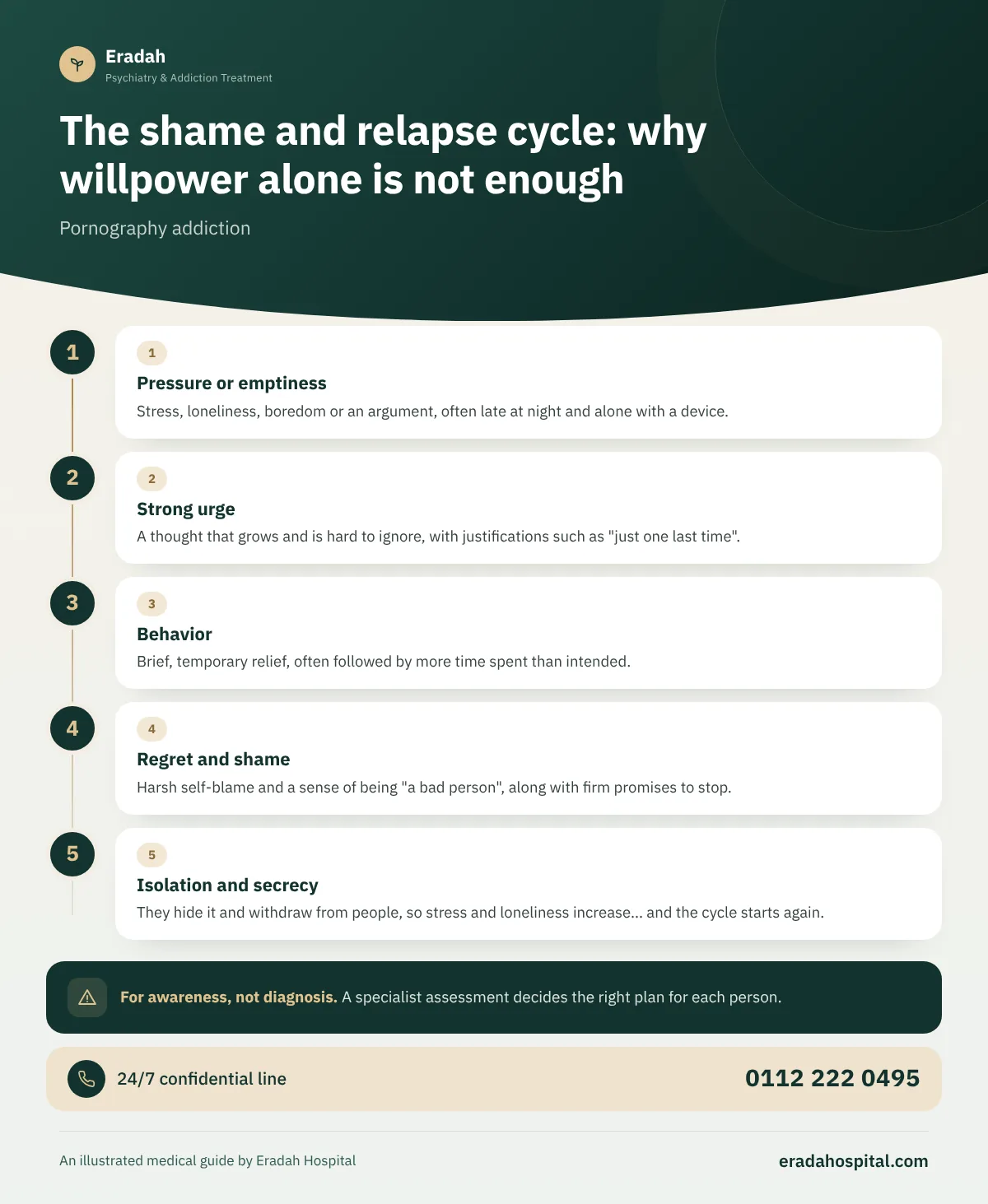
The paradox is that self-punishment does not protect against relapse; it paves the way for it, because shame is a painful feeling and the brain looks for an escape from it. Admitting the problem to a trusted person or a specialist, and treating a slip as information to learn from, breaks the cycle in the middle.
Myths and facts about compulsive pornography use
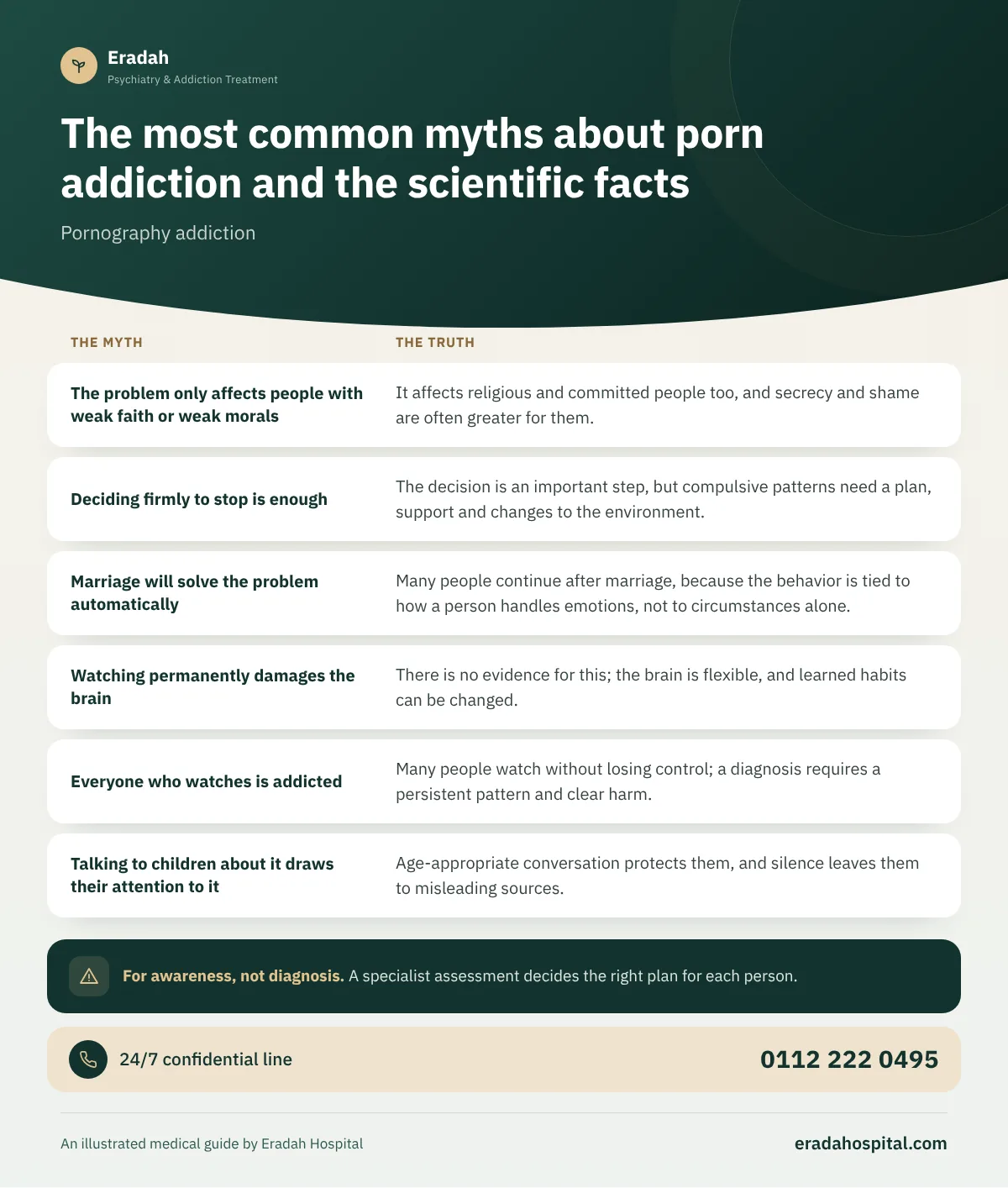
| The myth | The truth |
|---|---|
| The problem only affects people with weak faith or weak morals | It affects religious and committed people too, and secrecy and shame are often greater for them. |
| Deciding firmly to stop is enough | The decision is an important step, but compulsive patterns need a plan, support and changes to the environment. |
| Marriage will solve the problem automatically | Many people continue after marriage, because the behavior is tied to how a person handles emotions, not to circumstances alone. |
| Watching permanently damages the brain | There is no evidence for this; the brain is flexible, and learned habits can be changed. |
| Everyone who watches is addicted | Many people watch without losing control; a diagnosis requires a persistent pattern and clear harm. |
| Talking to children about it draws their attention to it | Age-appropriate conversation protects them, and silence leaves them to misleading sources. |
The religious perspective: how does it fit with medicine?
For many Egyptian families this subject is tied to religious values, which is understandable and respected. Faith can be a source of strength and a motive for change and a support in moments of weakness, and anyone who wishes can turn to a religious scholar or a trusted guide alongside the mental health specialist.
But it is important to tell apart a healthy sense of responsibility that drives repair from destructive shame that convinces a person they are beyond hope. The medical framework does not cancel values; it adds practical tools for understanding and changing the behavior. At Eradah we respect every patient's beliefs and build the plan around what gives them meaning and motivation.
How can families protect children and teenagers?
Many children reach this content by accident, out of curiosity or through peer pressure, at a younger age than parents expect. Protection does not rest on prohibition alone, but on a mix of technical controls, conversation and trust:
Turn on parental control tools on the router and on devices, and keep devices in shared spaces, not in bedrooms at night.
Teach the child that inappropriate content may suddenly appear, and that they should close it and tell a parent without fear of punishment.
If you find out your child has seen something, do not overreact and do not shame them; anger teaches them to hide, not to be careful.
Talk about respect, privacy and body boundaries, and about how what appears on screens is an act that does not reflect real relationships.
Warn children not to share photos or personal information with strangers, and to tell their parents immediately about any threat or blackmail.
This guidance is based on recommendations from child protection organizations such as the NSPCC, and is adapted to the child's age and maturity.
The role of the family and partner when the problem is discovered
A wife or parents discovering this is a painful moment for everyone. It is natural for a partner to feel betrayed or angry, and their feelings deserve acknowledgment and support too. But confronting the person with insults or exposing them in front of others increases secrecy and weakens the chances of change.
It is more helpful to separate the person from the behavior, to talk about the effect on the relationship and trust, and then to agree on a practical step such as seeing a specialist. A partner can also seek psychological support for themselves even if the other person is not yet ready.
When do you need a mental health specialist?
- You have tried to stop or cut down more than once and could not.
- The behavior steals your sleep or affects your studies or work.
- There is marital conflict or loss of trust because of it.
- You use it to escape ongoing sadness or anxiety, or it comes with use of other substances.
- You are overwhelmed by shame or hopelessness, or you have thoughts of harming yourself, in which case help is urgent.
A visit to a doctor or psychological therapist is confidential, and it does not mean you are "perverted" or "seriously ill"; it means you are dealing with a real problem with real tools.
Porn addiction guide: everything you need to know
We have gathered everything about porn addiction into 5 pages, each answering one question in detail. Choose what you are looking for:
Signs of pornography addiction
Behavioral, psychological and daily signs in teenagers and adults, how families notice them, non-diagnostic self-assessment questions, and how to start the conversation calmly.
Causes of pornography addiction
The role of platform design and conditioning, loneliness, anxiety and depression, early exposure, everyday triggers, and risk and protective factors.
Harms of pornography addiction
The effect of compulsive use on mood, concentration, sleep, the marital relationship and the family, teenage development, digital risks, and how to avoid them.
Treatment of porn addiction
Practical first steps, designing the digital environment, cognitive behavioral therapy and acceptance and commitment therapy, couples therapy, and dealing with relapse.
Benefits of quitting porn: what science supports and what is exaggerated
The benefits of quitting porn as supported by research: time, focus, sleep, relationships and reconciling with one's values, what to expect in the first weeks, and the myths of "rebooting" and superpowers.
Severe hopelessness or thoughts of self-harm? Get help now
- Talk of wanting to die, of being a "burden" on the family, or of not deserving to live
- Crushing shame and total hopelessness after a relapse or after the family or wife finds out
- Sudden withdrawal from everyone, or saying goodbye to people and putting affairs in order in a way that is hard to explain
- A teenager facing online threats or blackmail who seems terrified or broken down
- Increased use of alcohol or drugs, or violent agitation that threatens their safety or the safety of those around them
Do not leave the person alone, and speak to them calmly, without blame or shaming; the feeling of disgrace at this moment may be more dangerous than the problem itself. Call an ambulance on 123 or take them to the nearest emergency room, or call the mental health support line 16328 (24 hours). In cases of online blackmail: reassure the teenager that they are not at fault, keep the evidence, do not comply with any demand, and report it to the competent authorities.
Ambulance 123 Mental health support line 16328