How does LSD change inside the body?
After LSD enters the body it spreads quickly, then in the liver it is converted into inactive products, the best known being a compound abbreviated as “oxo-hydroxy-LSD.” Most of it is excreted in urine in the form of these products, and only a very small share as the original substance.
Present in blood and urine at very low concentrations and for a short time, so it is hard to detect.
They remain at a higher concentration and a little longer, which is why some confirmatory tests look for them.
And because the amount used is itself tiny, concentrations in the body are far lower than for most other substances, which is the main reason it is hard to detect.
Does LSD show up on a regular drug test?
Most of the time, no. Most routine rapid tests in labs and workplaces look for common groups such as cannabis, opiates, stimulants, and sedatives, and do not include LSD. To detect it, a test for it specifically must be requested.
How long does LSD stay in urine, blood, and hair?
Urine
Blood
Saliva
Hair
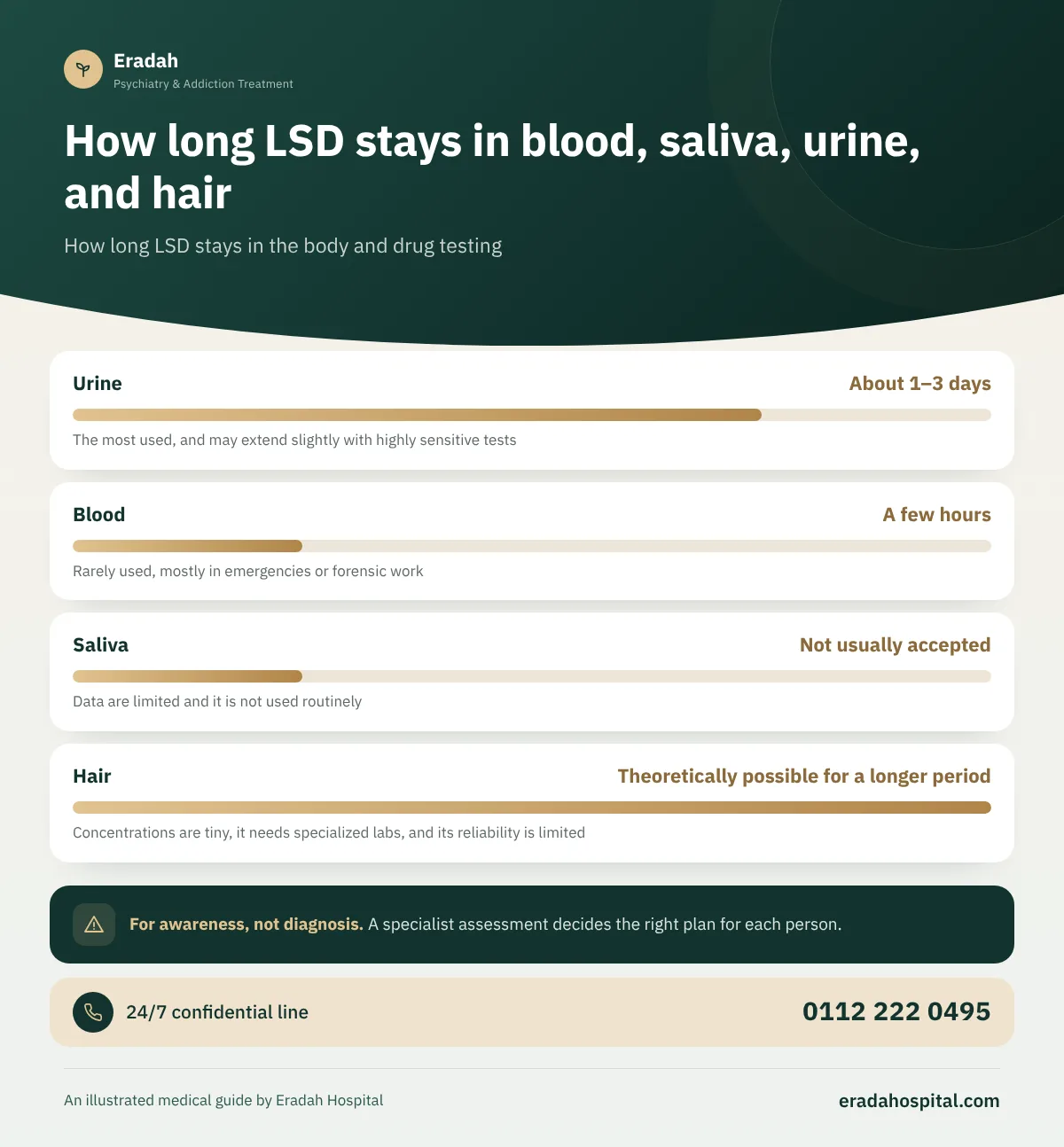
These durations are approximate and vary with the lab and the sensitivity and method of the test. For an accurate interpretation of a specific result, consult the doctor or the lab.
What factors affect detection time?
- Amount and frequency of use: repeated use may lengthen the detection period slightly.
- Type and sensitivity of the test: advanced methods detect lower concentrations for longer.
- Timing of the sample: the later the sample is taken, the lower the chance of detection.
- Liver function and metabolism: the speed of clearance varies from person to person.
- Age and general health, and taking other medications.
Which specialized tests detect LSD?
| Type of test | Purpose | Notes |
|---|---|---|
| Immunoassay screening test | Quick initial screen | Must be requested specifically, and may give false positives |
| Chromatography with mass spectrometry | Confirming the result | More accurate and sensitive, and needs a specialized lab |
| Blood test | Assessing very recent use | A short window, mostly used in forensic work |
Even when a test is positive, the concentration of LSD in urine does not reflect the severity of symptoms, so emergency doctors rely on the clinical picture more than the test.
Can a result be positive without LSD use?
Yes, this can happen on rapid initial tests, as it has been reported that some medications can interfere with some types. So an initial test is not relied on alone, and any positive result must be confirmed with a confirmatory test at a specialized lab.
What is the difference between how long it works and how long it can be detected?
Many people confuse how long a person feels the effect of LSD with how long it can be detected. In fact each has a different meaning:
| Stage | Approximate duration | Meaning |
|---|---|---|
| Onset of effect | Half an hour to two hours | Changes in perception and mood begin |
| Full effect | 6-12 hours | The period when judgment and perception are impaired |
| Exhaustion after the effect | Hours to a day | Tiredness, fogginess, and poor concentration |
| Detection in urine | About 1–3 days | Presence of the substance's products on specialized tests |
The substance disappearing from tests is not linked to its psychological effects disappearing; anxiety or visual disturbances may continue after tests become completely negative.
When are LSD tests requested?
- In emergencies, when there are unexplained hallucinations, agitation, or psychosis, although diagnosis relies mainly on examination.
- At the start of a treatment program and during it when abstinence needs to be monitored.
- In some legal proceedings or forensic work.
Why don't we mention ways to evade testing?
If you are a parent thinking about testing your son or daughter, remember that a calm conversation and psychological assessment matter far more than a test result, especially with a substance that is hard to detect like LSD. A test may tell you what happened in the last few days, while an assessment tells you what your child actually needs, and opens a door to treatment instead of confrontation. You will find details of the treatment plan on the page for LSD addiction treatment.