What harms happen during the effects?
These harms appear during the long hours of the effect, and can affect anyone, even the first time:
- The bad trip: intense terror, frightening hallucinations, and a sense of imminent death or losing one's mind.
- Panic attacks: palpitations, shortness of breath, and a feeling of suffocation, with inability to calm down.
- Delusions and persecution: believing others want to harm them, or strange ideas with no basis.
- Temporary physical effects: a racing heart, raised blood pressure and temperature, sweating, tremor, nausea, and lack of sleep.
- Impaired judgment: losing the ability to judge danger, such as distances, heights, and moving cars.
What is a bad trip and why is it dangerous?
A bad trip is a terrifying experience that can last hours, in which the person completely loses their sense of safety and cannot remind themselves that what they see is caused by a substance. Its likelihood is influenced by several factors, the most important being:
Anxiety, sadness, or stress before use raises the chance of a bad trip.
Crowded or unfamiliar places, or feeling unsafe, increase the risk.
An adulterated substance or one stronger than expected can make the experience more intense and longer.
A previous psychiatric disorder or a family history of one.
A bad trip can leave an effect that lasts after it ends, such as anxiety, fear, panic attacks, and sleep disturbance for days or weeks, and some people need specialist psychological support to recover from it.
Does LSD cause psychosis or schizophrenia?
LSD can cause temporary psychotic symptoms during the effects. More dangerous, though, is that it can trigger a psychotic episode that continues after the effect wears off in people predisposed to it, especially those with a personal or family history of schizophrenia or bipolar disorder. In these cases the person may need long psychological and medication treatment.
This does not mean everyone who uses LSD will develop psychosis, but there is no way to know who is predisposed. That is why a family history of psychotic illness is a strong reason to avoid hallucinogens entirely. You will find more details on the page about drug-induced psychosis.
What is persistent perception disorder and recurring hallucinations?
Some people who used LSD experience, after stopping, a return of visual disturbances without new use, which is called a “flashback.” If these disturbances continue and cause distress or disrupt daily life, it is called hallucinogen persisting perception disorder (HPPD).
- Halos around objects, and a trail of movement behind moving objects.
- Afterimages that remain after looking at something, and changes in the intensity of colors.
- A feeling of movement at the edge of vision, or changes in the size of objects.
- May be triggered by stress, exhaustion, or entering a dark place.
This disorder is rare, but it is linked to LSD more than to other hallucinogens, and may occur even after a single experience. Some cases are brief and disappear, while others last a long time and need follow-up with a psychiatrist.
Does LSD harm the body's organs?
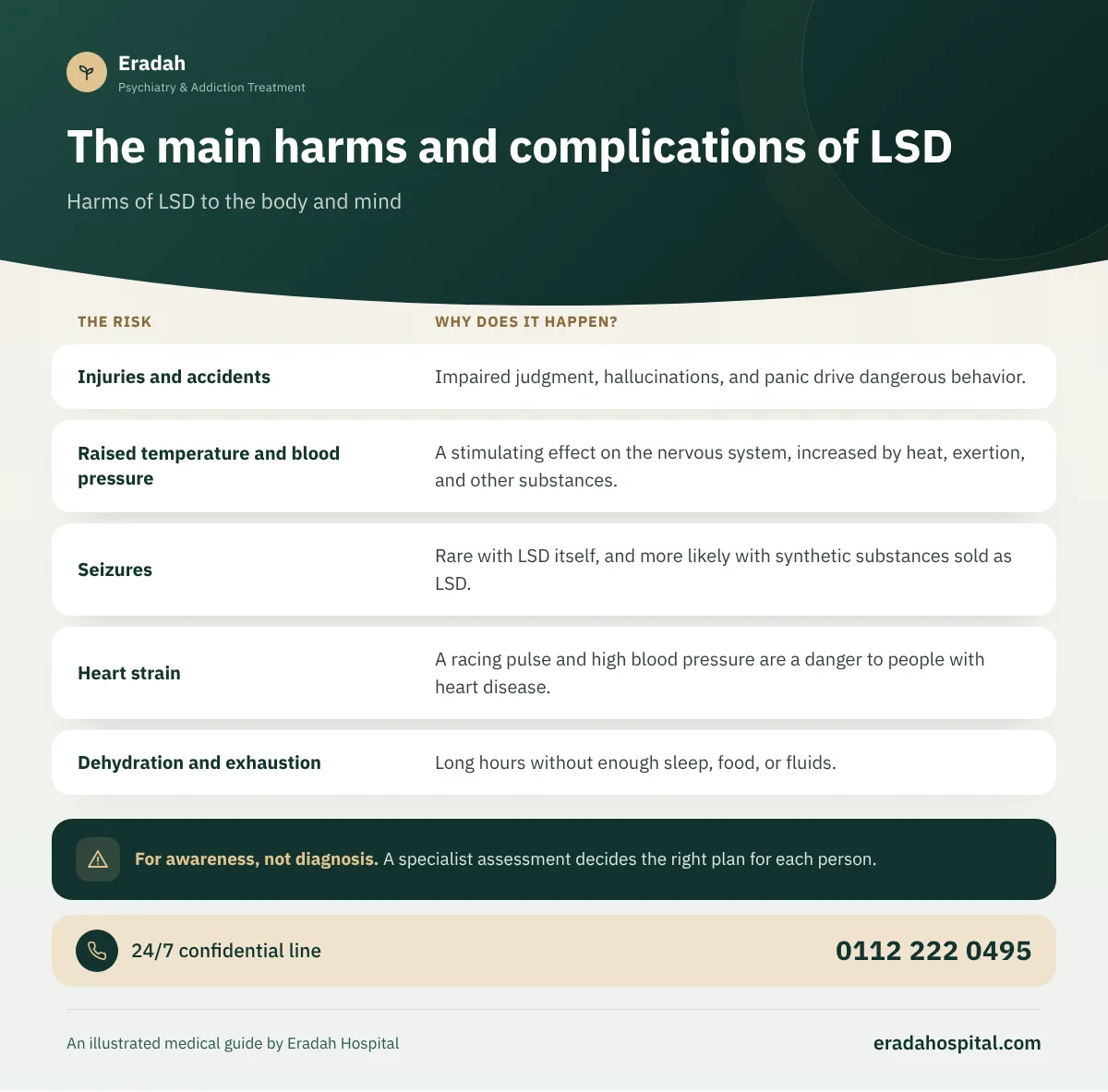
The available evidence does not suggest that LSD itself causes direct damage to the liver, kidneys, or brain the way other substances do. But there are real physical risks:
| The risk | Why does it happen? |
|---|---|
| Injuries and accidents | Impaired judgment, hallucinations, and panic drive dangerous behavior. |
| Raised temperature and blood pressure | A stimulating effect on the nervous system, increased by heat, exertion, and other substances. |
| Seizures | Rare with LSD itself, and more likely with synthetic substances sold as LSD. |
| Heart strain | A racing pulse and high blood pressure are a danger to people with heart disease. |
| Dehydration and exhaustion | Long hours without enough sleep, food, or fluids. |
What is the risk of mixing LSD with other substances?
LSD is often taken with other substances at parties, which makes the effect less predictable and higher in risk:
| The mix | The main risk |
|---|---|
| With cannabis | May increase the intensity of hallucinations and anxiety and the chance of a bad trip. |
| With ecstasy or stimulants | Strain on the heart and raised temperature, and a doubled effect on mood. |
| With alcohol | Greater impairment of judgment and balance, and a higher risk of accidents and vomiting. |
| With some psychiatric medications | The effect may change in unexpected ways, and no prescribed medication should be stopped or changed without the doctor. |
LSD harms in teenagers and young people
The brain keeps developing until about the mid-twenties, especially the regions responsible for judgment and impulse control. A teenager who uses a powerful hallucinogen is more likely to engage in risky behavior and to be psychologically affected by a terrifying experience, and may see school performance drop and drift away from family. Early experience with hallucinogens also often comes as part of experimenting with several substances, which raises all the risks.
Danger signs with LSD: call an ambulance (123) immediately
- Severe agitation or violence that cannot be calmed, or an attempt to harm themselves or others
- Dangerous behavior such as trying to jump from a height or going out into the road
- Seizures or loss of consciousness
- A very high body temperature with a rapid heartbeat or chest pain
- Severe psychosis: complete detachment from reality or frightening delusions that do not end when the expected effect should have ended
Call an ambulance on 123, remove sharp objects and sources of danger, and stay with the person in a quiet place with low light and noise. Speak to them calmly and reassuringly, without restraining them by force except to prevent imminent injury. If they lose consciousness, place them on their side so they do not choke.
Call the ambulance 123
16Social and legal harms
The harms of LSD are not limited to health; use can lead to legal problems because it is a banned substance, to problems at school and work after sleepless nights, and to strained family relationships because of unpredictable behavior. These harms often appear gradually without the person noticing them themselves.