What is LSD?
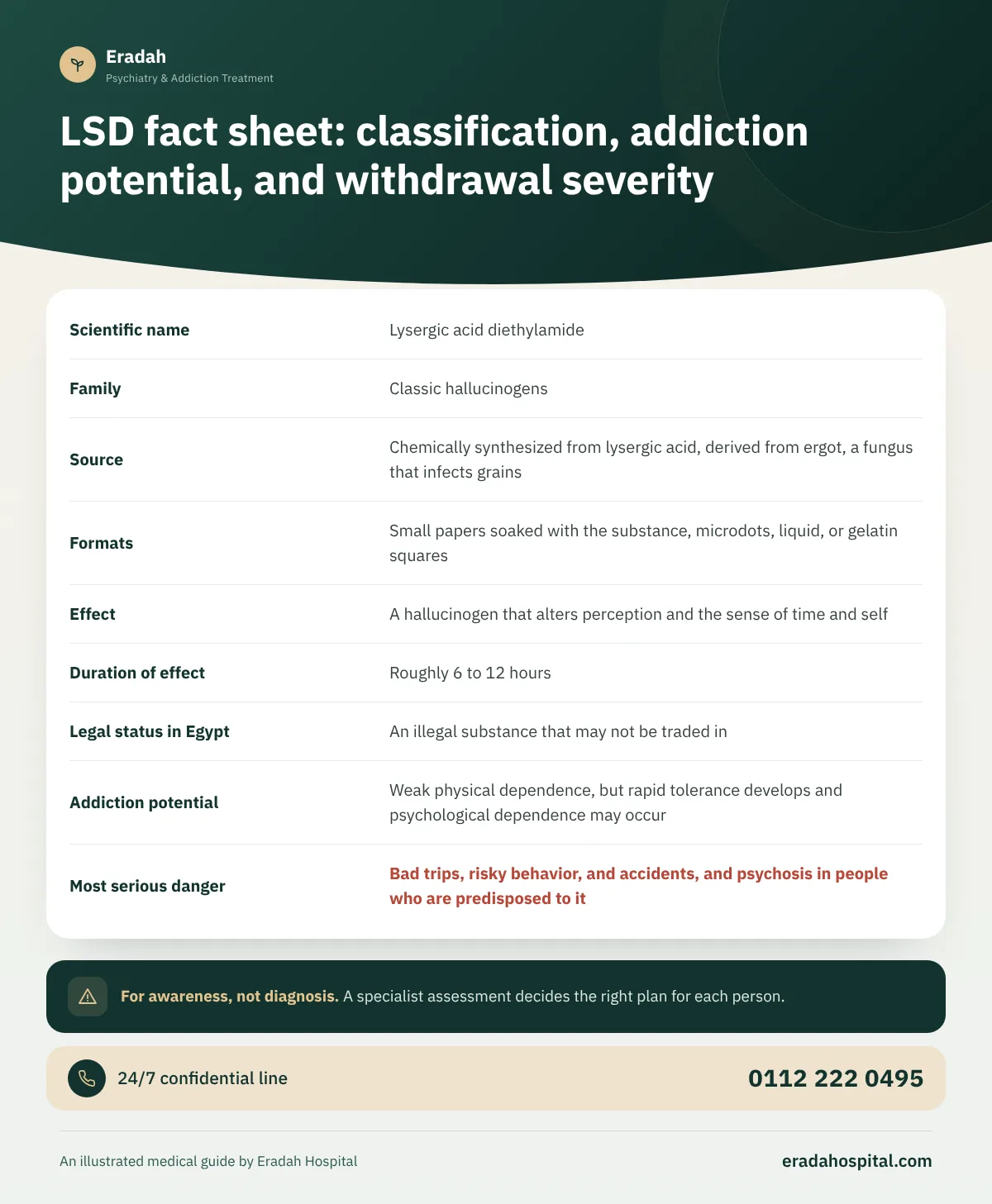
LSD, or lysergic acid diethylamide, is a hallucinogen made in laboratories starting from lysergic acid, a compound derived from ergot, a fungus that grows on rye and some other grains.
LSD was first synthesized in the 1930s during pharmaceutical research, and its hallucinogenic effects were discovered several years later. It was tried in psychiatric research in the middle of the last century, then spread outside medical settings, and was banned in most countries of the world. It no longer has any approved therapeutic use.
LSD is classed among the “classic hallucinogens,” alongside the psilocybin found in magic mushrooms, and it is exceptionally potent: a tiny amount, almost invisible to the eye, is enough to produce an effect lasting many hours. This same potency makes it hard for the person using it to know what they have actually taken.
Forms of LSD and its common names
In its pure form, LSD is colorless and odorless with a slightly bitter taste, so it is usually loaded onto other materials. Its known forms include:
Small paper squares, colored or printed with designs, and the best-known form of LSD.
Very small tablets sometimes known by foreign slang names.
A clear solution that may be hidden in small containers.
Thin, transparent gelatin squares.
How does LSD affect the brain?
LSD acts mainly on 5-HT2A serotonin receptors, which are widespread in the brain's cortex, the areas responsible for perception, mood, thinking, and the organization of information coming from the senses. When it activates these receptors, the brain's “filtering” of information is disrupted, so the senses overlap and images, sounds, and the sense of time become distorted.
- Perception: Moving colors and shapes, overlapping senses, as if the person “sees” sounds, and distorted sense of distance and size.
- Time and self: The sense of time slows or stops, with a feeling of detachment from the body or a “dissolving” of the self.
- Mood: Sharp swings that can move from joy to terror within minutes.
- Body: Dilated pupils, rapid heartbeat, raised blood pressure and temperature, sweating, and tremor.
The effect usually starts between about half an hour and two hours and lasts 6 to 12 hours, and afterward the person may remain exhausted and foggy for hours. The length of this period is one of the main reasons it is dangerous; someone who has a bad trip cannot end it.
The danger with LSD usually comes not from poisoning of the organs but from a mind that has temporarily lost its ability to tell real danger from imagined danger.
Is LSD addictive?
LSD is not considered a substance that causes physical dependence or compulsive drug-seeking behavior the way opioids or stimulants do, and no known physical withdrawal symptoms appear when it is stopped. But that does not mean it is safe:
- Rapid tolerance develops within days of repeated use, so the effect weakens, with cross-tolerance to other hallucinogens such as psilocybin.
- Psychological dependence may develop in some people who use it to escape anxiety or depression.
- It often comes as part of a pattern of polysubstance use with hashish, ecstasy, and alcohol, and this is where much of the danger lies.
- Its psychological harms can occur from the first time, with no connection to addiction.
LSD compared with other hallucinogens
Many people confuse LSD with other substances circulating at parties or among young people. Here is a simple comparison:
| Substance | Source | Duration of effect | Main risk |
|---|---|---|---|
| LSD | Chemically synthesized | Long: 6 to 12 hours | Bad trips, accidents, and psychosis |
| Magic mushrooms | A natural mushroom containing psilocybin | Medium: roughly 4 to 6 hours | Poisoning from a similar toxic mushroom |
| Ecstasy | Synthetic, both a stimulant and a hallucinogen | Moderate | High body temperature and dehydration |
| Ketamine | A medical anesthetic | Relatively short | Detachment from reality and bladder damage |
The details differ for each substance, but the common thread is that the effect cannot be predicted and depends heavily on the person's psychological state and the setting they are in.
Common myths about LSD
| The myth | The truth |
|---|---|
| “LSD is natural and safe because it doesn't cause addiction” | It is a chemically synthesized substance, and the absence of physical dependence does not mean safety; its psychological harms and accidents can occur from the first time. |
| “You can control the experience” | The effect cannot be predicted or stopped once it starts, and the experience can turn into terror within minutes. |
| “It expands the mind and boosts creativity” | A feeling of depth during the effect does not mean a real improvement in thinking, and it may leave behind anxiety or a disturbance in perception. |
| “Someone who tried it once won't be affected” | Persistent perceptual disturbance and episodes of psychosis can appear after a single experience in some people. |
Awareness of these facts is especially important for young people, because much of the information circulating online and on social media presents LSD in a misleading way that hides its real risks.
The legal status of LSD in Egypt
LSD is an illegal substance in Egypt. Law No. 182 of 1960 on drug control and its amendments criminalize its possession and trade, and there is no permitted medical use for it. Anyone who has problems because of use can seek treatment confidentially, including through the hotline of the Fund for Drug Control and Treatment of Addiction, 16023.
This is general educational information and not legal advice.
The LSD guide: everything you need to know
We have gathered everything about LSD into 4 pages, each answering one question in detail. Choose what you are looking for:
LSD harms
Bad trips, panic attacks, and accidents, the possibility of psychosis in people who are predisposed, and persistent perceptual disturbance and the return of hallucinations after stopping.
Symptoms of LSD use
The physical, behavioral, and psychological signs a family may notice, how to tell them apart from those of other substances, and how to talk with your son.
LSD addiction treatment
How hallucinogen misuse and its psychological complications are treated: assessment, psychotherapy, managing psychosis and anxiety, and relapse prevention.
How long LSD stays in the body
Why it doesn't show up in routine tests, roughly how long it remains in urine, blood, and hair, and which specialized tests detect it.
Did you find out your son tried LSD? Start here
Many families find out after a frightening experience or strange behavior in a single night. Your first reaction matters, and here are practical steps:
- If he is under the influence right now, his safety comes first: a quiet place, a calm voice, removing sources of danger, and an ambulance (123) at any danger sign.
- Postpone discussion and reproach until the effect has completely worn off and he has rested.
- Ask calmly about what happened: when it began, with whom, whether the experience has been repeated, and whether he took other substances with it.
- Over the following weeks, watch for any changes in sleep, mood, or thinking, or the appearance of visual disturbances.
- Seek a psychological assessment if strange thoughts or persistent anxiety appear, or if there is a family history of schizophrenia or bipolar disorder.
You will find the signs you might notice on the page about symptoms of LSD use.
Danger signs with LSD: call an ambulance (123) immediately
- Severe agitation or violence that cannot be calmed, or an attempt to harm themselves or others
- Dangerous behavior such as trying to jump from a height or going out into the road
- Seizures or loss of consciousness
- A very high body temperature with a rapid heartbeat or chest pain
- Severe psychosis: complete detachment from reality or frightening delusions that do not end when the expected effect should have ended
Call an ambulance on 123, remove sharp objects and sources of danger, and stay with the person in a quiet place with low light and noise. Speak to them calmly and reassuringly, without restraining them by force except to prevent imminent injury. If they lose consciousness, place them on their side so they do not choke.
Call the ambulance 123