What are the physical signs of LSD use?
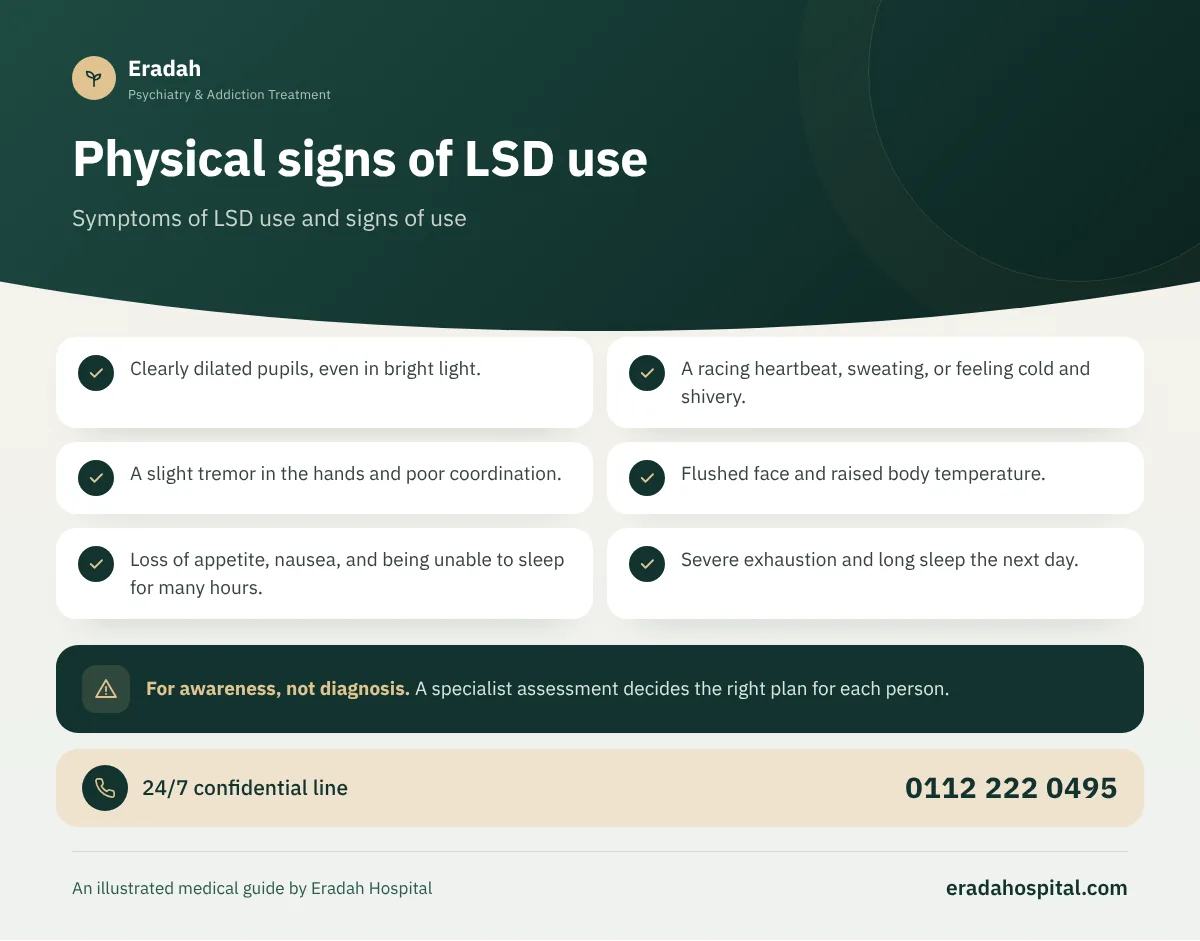
The physical signs of LSD are less obvious than with other substances, but some may catch a family's attention:
- Clearly dilated pupils, even in bright light.
- A racing heartbeat, sweating, or feeling cold and shivery.
- A slight tremor in the hands and poor coordination.
- Flushed face and raised body temperature.
- Loss of appetite, nausea, and being unable to sleep for many hours.
- Severe exhaustion and long sleep the next day.
What are the behavioral and psychological signs during the effect?
These are usually the clearest signs. They begin shortly after use and last many hours:
Long staring at lights or patterns, and describing moving colors or "visible" sounds.
Unexplained laughter followed by sudden fear or crying, with rapid mood swings.
A feeling that time has stopped or that hours have passed in minutes.
Scattered or strangely philosophical talk, or difficulty finishing a sentence.
A feeling of being detached from the body or that the world is not real.
Suspicion and accusing others of plotting during a bad trip.
What signs may appear after use?
The effects do not always end when the drug wears off. Over the following days and weeks, a family may notice:
- Persistent anxiety or fear, or panic attacks that were not there before.
- Talk of seeing halos or trails around moving objects, or flashes of the experience.
- Strange thoughts, suspicion of others or sudden withdrawal, which may point to the start of psychosis.
- Disturbed sleep and a decline in concentration and schoolwork.
These signs deserve an early psychological assessment, because prompt intervention greatly improves the chances of recovery. You can read about what LSD can cause on the harms of LSD page.
What indirect clues might you notice?
- Small colored or printed paper squares hidden in a wallet or book, or unfamiliar small bottles of liquid.
- A sudden interest in music, images or online content that glorifies hallucinogenic experiences.
- Staying out all night and coming back severely exhausted while hiding what happened.
- New friends linked to parties or gatherings where drug use is common.
- Unexplained money changes.
A single clue does not necessarily mean drug use; what matters most is several signs together with a clear change in behavior.
What signs might a teacher or family notice at school?
Because LSD is often used on weekends or at parties, its effects may show up in the following days more than on the day of use itself:
- Frequent absences after holidays, or sleeping in class and obvious exhaustion.
- A sudden drop in grades and poor concentration and short-term memory.
- Withdrawal from old friends and activities he used to enjoy.
- Talk of "spiritual" experiences or strange ideas unlike his usual way of thinking.
How do you tell LSD from other substances?
| Substance | Pupils | Most distinctive sign | Duration of effect |
|---|---|---|---|
| LSD | Very dilated | Visual hallucinations and mood swings with alertness | Long: 6 to 12 hours |
| Hashish | Usually normal with red eyes | Laughter, hunger, slowness and a distinctive smell | A few hours |
| Ecstasy | Dilated | Energy, closeness, sweating and jaw clenching | Several hours |
| Crystal meth (shabu) | Dilated | Excess activity, aggression and days without sleep | Very long |
| Opioids | Very small | Drowsiness, heaviness and slow breathing | Hours |
Because symptoms can overlap, and a person may have taken more than one substance, a medical assessment is the most accurate route, and a specialized test can help when needed.
When does LSD use become a disorder that needs treatment?
Medical diagnostic guides such as the DSM-5 and ICD-11 describe a "hallucinogen use disorder" when use is repeated and causes clear harm or distress. In brief, its signs include:
- Using in larger amounts or more often than the person intended.
- Unsuccessful attempts to stop or cut down.
- Spending a great deal of time getting the substance or recovering from its effects.
- Strong cravings to use.
- Declining performance at school, work or family responsibilities.
- Continuing despite problems in relationships.
- Giving up important activities because of use.
- Using in physically dangerous situations.
- Continuing despite psychological problems caused or worsened by use.
- Tolerance: needing more to get the same effect.
Physical withdrawal symptoms are not listed among the criteria for hallucinogens, because LSD does not cause clear physical dependence. Even if the criteria are not met, any psychological complication deserves assessment.
How do you talk to your son if you suspect he is using?
- Choose a time when he is calm and not under the influence, in a private place.
- Start with the behavior you have noticed, not with an accusation: "I noticed you hadn't slept and you seemed scared."
- Listen more than you talk, and do not interrupt with threats or lectures.
- Ask how he feels now: is he still anxious or seeing strange things?
- Agree on one clear step, such as seeing a psychiatrist.
Danger signs with LSD: call an ambulance (123) immediately
- Severe agitation or violence that cannot be calmed, or an attempt to harm themselves or others
- Dangerous behavior such as trying to jump from a height or going out into the road
- Seizures or loss of consciousness
- A very high body temperature with a rapid heartbeat or chest pain
- Severe psychosis: complete detachment from reality or frightening delusions that do not end when the expected effect should have ended
Call an ambulance on 123, remove sharp objects and sources of danger, and stay with the person in a quiet place with low light and noise. Speak to them calmly and reassuringly, without restraining them by force except to prevent imminent injury. If they lose consciousness, place them on their side so they do not choke.
Call the ambulance 123