How does Strox change inside the body?
After use the lungs absorb the substance quickly, and then the liver converts it into multiple metabolites that leave mainly in urine. The European Union Drugs Agency notes that the parent compound rarely appears in urine, which is why tests look for its metabolites, not for it.
Some of these substances dissolve in fat, so part of them may be stored in body tissue and released slowly in people who use heavily and for long periods, which may lengthen the detection time.
Does Strox show up on a standard drug test?
Mostly no. Rapid test strips and the standard cannabis test are designed to detect THC metabolites, and synthetic cannabinoids are chemically different. Medical references note that routine urine tests in hospitals do not detect these substances, and that detecting them needs a comprehensive screen at a reference laboratory.
Detects THC metabolites, and mostly does not detect synthetic cannabinoids.
Detect some families of synthetic cannabinoids, but may miss newer compounds.
The most accurate confirmatory test, carried out in specialized laboratories with an updated library of compounds.
How long does Strox stay in the body by type of test?
Urine
Blood
Saliva
Hair
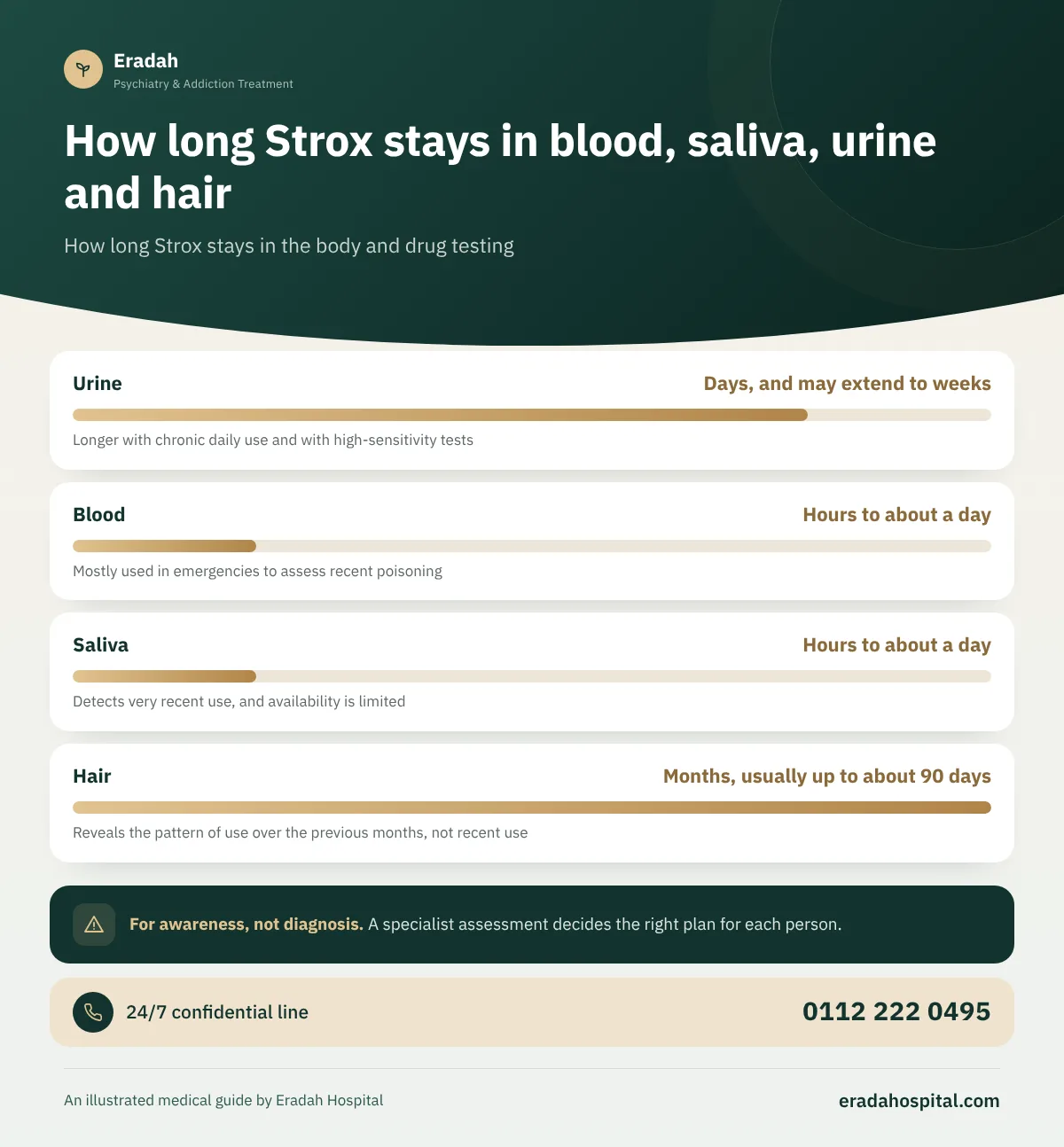
The periods are approximate and vary by compound, test sensitivity and laboratory. In a Norwegian study published in 2015, urine samples from some people who used remained positive for a synthetic cannabinoid metabolite for more than six weeks using high-sensitivity tests; these cases do not represent everyone.
What is the difference between a screening test and a confirmatory test?
| Type of test | What it detects | Limitations |
|---|---|---|
| Rapid screening or immunoassay test | Some known families of synthetic cannabinoids | May miss new compounds, and may need confirmation |
| Confirmatory mass spectrometry test | Specific compounds and metabolites with high accuracy | Needs a specialized laboratory and an updated list of compounds |
| Comprehensive screen at a reference laboratory | A wide range of substances at once | Takes longer and is not available everywhere |
That is why important medical or family decisions are not built on a rapid test strip alone, whatever its result.
Are quick home tests enough for reassurance?
Most home tests available detect a limited group of substances, and often do not include synthetic cannabis, or include only a few of its compounds. So they may give a family false reassurance. If there are worrying signs, it is better to consult a doctor who chooses the right test and interprets its result in the context of the whole picture.
What is the role of testing during addiction treatment?
In treatment programs, periodic testing is used as a helping tool, not a tool of accusation: it shows progress, detects relapse early so treatment can be adjusted, and may be tied to positive rewards in contingency management. It is agreed with the patient transparently from the start.
Factors that affect how long Strox stays
- Type of compound: each compound breaks down at a different speed and has different metabolites.
- Frequency and duration of use: long daily use lengthens detection time compared with a single use.
- Amount of the substance in the pack: which is unknown and variable to begin with.
- Body fat percentage: it may prolong the stay of some fat-soluble compounds.
- Liver and kidney function and age: when weaker, they slow the clearing of metabolites.
- Test sensitivity: newer tests detect smaller amounts and for longer.
Can the result be wrong?
A false negative result is more common with Strox than a false positive, because the test may not include the compound the person used. Immunoassay tests, on the other hand, can sometimes give a positive result that needs confirmation, so any positive preliminary result is confirmed by a confirmatory test in a specialized laboratory before it is relied on.
Does the doctor wait for the test result in the emergency room?
No. In acute poisoning, the emergency team treats the patient based on symptoms and vital signs right away, because specialized test results may take days. So the most important thing a family gives the paramedics is information: what he most likely took, when, and whether he took other substances or medicines with it. This information saves time and may save a life.
When are Strox tests requested?
- In the emergency room, with seizures, agitation, loss of consciousness, or unexplained kidney injury in a young person.
- When starting an addiction treatment program, and during it to follow adherence and support recovery.
- When clear signs of use appear while the standard cannabis test is negative.
- In some workplace procedures or legal proceedings.
Why don’t we offer ways to hide use from a test?
Because in treatment, testing is a means of protecting the patient, not punishing him, and because attempts to quickly “flush” the body with lots of fluids or various substances can be dangerous for the heart and kidneys, which are already among the organs most affected by Strox. If you really want to stop, the safe way is a medical assessment and detox under supervision.