Why can’t you predict what will happen?
“Last time he took it and was fine; this time he collapsed and his leg was shaking.” A mother of a seventeen-year-old said this, and it sums up what makes dealing with a person addicted to Strox different: no one knows what is in the bag this time, not even the person using it.
Strox is not hashish, but herbs sprayed with synthetic cannabinoid compounds whose type and concentration differ from batch to batch, as the page on Strox explains in detail. In a systematic review published in 2016 that gathered reports of about 4,000 cases from hospitals and poison centers, at least 26 deaths were recorded, and the main complications included heart attacks and strokes, acute kidney injury, generalized seizures, episodes of psychosis and paranoia, and severe vomiting. Even so, most cases were not serious, and most of those affected were young men.
What this means for the family: do not base your decision on “last time.” Every episode of use may be different, and being ready for an emergency is part of everyday handling.
What do emergency data in Egypt say?
In a study from the Poison Treatment Center at Ain Shams University Hospitals published in 2021, 71 cases of poisoning with Voodoo, a synthetic cannabinoid mixture of the same family, were analyzed; they reached the center during 2017. Patients’ ages ranged from 15 to 50 years, and 97.2% of them were male.
Agitation, hallucinations and altered consciousness were the most common findings in the patients, while vital signs were normal in more than half of them, which explains why a person may look “fine” and then deteriorate. The researchers noted that the variety of symptoms makes quick diagnosis harder. In addition, mixing Strox with other substances, as happened in more than half of the cases, changes the risk entirely.
If you find him under the influence: what do you do now?
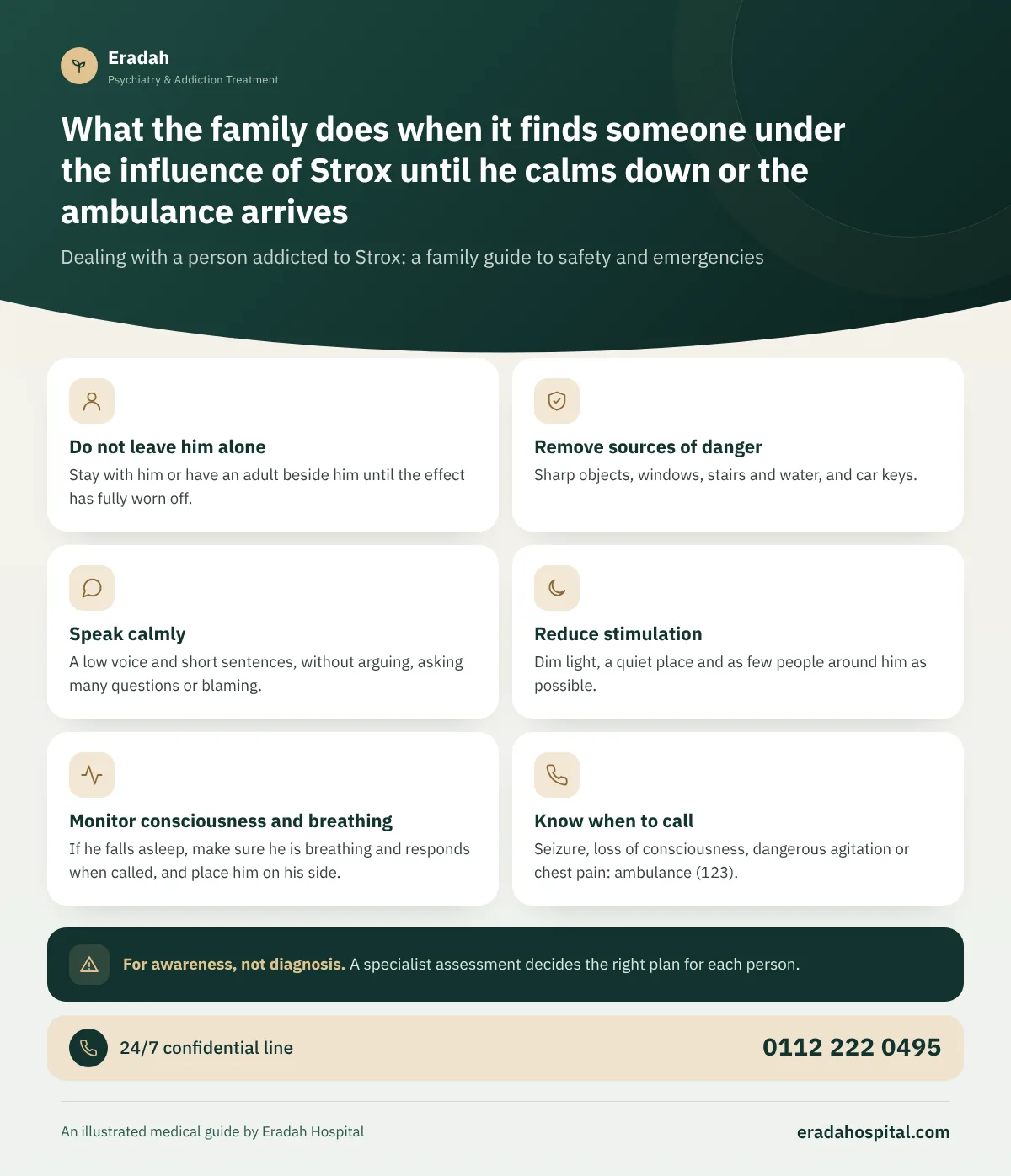
The first minutes matter, and these are practical steps until he calms down or the ambulance arrives:
Stay with him or have an adult beside him until the effect has fully worn off.
Sharp objects, windows, stairs and water, and car keys.
A low voice and short sentences, without arguing, asking many questions or blaming.
Dim light, a quiet place and as few people around him as possible.
If he falls asleep, make sure he is breathing and responds when called, and place him on his side.
Seizure, loss of consciousness, dangerous agitation or chest pain: ambulance (123).
Do not give him food or drink if he is not fully conscious, or any medicine from home to calm him. And tell the paramedics everything you know about what he took, even if it is only a street name.
Seizures and loss of consciousness: do not wait
Seizures are among the complications recorded in the systematic review, and they can happen in someone who has never had them. If they occur:
- Move hard objects away from him and put something soft under his head.
- Do not put anything in his mouth, and do not try to hold down his movements.
- Call an ambulance on 123 immediately.
- After the seizure stops, place him on his side and watch his breathing until the ambulance arrives.
Other complications that call for emergency care include chest pain and a very fast pulse, repeated vomiting and little urine, because acute kidney injury is a documented complication. You will find the other harms on the page about the harms of Strox.
A negative test does not mean he is not using
Many families are reassured when a home test comes back negative, but the US National Institute on Drug Abuse (NIDA) notes that synthetic cannabinoids are mostly not detected by routine urine tests, and that this is one reason some people turn to them. In a German study published in 2017, careful laboratory testing detected synthetic cannabinoid use in 8% of 549 patients, even though all their samples were negative on two immunoassay tests designed for these substances.
So do not treat the home strip as a final verdict, and do not turn it into a daily tool of accusation. If clear signs appear with a negative test, consult a doctor who will choose the right test, and the page on how long Strox stays in the body explains what tests detect and what they do not.
Strox and teenagers: the role of the family and school
In the Ain Shams cases ages started at 15, and Strox is widespread among teenagers because it is cheap, easy to hide, and thought to be “herbs” that don’t show up in tests. With a teenager, what helps is:
- A calm conversation after the effect wears off, starting from your worry and not from accusing him.
- A frank explanation that Strox is not hashish, and that what happened to others can happen to him the first time.
- Knowing his friends and where he goes, and pocket money with a clear purpose.
- Contacting the school if absences recur or behavior changes, coordinating with him as far as possible.
- A quick specialist assessment if use recurs, or if agitation, suspicion or a clear drop in school performance appears.
You will find more details in the guide to teen addiction.
The conversation after he calms down
After a crisis under the influence of Strox, the young person may be scared or embarrassed, and this is a moment that can open the door to treatment if used calmly. Say what you saw without exaggeration: “Yesterday you were out of it and I was really scared for you,” then offer one small, specific step: “Come on, let’s just hear a doctor’s opinion once.” Avoid turning it into a trial or a group punishment in front of the family. You will find the CRAFT approach and other phrases in how to persuade a person with addiction to get treatment.
When does he need specialized treatment?
If use recurs, or withdrawal symptoms such as irritability and insomnia appear on stopping, or a single emergency crisis has happened, it deserves an assessment. Treatment usually begins with a comprehensive assessment that identifies the substances mixed, then detox if needed, then psychological and behavioral treatment and family involvement. You will find the stages in Strox addiction treatment, and at Eradah the family can start with a free, confidential consultation.
Danger signs after using Strox: call an ambulance (123) immediately
- Seizures or involuntary movements.
- Loss of consciousness, difficulty rousing him, or abnormal breathing.
- Severe agitation, hallucinations, or behavior that puts him or others at risk.
- Chest pain or a very fast pulse.
- Repeated vomiting or a clear drop in urine after use.
Call ambulance (123) immediately. If the person is unconscious but breathing, place them on their side so they do not choke on vomit. Stay with them and do not leave them alone. Do not give them food or drink, and tell the paramedics everything they took or used, and the amount and time if you know them.
Call the ambulance 123